















A transportation management system is logistics software that helps businesses plan, manage, and optimise the movement of goods. It provides real-time visibility, automates freight billing, and streamlines shipping across land, air, or sea to reduce costs and improve delivery efficiency.
Transport issues rarely begin when a truck is already late. They usually start earlier, when planners work with fragmented data, teams react too slowly, and rising freight costs quietly eat into margins.
That pressure is becoming harder to manage in Australia, where the domestic freight task is projected to grow by up to 26% between 2020 and 2050. As shipment volume grows, relying on spreadsheets, manual calls, or disconnected systems makes it harder to stay efficient, responsive, and in control.
A modern transportation management system software helps businesses regain control before minor transportation issues become larger service and cost problems. Better planning, real-time visibility, and faster coordination provide a solution for streamlined delivery, helping businesses manage freight and scale with more confidence.
Key Takeaways
A transportation management system helps businesses improve freight planning, shipment visibility, and transport cost control.
A TMS supports planning, execution, tracking, freight audit, and reporting in one connected workflow.
Core modules cover load planning, carrier management, route optimisation, tracking, documentation, and analytics.
A TMS helps Australian businesses reduce freight costs, improve delivery reliability, and strengthen transport visibility.
What Is a Transport Management System (TMS)?
A transportation management system (TMS) is a TMS for Australian logistics that helps businesses plan, execute, optimise, and track the movement of goods. It gives teams better visibility across both inbound and outbound shipments while supporting timely delivery, trade compliance, and proper shipping documentation.
A TMS usually works as part of a broader supply chain management process and sits between the ERP and WMS. While ERP manages business data and WMS controls warehouse activity, the TMS takes over when goods need to move by road, rail, air, or sea.
Modern TMS platforms do more than manage transport execution. Shippers (manufacturers, retailers, and distributors), logistics service providers, and 3PLs (Third-Party Logistics) use it to compare shipping options, track freight more accurately, and replace manual coordination with faster, smarter workflows.
How Does a TMS Work?
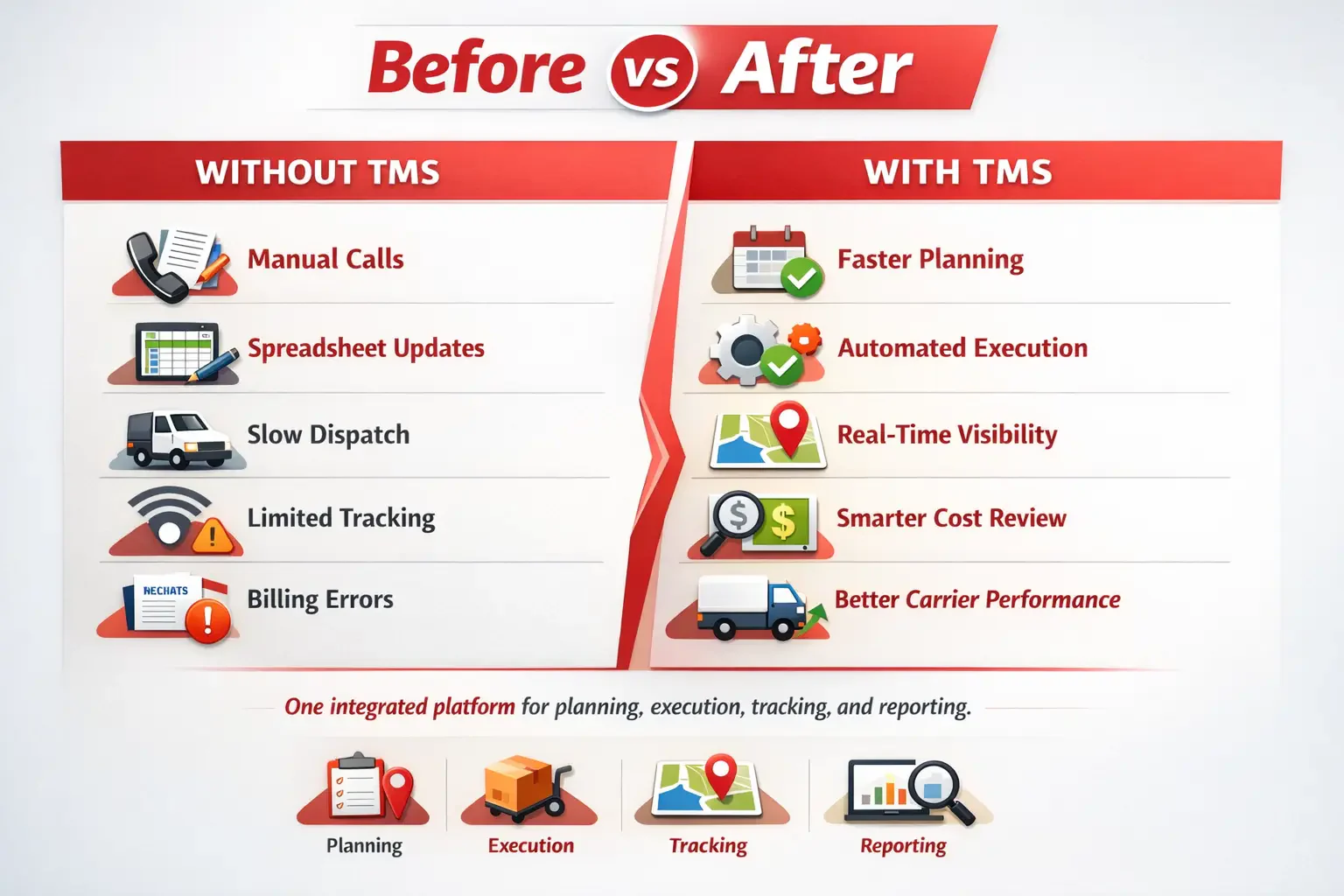
A transportation management system helps businesses manage order processing, plan, move, track, and review freight in one connected workflow. Instead of relying on manual calls, spreadsheets, and disconnected updates, a transport management system enables teams to make faster decisions and gain better control over daily transport operations.
It also works closely with ERP and WMS as part of a broader supply chain process. While ERP handles orders, finance, and procurement, and WMS manages warehouse activity, transport management system software takes over when goods need to move from one location to another, whether inbound from suppliers or outbound to customers.”
- Plan the shipment: The process begins when order details are entered into the system from the ERP or warehouse. The TMS transportation management system reviews shipment size, destination, timing, and carrier options to select the most efficient route and mode of transport.
- Execute the delivery: Once the best plan is ready, the system sends the job to the selected carrier. It can also generate shipping documents and reduce manual work during dispatch.
- Track freight in real time: As goods move, the system tracks shipment progress and updates delivery status. This helps teams respond faster to delays, improve visibility, and keep customers better informed.
- Review costs and performance: After delivery, the system checks freight charges, compares invoices, and highlights discrepancies. A modern transportation management system also turns shipment data into reports that help businesses improve cost control and carrier performance over time.
For businesses evaluating a transport management system Australia, the real value comes from having one platform that connects planning, execution, visibility, and reporting. The right transport management system software helps teams work faster, reduce freight inefficiencies, and manage transport operations with more confidence.
Core Modules of a Transport Management System

A strong transportation management system is not just one feature. It is a connected platform comprising several modules that help businesses plan, execute, control, and improve freight operations more effectively.
Each module supports a different part of the logistics process, from load planning to carrier selection, tracking, invoicing, and reporting. For businesses comparing transport management system software or evaluating a transport management system solution in Australia, understanding these modules makes it easier to judge which platform can deliver real operational value.
1. Order & load management
This module receives order data from your ERP, sales, or warehouse system and turns it into a workable shipment plan. It decides how goods should be grouped, packed, and loaded based on size, weight, destination, and delivery timing.
A strong transportation management system also uses this module to consolidate smaller loads, reduce wasted trailer space, and lower freight spend. For businesses that want faster planning and better load utilisation, this is one of the most valuable parts of a transport management system.
2. Carrier & rate management (Multi-carrier)
This module stores carrier contracts, lane rates, fuel rules, and service terms in one place. It lets teams compare multiple carriers quickly instead of checking quotes one by one.
Good transport management system software also calculates the true cost of each option by including surcharges, accessorial fees, and service commitments. That helps businesses choose the right carrier faster, control costs better, and support a stronger multi-carrier strategy.
3. Route optimisation & planning
This module plans the most efficient route for freight based on distance, delivery windows, vehicle capacity, and traffic conditions. It helps teams sequence stops more logically, cut unnecessary mileage, and improve vehicle route optimization across daily operations.
In a modern transportation management system, route planning can also adapt to disruptions such as road closures or delays. That makes deliveries more reliable while reducing fuel use, driver downtime, and avoidable transport costs.
4. Freight audit & payment
This module checks whether the carrier invoice matches the agreed rate, the shipment record, and the proof of delivery. It helps businesses catch duplicate invoices, billing mistakes, and unexpected charges before they affect margin.
A good TMS (transportation management system) can automate much of this review process, saving finance teams time and reducing manual checks. The result is better freight-cost control, faster payment approval, and greater confidence in transport spend data.
5. Real-time tracking & visibility (GPS/IoT)
This module gives teams live visibility into where freight is, how it is moving, and whether it is likely to arrive on time. It connects with GPS, carrier systems, driver apps, and sometimes IoT sensors that track conditions such as temperature or shock.
For companies evaluating a transport management system solution in Australia, this visibility matters even more because long delivery distances can turn small delays into major service issues. Better tracking also improves ETA accuracy, supports proactive communication, and strengthens service performance.
6. Documentation & EDI
This module digitises the documents such as ePOD (Electronic Proof of Delivery) and EWD (Electronic Work Diaries) that usually slow transport teams down, including consignment notes, invoices, customs paperwork, and proof of delivery. It also supports EDI and other electronic data exchange methods, enabling information to move faster among shippers, carriers, warehouses, and customers.
By replacing manual paperwork, a transportation management system reduces errors, shortens processing time, and makes documentation easier to trace. This gives businesses better compliance control and a cleaner audit trail across the shipping process.
7. Warehouse-to-transport integration
This module connects warehouse activity to transport planning, ensuring outbound freight is not delayed by poor coordination at the dock. It aligns picking, packing, staging, and loading schedules with carrier arrival times and transport priorities.
A transport management system works much better when warehouse and delivery teams can operate on the same timeline and share the same shipment data. That connection reduces congestion, avoids detention costs, and helps businesses move goods out faster with fewer handover issues.
8. Reporting, analytics & BI
This module turns daily shipment activity into dashboards, performance reports, and practical operational insight. It helps teams measure KPIs such as on-time delivery, cost per load, carrier performance, freight exceptions, and service trends.
Strong transport management system software does not just collect data; it helps managers spot waste, compare partners, and make better evidence-based decisions. Over time, this module supports continuous improvement instead of reactive problem-solving.
9. Driver & fleet management
This module is especially important for businesses that operate their own trucks, drivers, or dedicated fleets. It helps teams manage driver schedules, asset usage, maintenance planning, and compliance with working-hour or safety rules.
A modern transportation management system can also improve utilisation by more consistently matching the right vehicle and driver to the right job. That supports safer operations, stronger fleet productivity, and better day-to-day dispatch control.
10. Customer portal
This module gives customers direct access to shipment status, ETA updates, delivery documents, and other order-related information. It reduces the need for constant follow-up calls because customers can check progress on their own.
In a competitive market, a transport management system that improves transparency can also strengthen trust and overall service experience. This makes the portal more than a convenience feature, because it becomes a practical tool for customer satisfaction and retention.
Key Benefits of a TMS for Australian Businesses

Transport operations in Australia often involve long distances, rising freight costs, service pressure, and stricter compliance demands. The right transportation management system gives businesses better visibility, stronger control, and more confidence in daily transport decisions.
1. Freight cost reduction
Freight costs in Australia can rise quickly when businesses manage long routes, urgent deliveries, and fragmented loads without a clear transport strategy. A transportation management system helps teams reduce these costs by improving load consolidation, selecting more efficient transport modes, and avoiding unnecessary premium freight.
It also makes carrier comparison easier, allowing businesses to secure more competitive rates rather than relying on limited options. Over time, a strong transport management system gives businesses better cost control across everyday freight activity.
2. Fuel & route savings
Fuel is one of the biggest ongoing transport expenses, especially when routes are inefficient or vehicles return empty. A transport management system improves vehicle route optimization by helping teams plan smarter routes, reduce unnecessary mileage, and avoid avoidable delays.
This leads to lower fuel consumption, improved fleet productivity, and less time wasted on the road. For businesses running frequent deliveries, even small route improvements can create meaningful savings over time.
3. On-time delivery improvement
Late deliveries do more than cause inconvenience; they can damage service levels, retail relationships, and customer trust. A transportation management system helps teams improve on-time performance by planning more accurately, tracking shipments more closely, and responding to delays earlier.
It also supports tighter coordination between warehouses, carriers, and delivery schedules so freight arrives when it should. This makes the TMS transportation management system especially valuable for businesses that depend on strict delivery windows and consistent service performance.
4. Automated compliance and operational control
Compliance is a major concern for Australian transport operations. In Australia, logistics businesses need to comply with CoR (Chain of Responsibility) and NHVR fatigue management. Good transport management software helps teams maintain better records, follow approved processes, and reduce the risk of preventable compliance issues.
It also improves operational discipline by making transport data, delivery activity, and supporting documentation easier to track. For many businesses, a transport management system adds practical protection by strengthening both visibility and control.
5. Better visibility for customer experience
Customers now expect clear delivery updates, accurate ETAs, and fewer surprises once goods are in transit. A transportation management system improves the customer experience by providing teams with real-time shipment visibility and faster, more reliable communication.
It can support branded tracking updates, clearer proof of delivery, and quicker responses when delays happen. This helps businesses build trust, reduce service friction, and create a stronger delivery experience.
6. Support for fuel tax credit accuracy
Accurately tracking fuel use can be difficult when transport activity spans vehicles, locations, and operating conditions. A transport management system can help businesses capture cleaner transport data, which supports more accurate reporting and stronger financial control.
When connected with the right operational records, this visibility can make fuel-related calculations easier to review and manage internally. This gives finance and operations teams a more reliable foundation for cost recovery and compliance-related processes.
7. Carbon reporting and sustainability visibility
Sustainability reporting is becoming more important as businesses face growing pressure to measure and explain transport-related emissions. A modern transportation management system helps teams track shipment activity in a more structured way, making carbon reporting easier to support over time.
It can also help businesses compare routes, transport modes, and carrier performance with efficiency and environmental impact in mind. As expectations around sustainability continue to rise, a transport management system provides businesses with better visibility into both reporting and long-term supply chain improvement.
TMS vs WMS vs ERP vs 3PL
| System | Main Role | What It Handles | Where Its Role Starts and Ends | Main Business Value |
|---|---|---|---|---|
| ERP | Manages core business operations | Finance, procurement, HR, order data, invoicing, and high-level planning | Starts from business transactions and planning, but does not deeply manage warehouse execution or freight movement | Gives businesses one central source of truth across departments |
| WMS | Manages warehouse operations | Inventory tracking, receiving, put-away, picking, packing, staging, and dock preparation | Starts when goods arrive at the warehouse and usually ends once freight is ready to leave the facility | Improves stock accuracy, warehouse speed, and fulfilment control |
| TMS | Manages transport execution and visibility | Carrier selection, route planning, shipment tracking, freight audit, delivery coordination, and freight cost control | Starts when goods need to move outside the facility and continues until delivery is completed | Helps businesses reduce freight costs, improve visibility, and manage delivery performance |
| 3PL | Provides outsourced logistics services | Warehousing, transport execution, fulfilment, and distribution on behalf of another business | Operates as an external partner that physically handles some or all logistics activities | Gives businesses access to logistics capability without building everything in-house |
Industries That Need a TMS in Australia
Not every business needs the same level of transport control, but for some sectors, a transportation management system quickly becomes essential. The right transport management system software helps businesses improve visibility, reduce delays, and manage freight more confidently across complex operations.
- Retail and FMCG: Retail and FMCG businesses move high volumes under tight delivery windows, so delays can quickly affect shelf availability and customer satisfaction. A transport management system helps coordinate store replenishment, omnichannel fulfilment, and distribution management more efficiently.
- Manufacturing: Manufacturers depend on steady inbound deliveries to keep production running and avoid costly disruptions. A strong transport management system gives them better visibility into raw materials, supplier shipments, and outbound distribution of finished goods.
- Mining and resources: Mining and resources businesses often move freight across remote areas where transport delays are harder and more expensive to fix. A tms transportation management system helps them improve shipment planning, track high-value loads, and maintain stronger control over difficult transport environments.
The Future of TMS: AI, IoT & Sustainability
The future of a transportation management system is no longer just about moving freight more efficiently. It is about helping businesses make faster decisions, gain deeper visibility, and build more resilient, data-driven, and sustainable transport operations.
- AI-powered planning and decision-making: Modern transport management system software can use AI to recommend better routes, predict delays, and improve carrier selection with less manual effort. This helps teams respond faster and make transport decisions with more confidence.
- Smarter exception management: A strong tms transportation management system can detect disruptions earlier and alert teams before delays become larger service issues. This gives planners more time to act, reduce disruption, and protect delivery performance.
- IoT and real-time freight visibility: IoT sensors and connected devices help businesses track freight conditions such as location, temperature, and handling status in real time. For businesses that move sensitive or high-value goods, this makes a transportation management system even more valuable.
- More accurate ETAs and service updates: As AI and IoT improve, a transport management system can produce more reliable ETAs and better delivery updates for both internal teams and customers. This supports stronger service levels and a better customer experience.
- Stronger sustainability tracking: More businesses now expect a transport management system solution in Australia to support carbon visibility and greener route planning. This helps companies reduce waste, improve fuel efficiency, and prepare for growing sustainability expectations.
- Better long-term transport strategy: The future of transport management system software is not just automation, but smarter, continuous improvement. Businesses can use richer transport data to redesign routes, compare carriers more effectively, and improve freight performance over time.
How to Choose a TMS: Features Checklist & Pricing
Choosing the right transportation management system requires more than comparing brand names or looking at surface-level features. The best choice is the one that fits your transport model, operational complexity, integration needs, and long-term growth plans.
- Check route planning and optimisation first: A good transport management system should help reduce unnecessary mileage, improve delivery efficiency, and support better vehicle route optimization. This is often one of the fastest ways to create measurable transport savings.
- Look for strong carrier and rate management: The right transport management system software should make it easier to compare carriers, manage rates, and choose the best option without manual back-and-forth. This helps businesses improve cost control and execution speed.
- Prioritise real-time tracking and visibility: A modern transportation management system should give teams live shipment tracking, delivery status updates, and clearer ETAs. Better visibility helps businesses respond earlier and maintain stronger service performance.
- Review integration capabilities carefully: A transport management system Australia platform should connect smoothly with ERP, WMS, finance systems, APIs, EDI, and carrier networks. Strong integration reduces duplicate work and gives teams one clearer operational flow.
- Do not overlook freight audit and payment tools: Billing errors and hidden charges can quietly reduce margin over time. A strong tms transportation management system should help businesses validate freight invoices and improve control over transport spend.
- Check usability for daily operations: Even powerful transport management system software can fail if teams avoid using it. Choose a platform that feels practical, clear, and easy enough for planners, coordinators, and operations staff to adopt consistently.
- Evaluate reporting and analytics depth: A strong transportation management system should turn shipment data into useful insights into costs, carrier performance, delays, and service trends. Better reporting helps businesses improve operations instead of just tracking activity.
- Understand pricing beyond the base quote: TMS pricing may depend on users, shipment volume, integrations, modules, customisation, onboarding, and support. When comparing vendors, look at the total cost of ownership, not just the starting price.
- Match the system to your business size and model: Some platforms work better for enterprise freight networks, while others suit mid-sized operations, private fleets, or multi-carrier distribution. The best transport management system is the one that fits your real workflow, not just the one with the longest feature list.
Conclusion
A transportation management system helps businesses do more than move freight from one place to another. It gives teams better visibility, stronger cost control, and faster decision-making across daily transport operations.
As transport complexity continues to grow, relying on manual coordination or disconnected systems makes it harder to stay efficient and responsive. The right platform helps businesses improve delivery performance, reduce avoidable costs, and build a more connected supply chain over time.
If your business is evaluating the next step, this is the right time to identify which solution best fits your transport model and operational needs. You can request a free consultation to explore the right transportation management system for your business.

FAQ About Transportation Management Software
How long does it take to implement a TMS in Australia?
Implementation time depends on your shipment volume, integrations, data quality, and process complexity. A simpler cloud rollout may take days or a few weeks, while a larger deployment with ERP or WMS integration, multiple depots, or custom workflows can take several weeks or longer.
Do small trucking businesses really need a TMS, or is a spreadsheet enough?
A spreadsheet may work for a very small operation with low load volume and simple processes, but it becomes harder to control as jobs, customers, drivers, and paperwork grow. A TMS helps small trucking businesses reduce manual work, improve visibility, manage proof of delivery, and keep dispatch, invoicing, and tracking more organised.
Can a TMS handle both interstate and last-mile delivery in Australia?
Yes, many TMS platforms can support both interstate and last-mile delivery, as long as the software is built for your transport model. The right system can help manage long-haul planning, depot coordination, route optimisation, live tracking, proof of delivery, and customer updates in one workflow.
What kind of ROI can Australian shippers expect from a TMS?
ROI usually comes from lower freight costs, less manual administration, fewer billing errors, better route planning, and stronger delivery performance. The exact return varies by business, but companies often see the most value when they reduce avoidable transport spend, improve visibility, and handle more freight without adding the same level of overhead.
Is my data safe in a cloud-based TMS? What about Australian Privacy Act compliance?
A cloud-based TMS can be secure, but safety depends on the vendor’s controls and your own governance, such as access control, encryption, retention rules, and incident response. For Australian Privacy Act compliance, businesses should check whether the platform supports reasonable security measures, data handling processes, and any cross-border data obligations that may apply if personal information is stored or accessed overseas.
How does a TMS help with NHVR Chain of Responsibility obligations?
A TMS can support NHVR Chain of Responsibility obligations by improving records, visibility, and process control across transport activity. It may help teams track load and delivery data, support fatigue-related workflows, store key documents, and create clearer audit trails, but it does not replace the legal responsibility of parties in the transport chain to manage safety risks properly.