














For Australian businesses managing complex supplier relationships, source to pay (S2P) is the end-to-end procurement framework that connects every steps, rom identifying a need all the way to releasing a payment.
When executed well, S2P reduces costs, improves supplier performance, and gives finance teams the real-time visibility they need to make confident spending decisions.
This guide covers the full source to pay process, how it compares to related frameworks like P2P and S2C, and the best practices Australian procurement and finance teams can apply today.
Key Takeaways
Understand the fundamental definition and scope of the source to pay framework.
Explore the seven critical steps from spend analysis to supplier payment.
Learn the key differences between these fundamental procurement methodologies.
Discover how an integrated approach improves visibility, compliance, and cost control.
What Is Source to Pay?

Source to pay (S2P) is the full procurement process, from identifying a business need and finding suppliers to purchasing, invoice processing, and final payment. Unlike basic purchasing, S2P connects procurement decisions directly to business costs and financial performance.
In Australia, industries such as mining, healthcare, and construction are adopting structured S2P processes to manage complex supply chains and meet compliance requirements like eInvoicing and the Modern Slavery Act 2018.
A strong S2P process helps businesses reduce off-contract spending, minimise invoice errors, improve supplier management, and maintain clear audit trails across procurement activities.
Key Stages of the Source to Pay Process
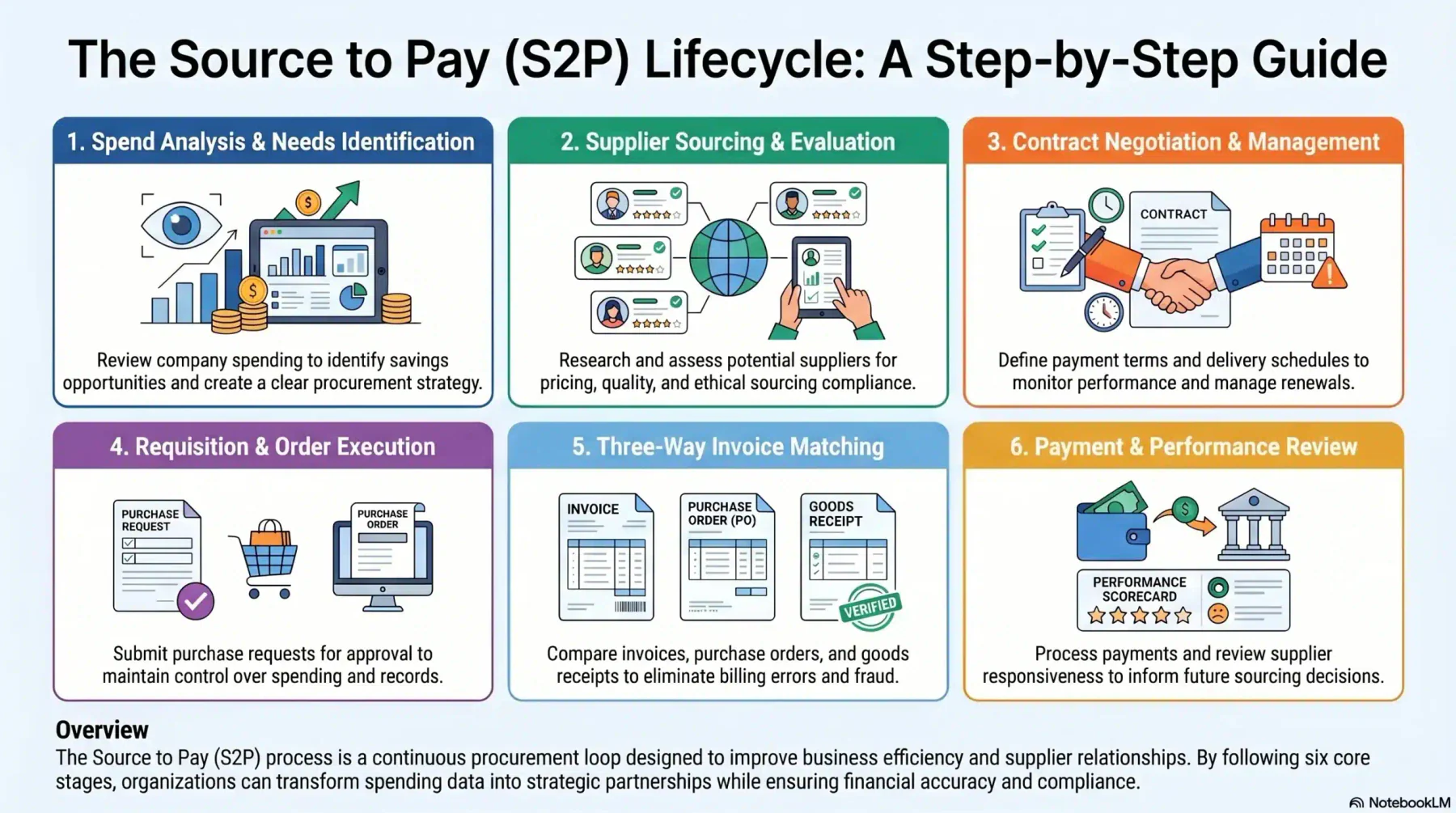
The source to pay process is broken into seven core stages. Each builds on the previous, creating a continuous loop that improves over time as data and supplier relationships mature.
1. Spend Analysis and Needs Identification
Procurement teams first review company spending to understand where money is being used and identify purchasing needs. This helps businesses find savings opportunities, reduce unnecessary spending, and create a clear procurement strategy.
2. Strategic Sourcing and Supplier Discovery
Businesses search for and evaluate potential suppliers through market research, RFIs, and RFPs. The goal is to find suppliers that match business priorities such as pricing, quality, sustainability, or local sourcing.
3. Supplier Evaluation and Selection
Suppliers are assessed based on pricing, reliability, quality, and compliance standards. Many Australian businesses also check suppliers for ethical sourcing and modern slavery risks before making a final decision.
4. Contract Negotiation and Management
Contracts define pricing, payment terms, delivery schedules, and service expectations. Proper contract management helps businesses avoid disputes, monitor supplier performance, and manage renewals efficiently.
5. Purchase Requisition and Order Execution
Employees submit purchase requests for approval before orders are placed with suppliers. Once approved, the request becomes a purchase order (PO), helping businesses control spending and maintain accurate procurement records.
6. Invoice Processing and Three-Way Matching
Businesses compare the invoice, purchase order, and goods receipt to confirm all details match before payment is approved. This process reduces billing errors, duplicate payments, and fraud risks.
7. Supplier Payment and Performance Review
After invoice approval, payment is processed according to agreed terms. Supplier performance is then reviewed based on factors such as delivery speed, product quality, and responsiveness to support future sourcing decisions.
Source to Pay vs Procure to Pay vs Source to Contract
These three frameworks are closely related and often confused. Understanding where each begins and ends helps businesses choose the right approach for their procurement goals.
1. How S2P, P2P, and S2C Differ
Source to Pay (S2P) covers the entire procurement process, from finding suppliers to making final payments. Procure to Pay (P2P) focuses only on purchasing and payment activities after a supplier has been chosen. Source to Contract (S2C) covers supplier sourcing and contract creation, but does not include purchasing or payment processes.
2. Where Each Process Begins and Ends
Framework |
Starts At |
Ends At |
Source to Pay (S2P) |
Spend analysis and supplier discovery | Supplier payment and performance review |
Procure to Pay (P2P) |
Purchase requisition | Supplier payment |
Source to Contract (S2C) |
Spend analysis and supplier discovery | Contract execution |
3. When to Use S2P Over P2P
P2P works well when supplier relationships are mature and contracts are stable — the main challenge is processing transactions faster and more accurately. S2P is the better choice when the business needs to improve how it selects and manages suppliers, not just how it processes orders.
Benefits of a Source to Pay Process
The implementation of an integrated source to pay methodology yields transformative benefits that extend far beyond the procurement department, positively impacting the financial health and operational agility of the entire business
1. Greater Spend Visibility and Cost Control
An S2P process gives businesses a clear view of spending across suppliers, categories, and departments. This helps procurement teams control costs, identify savings opportunities, and negotiate better supplier pricing.
2. Stronger Supplier Relationships and Compliance
Standardised supplier processes improve communication, performance tracking, and contract management. It also helps Australian businesses meet compliance requirements such as the Modern Slavery Act 2018.
3. Reduced Maverick Spending and Procurement Risk
S2P reduces unauthorised purchasing by using approval workflows and approved supplier lists. This helps businesses control budgets and lower supplier-related risks.
4. Faster Cycle Times Through Automation
Automation speeds up procurement by reducing manual tasks such as email approvals and manual invoice entry. Integrated S2P or a purchase management system help businesses process purchases and payments faster, while allowing procurement and finance teams to focus on more strategic work.
How AI and Automation Are Transforming Source to Pay
AI and automation are transforming source to pay by making procurement faster, more accurate, and less dependent on manual work. They improve efficiency across supplier selection, contracting, and invoice processing.
AI helps evaluate suppliers by analysing data such as pricing, performance, financial stability, and risk. This helps procurement teams make faster and more reliable sourcing decisions.
Automation streamlines contract management and invoice processing by tracking renewals, monitoring supplier performance, and flagging issues like duplicate invoices or pricing errors before payment is made.
Modern businesses must manage supplier compliance, ethical sourcing, and risk monitoring more carefully than ever. An integrated S2P process helps procurement teams track supplier risks, meet Australian regulations, and maintain responsible sourcing practices.
1. Supplier Due Diligence Under the Modern Slavery Act 2018
Australia’s Modern Slavery Act 2018 requires large businesses to report on supply chain risks and prevention efforts. S2P systems help procurement teams document supplier checks and manage due diligence during supplier selection and onboarding.
2. Building Ethical Sourcing Into the S2P Process
With integrated sourcing management, businesses can embed ethical sourcing requirements directly in supplier evaluations, onboarding forms, and contract reviews.
This helps ensure compliance becomes part of everyday procurement activities rather than a separate process.
3. Using S2P Data to Monitor Supplier Risk
Integrated S2P systems continuously track supplier performance and risk factors in one platform. Automated alerts can notify procurement teams about changes in supplier risk, helping businesses respond quickly before issues escalate.
eInvoicing and Source to Pay in Australia
eInvoicing is becoming an essential part of modern procurement in Australia. It helps reduce manual work, improve accuracy, and speed up processes by working digitally with a software for procurement automation.
It integrates directly into the source to pay cycle by removing manual data entry and allowing invoices to be automatically processed, matched, and validated. This improves GST accuracy and reduces processing delays.
In Australia, eInvoicing is supported through the Peppol framework, which is widely used across government agencies. For businesses, it lowers processing costs, speeds up payment cycles, and improves overall cash flow management.
Challenges in Implementing Source to Pay
Implementing S2P can improve procurement performance, but businesses often face challenges related to data, systems, and internal processes.
1. Data Silos Across Procurement and Finance Teams
When supplier data, invoices, and contracts are stored in separate systems, businesses lose visibility across the procurement process. Centralising data is essential for effective S2P management.
2. Low User Adoption of S2P Platforms
Employees may continue using manual processes if the system feels too complicated. Successful S2P projects focus on user-friendly workflows and strong change management.
3. Integrating S2P with Existing ERP Systems
Many businesses already use ERP systems, making integration a major challenge. Choosing an ERP with built-in procurement features can simplify implementation and reduce technical issues.
4. Managing Change Across Multiple Departments
S2P affects procurement, finance, operations, legal, and IT teams. Clear communication, executive support, and defined responsibilities are important for a smooth rollout.
Source to Pay Across Industries in Australia
Different industries use S2P to manage their specific procurement needs and compliance requirements.
- Mining and Resources: Mining companies use S2P to manage complex supplier networks, remote operations, and strict safety requirements, helping reduce operational and compliance risks.
- Healthcare and Aged Care: Healthcare organisations use S2P to manage medical supplies, control costs, and maintain compliance while ensuring patient safety.
- Construction and Infrastructure: Construction businesses use S2P to track project spending, manage subcontractors, and control procurement across multiple projects and timelines.
Common Mistakes in Source to Pay
Many S2P projects fail because businesses focus too heavily on technology instead of improving processes and governance.
- Treating S2P as only a technology project limits results if workflows and governance are not updated alongside system implementation.
- Neglecting supplier onboarding and data quality can lead to payment delays, invoice errors, and compliance risks.
- Failing to connect sourcing decisions to payment outcomes reduces visibility over pricing accuracy and can result in lost savings.
Best Practices for Source to Pay Management
Businesses can improve S2P performance by combining strong processes, accurate data, and integrated technology.
- Start with a thorough spend analysis: Reviewing spending data helps identify savings opportunities and ensures sourcing efforts focus on the right categories.
- Centralise supplier data in one database: A single system improves visibility, reduces duplicate records, and supports better procurement decisions.
- Align procurement and finance teams on shared KPIs: Metrics like invoice accuracy, cycle time, and on-contract spend help both teams work toward the same goals.
- Use an integrated ERP or S2P platform: Automating sourcing, purchasing, invoice matching, and payments improves efficiency and gives end-to-end visibility across procurement.
Conclusion
Source to pay (S2P) helps businesses manage the full procurement process, from supplier sourcing to final payment, in one connected workflow.
For Australian businesses dealing with complex supply chains, compliance requirements, and eInvoicing adoption, having a structured S2P process is becoming increasingly important.
Businesses that succeed with S2P focus on improving supplier data, aligning procurement and finance goals, and using integrated systems to reduce manual work, improve visibility, and strengthen procurement control across the organisation.
Businesses looking to improve their procurement processes can also schedule a free consultation with our experts to discuss their S2P requirements and implementation approach.
Frequently Asked Question
S2P covers the full cycle from supplier discovery to payment, while P2P only covers the operational steps after a supplier is already chosen. Think of P2P as a subset of S2P.
It requires entities with annual revenue above $100 million to document modern slavery risks in their supply chains. S2P helps by embedding supplier due diligence directly into the sourcing and onboarding process.
The most important ones are PO cycle time, invoice exception rate, on-contract spend percentage, and supplier on-time delivery rate. Days payable outstanding (DPO) is also worth tracking on the finance side.
Yes. Smaller businesses can start with the basics, spend visibility, structured supplier selection, and accurate invoice processing without a full enterprise implementation. Cloud-based ERP tools make this accessible and affordable.
eInvoicing automates invoice receipt and matching within the S2P cycle by replacing manual PDF handling with structured digital data. It reduces errors, speeds up payment, and is increasingly required for businesses supplying to Australian government entities.