















Inventory turnover is one of the most important metrics for measuring how efficiently a business manages stock. It shows how many times inventory is sold and replaced during a specific period.
A healthy inventory turnover ratio can improve cash flow, reduce inventory carrying costs, and support better purchasing decisions.
For manufacturers, wholesalers, retailers, and distributors, understanding inventory turnover helps identify slow-moving stock, prevent overstocking, and improve overall business performance.
Key Takeaways
Understand the core definition and importance of inventory turnover.
Discover how turnover impacts cash flow and efficiency.
Learn the standard inventory turnover formula.
Step-by-step guide to calculating the ratio.

What Is Inventory Turnover?
Inventory turnover is a financial and operational ratio that measures how often a company sells and replenishes its inventory over a set period, usually annually.
A higher inventory turnover ratio generally means products are selling efficiently. A lower ratio may indicate excess stock, weak demand, or inefficient inventory management.
Businesses use this metric to understand whether inventory levels align with customer demand and sales activity.
This metric is more efficient when backed with factual data, which is why most business uses inventory solutions in Australia to utilize inventory turnover effectively, as well as other metrics.
Why Inventory Turnover Matters for Businesses
Monitoring inventory turnover helps businesses maintain healthy stock levels while improving profitability and operations.
1. Improves Cash Flow and Working Capital
Inventory ties up capital until products are sold. Faster turnover means cash returns to the business more quickly, improving liquidity and working capital.
2. Reduces Inventory Holding Costs
Unsold inventory creates storage, insurance, handling, and depreciation costs. Better turnover reduces these carrying costs and frees warehouse space.
3. Enhances Operational Efficiency
Strong turnover often reflects better purchasing decisions, improved demand planning, and smoother stock movement across the supply chain.
4. Helps Prevent Obsolete Stock
Products that remain unsold too long may become outdated, damaged, or unsellable. Monitoring turnover helps businesses reduce dead stock risk.

Inventory Turnover Formula
To measure how efficiently a company manages stock, businesses use a standard formula that compares the cost of goods sold with the average inventory held during the same period.
The standard inventory turnover formula is:
This ratio indicates how many times average inventory was sold during the selected period.
How to Calculate Inventory Turnover
Calculating inventory turnover is straightforward when you have accurate financial and stock records.
1. Calculate Cost of Goods Sold (COGS)
COGS represents the direct costs of producing or purchasing goods sold during the period. It usually includes raw materials, direct labour, and production-related expenses, all anchored by accurate inventory valuation.
2. Calculate Average Inventory
Use beginning and ending inventory values:
This gives a more balanced view than using one inventory figure alone.
3. Apply the Inventory Turnover Formula
Divide COGS by average inventory to determine how many times stock rotated during the period.






Inventory Turnover Calculation Example
A business reports:
- Cost of Goods Sold: $600,000
- Beginning Inventory: $120,000
- Ending Inventory: $80,000
Average Inventory = (120,000 + 80,000) / 2 = 100,000
Inventory Turnover = 600,000 / 100,000 = 6
This means the business sold and replaced its inventory 6 times during the year.
What Is a Good Inventory Turnover Ratio?
There is no universal benchmark. A good inventory turnover ratio depends on the industry, product type, margins, and demand patterns.
1. Industry Benchmarks
Examples:
- Grocery and fast-moving retail: higher turnover
- Fashion retail: moderate turnover
- Heavy equipment or furniture: lower turnover
- Manufacturing with long production cycles: lower to moderate turnover
2. High vs Low Inventory Turnover Explained
High turnover may indicate:
- Strong demand
- Efficient purchasing
- Lean inventory levels
However, excessively high turnover can also mean understocking and missed sales.
Low turnover may indicate:
- Overstocking
- Slow sales
- Poor forecasting
- Obsolete inventory
3. Why “Good” Depends on Industry
Comparing your ratio with businesses in the same sector provides more useful insight than using generic benchmarks.
Inventory Turnover vs Inventory Days
Inventory turnover shows how many times stock is sold annually, while inventory days shows how long inventory sits before being sold.
Formula:
Inventory Days = 365 / Inventory Turnover
If turnover is 6:
365 / 6 = 61 days
This means inventory is held for approximately 61 days on average.
Factors That Affect Inventory Turnover
Several internal and external factors influence turnover performance.
1. Demand Fluctuations
Seasonality, market trends, and consumer behavior can quickly change sales velocity.
2. Supply Chain Efficiency
Supplier delays, freight issues, and procurement bottlenecks can disrupt replenishment cycles.
3. Inventory Management Practices
Poor stock control, inaccurate counts, and lack of reorder planning often reduce turnover efficiency.
4. Seasonal Trends
Businesses with peak periods may experience strong turnover in some months and slower movement in others.
How to Improve Inventory Turnover
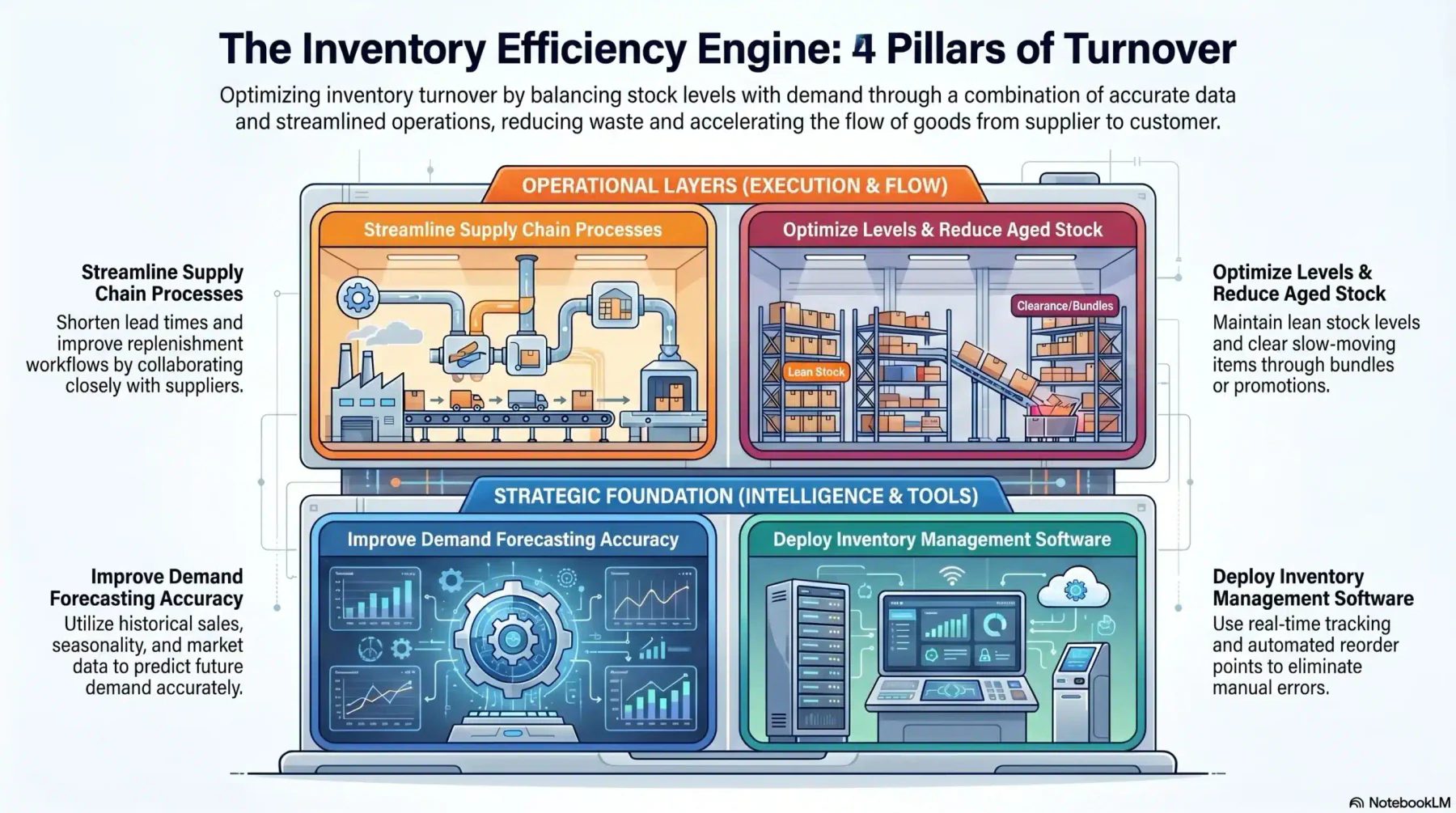
Businesses can improve turnover by combining better planning, operational discipline, and technology.
1. Optimize Inventory Levels
Maintain enough stock to meet demand without excessive overstocking.
2. Improve Demand Forecasting Accuracy
Use historical sales, seasonality, and market data to forecast demand more accurately.
3. Streamline Supply Chain Processes
Work closely with suppliers, shorten lead times, and improve replenishment workflows.
4. Use Inventory Management Software
Real-time stock tracking platform help track stock constantly, automate reorder points, and reduce manual errors.
5. Reduce Slow-Moving Stock
Identify aged inventory early and clear it through promotions, bundles, or product rationalization.
How ERP Software Helps Improve Inventory Turnover
Automated stock control software gives businesses better visibility and control over inventory across purchasing, warehousing, sales, and finance.
1. Real-Time Inventory Tracking
Monitor stock levels, movements, and locations instantly to reduce shortages and overstocking.
2. Automated Reordering and Stock Control
ERP systems can trigger replenishment based on minimum stock levels and demand trends.
3. Integrated Demand Forecasting
Combining sales history, purchasing data, and planning tools improves forecasting accuracy.
4. Data-Driven Decision Making
Dashboards and reports help managers identify slow-moving products, optimize purchasing, and improve turnover ratios.
Conclusion
Inventory turnover is a key indicator of how effectively a business converts stock into sales. It helps businesses understand whether inventory levels are aligned with demand and sales performance.
By understanding the formula and reviewing turnover regularly, companies can identify slow-moving products, avoid overstocking, and make better purchasing decisions.
Improving inventory turnover can also strengthen cash flow, reduce storage costs, and support more efficient day-to-day operations across the business.
Get a free consultation to find the right inventory management or ERP solution for your business.

Frequently Asked Question
Inventory turnover measures how often a business sells and replaces its inventory during a specific period. It helps evaluate stock efficiency and sales performance.
Inventory turnover is calculated by dividing Cost of Goods Sold (COGS) by Average Inventory. This shows how many times inventory is sold and replenished over a period.
A good inventory turnover ratio depends on the industry. Fast-moving retail sectors may have higher ratios, while industries with expensive or slow-moving goods may have lower averages.
Not always. Very high inventory turnover may indicate strong sales, but it can also mean stock shortages or understocking that leads to missed sales opportunities.
ERP software improves inventory turnover by providing real-time stock visibility, automated reordering, demand forecasting, and better inventory planning across departments.