














Procurement teams in Australia are under increasing pressure to reduce costs, manage supplier risk, and deliver measurable value to the business. Strategic sourcing provides a structured framework to achieve all three.
Unlike reactive purchasing, strategic sourcing aligns procurement decisions with long-term business objectives. It involves analysing spend, evaluating the supply market, building supplier relationships, and continuously improving the sourcing process over time.
This article covers what strategic sourcing is, why it matters, how the process works step by step, and what best practices separate high-performing procurement teams from the rest.
Key Takeaways
Understand the core definition and scope of strategic sourcing.
Discover why modern businesses prioritize strategic sourcing.
Learn the crucial steps to execute sourcing effectively.
Explore spend analysis, supplier evaluation, and more.
What Is Strategic Sourcing?

Strategic sourcing is a procurement methodology that focuses on analysing an organisation’s total spend, evaluating supplier markets, and making purchasing decisions that deliver long-term value rather than short-term savings alone.
It treats procurement as a strategic function rather than an administrative one. Instead of simply finding the lowest price, strategic sourcing considers total cost of ownership, supplier capability, supply chain risk, and alignment with business goals.
The approach is cyclical. Sourcing strategies are reviewed regularly to reflect changes in market conditions, supplier performance, and internal requirements.
Why Strategic Sourcing Is Important
Strategic sourcing gives procurement teams a structured supplier-to-payment workflow to manage spend, suppliers, and risk. As supply chains grow more complex, sourcing strategically is increasingly a competitive advantage.
1. Cost Savings and Value Optimisation
Strategic sourcing addresses the full cost of acquiring goods and services, not just unit price. Analysing spend, consolidating suppliers, and improving contract compliance together deliver sustainable savings.
2. Stronger Supplier Relationships
Treating key suppliers as long-term partners leads to better service levels, preferential pricing, and greater resilience during disruptions. This is especially valuable for Australian businesses exposed to international supply chain volatility.
3. Risk Reduction and Supply Chain Resilience
Strategic sourcing includes structured assessment of supplier risk covering financial stability, geographic exposure, and regulatory compliance. For Australian operations, this is particularly relevant given obligations under the Modern Slavery Act 2018.

Strategic Sourcing Process (Step-by-Step)
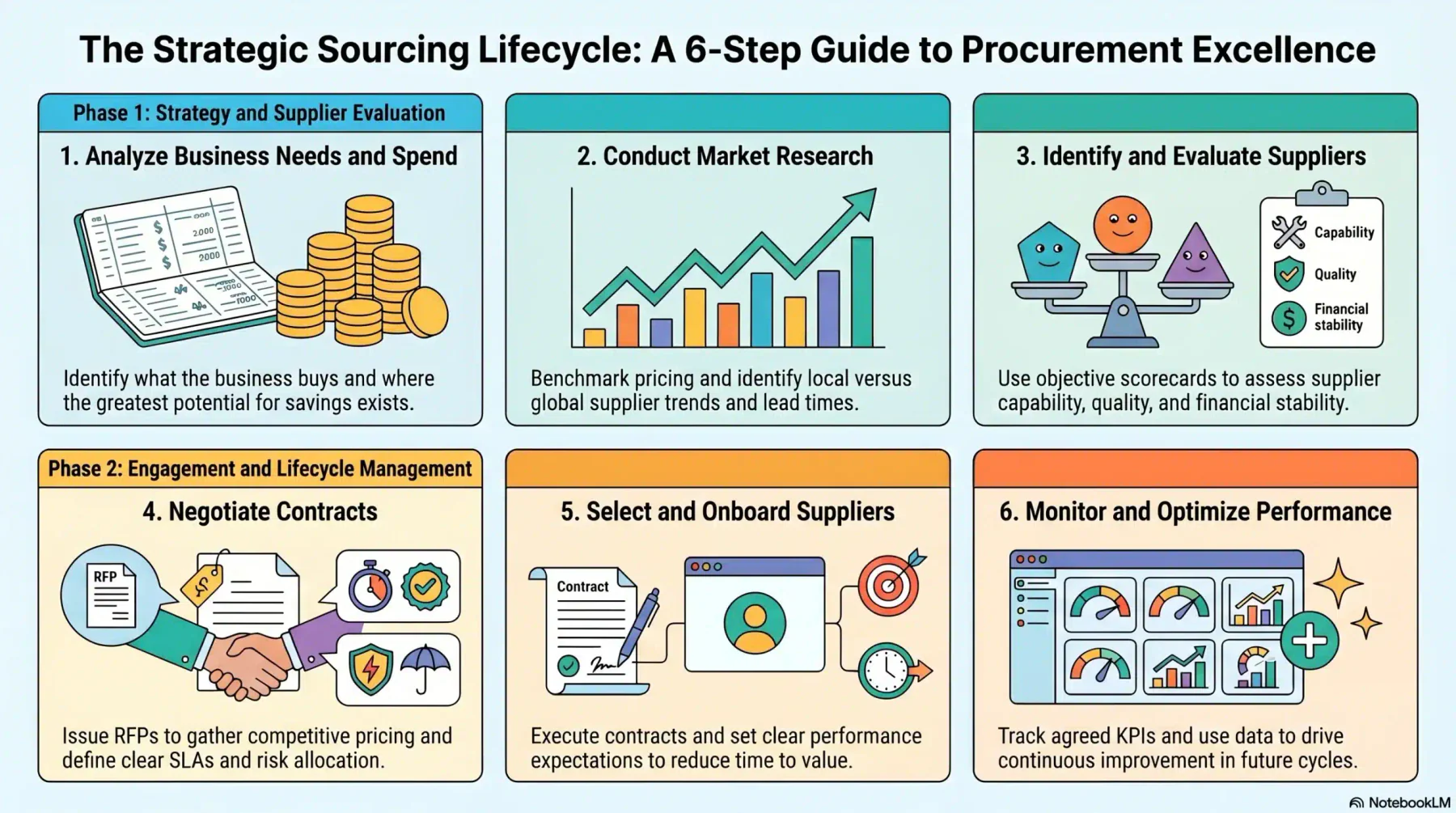
A repeatable sourcing process ensures consistent outcomes across categories and reduces reliance on individual expertise.
1. Analyse Business Needs and Spend
The process begins by analysing what the business buys, how much it spends, and who the current suppliers are. This spend analysis identifies which categories offer the greatest potential for savings or risk reduction.
2. Conduct Market Research
Market research identifies available suppliers, benchmarks current pricing, and surfaces trends affecting supply availability or cost. Australian businesses should also weigh local supplier options against global sources, factoring in lead times and total cost.
3. Identify and Evaluate Suppliers
Suppliers are assessed against defined criteria including capability, quality, financial stability, and regulatory compliance. A structured evaluation using scorecards ensures selection is objective and auditable.
4. Issue RFP/RFQ and Negotiate Contracts
An RFP or RFQ is issued to shortlisted suppliers to gather comparable pricing and terms in a competitive environment. Contract negotiation follows, covering SLAs, payment terms, risk allocation, and performance review mechanisms.
5. Select Suppliers and Onboard
Supplier selection is based on evaluation and negotiation outcomes, followed by structured onboarding covering contract execution, system setup, and clear communication of expectations. A well-managed onboarding process reduces time to value and sets performance standards from day one.
6. Monitor Supplier Performance and Optimise
Supplier performance is tracked against agreed KPIs with regular reviews to identify issues and capture improvement opportunities. Monitoring data feeds back into the next sourcing cycle to drive continuous improvement.
Key Components of Strategic Sourcing
A mature strategic sourcing function is built on several interconnected capabilities that deliver consistent results.
1. Spend Analysis and Data Management
Spend analysis requires clean, centralised purchasing data drawn from an integrated procurement or ERP system. Without it, sourcing decisions are made on incomplete information.
2. Supplier Evaluation and Selection
A structured evaluation process ensures supplier decisions are based on objective criteria, not familiarity or convenience. Maintaining a register of approved suppliers also speeds up future sourcing activities.
3. Contract Management
Effective contract management ensures negotiated terms are implemented, tracked, and enforced throughout the supplier relationship. This includes version control, milestone tracking, and monitoring of obligations on both sides.
4. Supplier Relationship Management
SRM develops productive relationships with key suppliers beyond performance monitoring, including joint improvement initiatives and strategic alignment. It delivers the most value for Tier 1 suppliers with significant commercial or operational impact.
Strategic Sourcing vs Traditional Purchasing
Strategic sourcing and traditional purchasing serve different objectives and operate at different levels of the organisation.
1. Short-Term Cost Focus vs Long-Term Value
Traditional purchasing focuses on securing goods at the lowest available price on a transaction-by-transaction basis. Strategic sourcing optimises for total cost of ownership and business alignment over the life of a supplier relationship.
2. Transactional vs Strategic Approach
Traditional purchasing is largely transactional, processing requisitions and managing deliveries. Strategic sourcing involves market analysis, supplier development, and risk management requiring a more senior procurement function.
3. Role in Source-to-Pay (S2P)
Strategic sourcing sits at the front end of S2P, covering spend analysis through to contract execution, while traditional purchasing operates within the P2P portion. Integrating both functions ensures strategically sourced contracts are properly executed at the operational level.
Benefits of Strategic Sourcing
Organisations that source strategically consistently outperform peers on procurement efficiency, supplier quality, and supply chain resilience.
1. Improved Cost Efficiency
Analysing spend, leveraging supplier competition, and negotiating on total value delivers sustainable cost improvements. Consolidating spend with fewer, higher-quality suppliers also reduces the administrative overhead of managing a fragmented supplier base.
2. Better Decision-Making with Data
Spend analysis, supplier scorecards, and market benchmarks improve sourcing decisions and provide clear justification for supplier selection. This reduces reliance on individual judgment and supports defensible procurement outcomes.
3. Increased Procurement Visibility
A structured sourcing process creates a documented audit trail from needs analysis through to contract award. This creates centralised procurement oversight with greater visibility into procurement decisions and budget allocation.
4. Enhanced Supplier Collaboration
Strategically managed suppliers invest more in service quality, responsiveness, and joint problem-solving. Collaborative relationships also provide early warning on supply disruptions and opportunities for co-developed improvements.
Challenges in Strategic Sourcing
Even well-resourced procurement teams encounter barriers when implementing or scaling strategic sourcing.
1. Limited Data and Spend Visibility
Fragmented purchasing data makes it difficult to build the consolidated view needed for meaningful spend analysis. A centralised procurement or ERP system is the most direct solution.
2. Supplier Risk and Market Volatility
Financial instability, geopolitical disruption, and currency fluctuations can undermine sourcing strategies that were sound at implementation. Multi-sourcing, contract flexibility, and continuous monitoring reduce this exposure.
3. Resistance to Process Changes
Shifting from reactive purchasing to strategic sourcing requires changes in how teams operate and how suppliers are managed. Executive sponsorship and phased implementation help manage the transition effectively.
Best Practices for Strategic Sourcing
The most effective procurement teams share common disciplines that separate strategic sourcing in practice from strategic sourcing in theory.
1. Align Sourcing with Business Goals
Sourcing strategies should reflect the organisation’s broader priorities, whether growth, cost reduction, or supply chain resilience. Procurement leaders who engage regularly with finance and executive stakeholders make better-aligned decisions.
2. Use Data and Analytics for Decisions
Every sourcing decision should be supported by spend data, supplier performance history, and market benchmarks. Modern procurement platforms provide real-time dashboards that make this analysis accessible without extensive manual effort.
3. Build Long-Term Supplier Partnerships
Treating key suppliers as partners creates advantages that transactional relationships cannot produce, including flexibility during disruptions and proactive improvement. Competitive tension should still be maintained through regular benchmarking even with long-term partners.
4. Continuously Monitor and Improve
Supplier performance should be reviewed regularly and sourcing strategies updated as market conditions and business needs change. Building a continuous improvement culture in procurement compounds into a significant advantage over time.
Role of Technology in Strategic Sourcing
Modern purchasing technology enables the scale, speed, and analytical depth that manual sourcing processes cannot match.
1. Automation of Sourcing Processes
Procurement platforms automate RFP distribution, bid comparison, and contract generation, reducing administrative burden and accelerating the sourcing cycle. Automated workflows also enforce process compliance across every sourcing activity.
2. Real-Time Spend and Supplier Insights
Modern sourcing tools surface spend patterns, supplier performance, and contract status in real time through dashboards that flag risks and highlight opportunities. For Australian businesses managing multiple supplier relationships across locations, this visibility is essential.
3. Integration with Procurement Systems
Strategic sourcing delivers the most value when integrated with end-to-end purchasing software, purchase order management, accounts payable, inventory, and ERP systems. HashMicro’s procurement module connects sourcing workflows with real-time inventory data and financial reporting in one platform.
Strategic Sourcing in the Procurement Lifecycle
Strategic sourcing is one component of a broader procurement lifecycle spanning from need identification through to payment and supplier review.
1. Role in Source-to-Contract (S2C)
Source-to-Contract covers the full upstream procurement process from spend analysis through to contract execution. A well-executed S2C process produces supplier contracts with market-competitive terms, clear performance expectations, and appropriate risk allocation.
2. Connection to Procure-to-Pay (P2P)
P2P supports the invoice-to-procurement process by executing purchasing against supplier contracts and relationships. Well-structured upstream sourcing directly reduces friction, exceptions, and disputes in day-to-day purchasing operations.
3. Supporting End-to-End Procurement Efficiency
Integrating strategic sourcing with operational procurement creates a process that is both strategically sound and operationally efficient. Organisations managing both in a connected system gain full lifecycle visibility from spend analysis to final payment.
Conclusion
Strategic sourcing is one of the highest-return investments a procurement function can make.
By applying a structured, data-driven approach to supplier selection, contract management, and performance monitoring, businesses achieve sustainable savings, stronger supplier relationships, and greater supply chain resilience.
For Australian businesses operating in competitive markets, the ability to source strategically affects margins, operational continuity, and long-term growth.
You can consult the experts to streamline sourcing and reduce procurement costs.
Frequently Asked Question
Procurement is the broader function covering everything from identifying a need to paying a supplier. Strategic sourcing is a specific methodology within it, focused on analysing spend and making supplier decisions that deliver long-term value.
A simple category may take four to six weeks from spend analysis to contract award. Complex categories with multiple suppliers or high-value contracts can take three to six months or longer.
No. The principles apply at any scale. Small and medium businesses can start with their highest-spend categories and expand the approach as their procurement function matures.
Categories with high spend, multiple potential suppliers, or significant supply chain risk deliver the greatest return. Common starting points include IT, professional services, logistics, raw materials, and facilities management.
Procurement platforms centralise spend data, automate RFP and contract workflows, and integrate sourcing decisions with operational purchasing, reducing manual effort and improving data quality throughout the cycle.