















Cost accounting helps businesses see what it really costs to produce goods, deliver services, complete projects, and run daily operations.
For Australian businesses, that visibility supports better pricing, tighter budgets, stronger margin control, and clearer decisions across departments.
This article explains what cost accounting means, how it works, which methods businesses use, and how it supports reporting, compliance, and profitability.
Key Takeaways
Retail loss prevention identifies and controls stock losses from theft, fraud, inventory errors, and weak internal processes.
Common causes of retail loss include shoplifting, employee theft, supplier fraud, checkout errors, and damaged or expired stock.
Building a retail loss prevention strategy starts with identifying where losses happen, then improving tracking, training, and reporting.
HashMicro reduces retail loss by connecting POS, inventory, purchasing, and reporting in one platform for better stock visibility.
What Is Retail Loss Prevention?
Retail loss prevention is the process of identifying, reducing, and preventing losses across a retail business. It focuses on stock, cash, transactions, staff activity, and store processes.
Loss prevention is not only about stopping shoplifting. It also covers internal theft, supplier errors, incorrect pricing, poor stock handling, and inaccurate inventory records.
A strong approach combines staff training, store controls, inventory tracking, POS monitoring, and regular review. The goal is to reduce loss while keeping service smooth.

Why Retail Loss Prevention Matters for Australian Businesses
Retailers often work with tight margins, high stock movement, and busy customer traffic. When shrinkage rises, profit can fall even when sales look healthy.
The Australian Bureau of Statistics tracks retail and wholesale trade activity across Australia. This shows how important accurate stock and sales data are in a large retail market.
Loss prevention helps Australian retailers protect working capital and improve stock availability. It also supports better purchasing, store planning, and customer service.
Without clear controls, stores may reorder products they already have, miss fast-moving shrinkage issues, or rely on sales reports that do not match physical stock.
Common Causes of Retail Loss
Retail loss can come from many areas, not just customer theft. Retailers need to understand each cause before they choose the right controls.
1. Shoplifting and external theft
Shoplifting happens when customers or organised groups take goods without paying. It can involve small items, high-value products, or repeated theft across several store visits.
External theft often increases when stores have poor visibility, weak product placement, or limited staff coverage. High-risk categories need tighter monitoring and clearer controls.
2. Employee theft and internal fraud
Employee theft can involve stolen stock, cash handling issues, false refunds, unauthorised discounts, or misuse of staff privileges. These losses can be hard to detect without data.
Internal fraud often happens when one person controls too much of a process. Clear approval rules, access controls, and transaction monitoring help reduce that risk.
3. Supplier fraud and receiving errors
Supplier-related loss can happen when delivered quantities do not match purchase orders or invoices. It can also come from incorrect pricing, substitutions, or duplicate billing.
Receiving errors create stock gaps before items even reach the sales floor. Retailers need checks between purchase orders, deliveries, invoices, and system records.
4. Inventory discrepancies
Inventory discrepancies happen when system stock does not match physical stock. Causes include missed scans, wrong product codes, transfer errors, and unrecorded wastage.
When stock data is wrong, staff may make poor purchasing and replenishment decisions. This can lead to stockouts, overstocking, and unreliable margin reports.
5. Pricing and checkout errors
Pricing errors happen when shelf labels, POS prices, promotions, and product records do not align. Checkout errors may involve missed scans, wrong quantities, or manual overrides.
These issues reduce margin and weaken customer trust. Regular price checks and connected POS data help stores catch errors before they repeat.
6. Damaged or expired stock
Stock loss also comes from damage, expiry, spoilage, and poor handling. This is common in grocery, pharmacy, food service, and retailers with seasonal products.
Without proper tracking, damaged or expired items may stay in records as saleable stock. This creates misleading availability data and inaccurate gross margin reporting.
Retail Shrinkage vs Retail Loss Prevention
Retail shrinkage is the difference between the stock a retailer should have and the stock it actually has. It measures the loss after theft, error, damage, or fraud occurs.
Retail loss prevention is the strategy used to reduce that shrinkage. It includes the controls, systems, training, and review processes that stop losses from repeating.
| Area | Retail shrinkage | Retail loss prevention |
| Meaning | The measured gap between expected and actual stock | The actions used to reduce stock and revenue loss |
| Focus | What was lost | Why it happened and how to prevent it |
| Timing | Identified after stock movement or stocktake | Applied before, during, and after store operations |
| Examples | Missing stock, damaged goods, stocktake variances | POS checks, inventory controls, staff training, CCTV |
Both concepts work together. Shrinkage shows the size of the problem, while loss prevention helps the business reduce future losses.
How to Build a Retail Loss Prevention Strategy
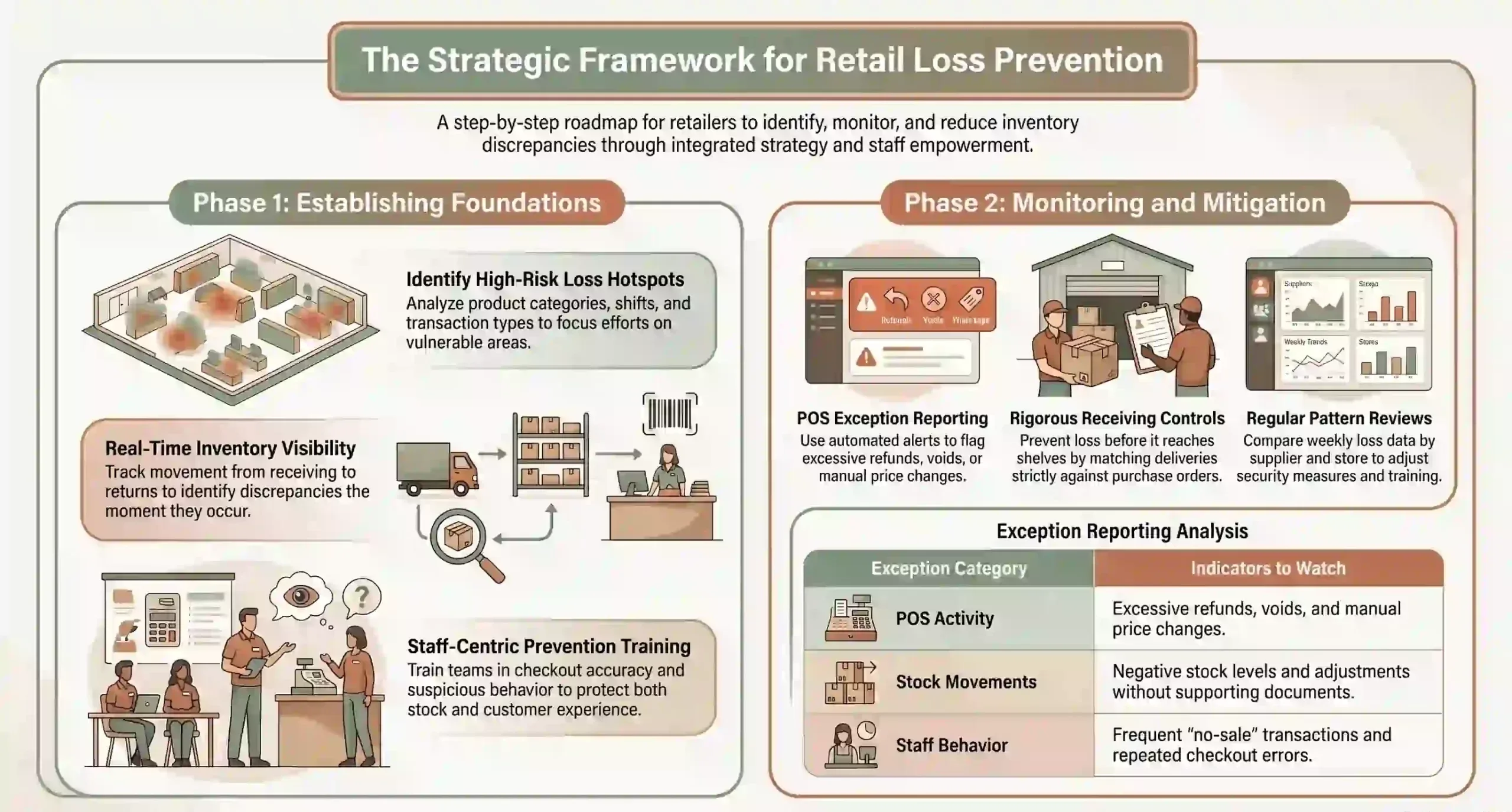
The Australian Retailers Association notes that shrinkage remains one of the key profit risks facing retailers. A retail loss prevention strategy should match how the business operates.
The best strategy connects store activity, inventory data, POS transactions, staff procedures, and management reporting. This helps teams see loss patterns clearly.
1. Identify where losses happen
Start by reviewing where stock differences appear most often. Look at product categories, store locations, shifts, suppliers, transfer points, and transaction types.
This helps the business focus on the highest-risk areas first. It also prevents teams from assuming shoplifting is the only cause of loss.
2. Improve inventory tracking
Accurate inventory tracking gives retailers a stronger view of stock movement and plays an important role in improving stock accuracy across stores, warehouses, and sales channels
When stock data updates in real time, teams can find discrepancies earlier. They can also reduce manual checks that often create new errors.
3. Train store staff
Staff play a key role in spotting risk and following control procedures. Training should cover receiving checks, checkout accuracy, stock handling, refunds, and suspicious behaviour.
Good training also protects customer experience. Staff need clear steps that reduce loss without creating unnecessary conflict or delays.
4. Monitor POS transactions
POS monitoring helps retailers identify unusual activity. This may include excessive refunds, voids, discounts, manual price changes, or repeated no-sale transactions.
Managers should review exceptions by store, cashier, shift, and product category. Patterns often reveal process issues or fraud risks that manual review may miss.
5. Strengthen receiving and stocktake processes
Receiving controls help prevent loss before stock reaches shelves. Staff should match deliveries against purchase orders, supplier documents, and system records.
Stocktakes should follow consistent rules and schedules. Regular cycle counts can reduce the pressure of large stocktakes and reveal issues faster.
6. Use exception reporting
Exception reporting highlights transactions or stock movements that fall outside normal patterns. It helps managers focus on risk instead of reviewing every record manually.
Reports can flag unusual discounts, negative stock, large adjustments, frequent returns, and stock movements without supporting documents. These alerts support faster action.
7. Review loss patterns regularly
Loss prevention should be reviewed regularly, not only after a major stocktake. Weekly or monthly reviews help managers track whether controls are working.
Retailers should compare loss by store, category, supplier, and period. This makes it easier to adjust training, staffing, purchasing, and security measures.
Retail Loss Prevention Technologies
Technology helps retailers detect loss earlier and manage stock more accurately. It works best when POS, inventory, reporting, and store controls connect in one workflow.
1. POS system monitoring
POS monitoring helps managers review risky transactions across stores and acts as valuable software for tracking in-store purchases, refunds, discounts, and cashier activity.
These alerts make it easier to spot mistakes or fraud patterns. Managers can review exceptions by staff member, shift, product, or branch.
2. Inventory management software
Inventory management software tracks stock movement from receiving to sale. It records purchases, transfers, returns, adjustments, damage, and stocktake results.
Real-time inventory data helps retailers find discrepancies faster, making it easier for businesses focused on tracking inventory in real time to identify stock issues before they affect sales
3. CCTV and store security
CCTV supports loss prevention by improving store visibility and helping teams review incidents. It can also deter theft when placed in high-risk areas.
Security measures should support daily operations, not disrupt service. Retailers should combine camera coverage with staff procedures and transaction data.
4. Barcode and RFID tracking
Barcode and RFID tracking improve the accuracy of stock movement records. They help stores scan products during receiving, transfers, sales, stocktakes, and returns.
RFID can be useful for high-volume or high-value stock because it speeds up counting. It also helps identify stock gaps with less manual handling.
5. Automated stock reporting
Automated stock reporting gives managers regular visibility into shrinkage, adjustments, returns, and stock variances. It reduces reliance on manual spreadsheet checks.
Reports can compare stores, categories, suppliers, and periods. This helps retailers spot repeated issues and act before losses become larger.
Common Mistakes in Retail Loss Prevention
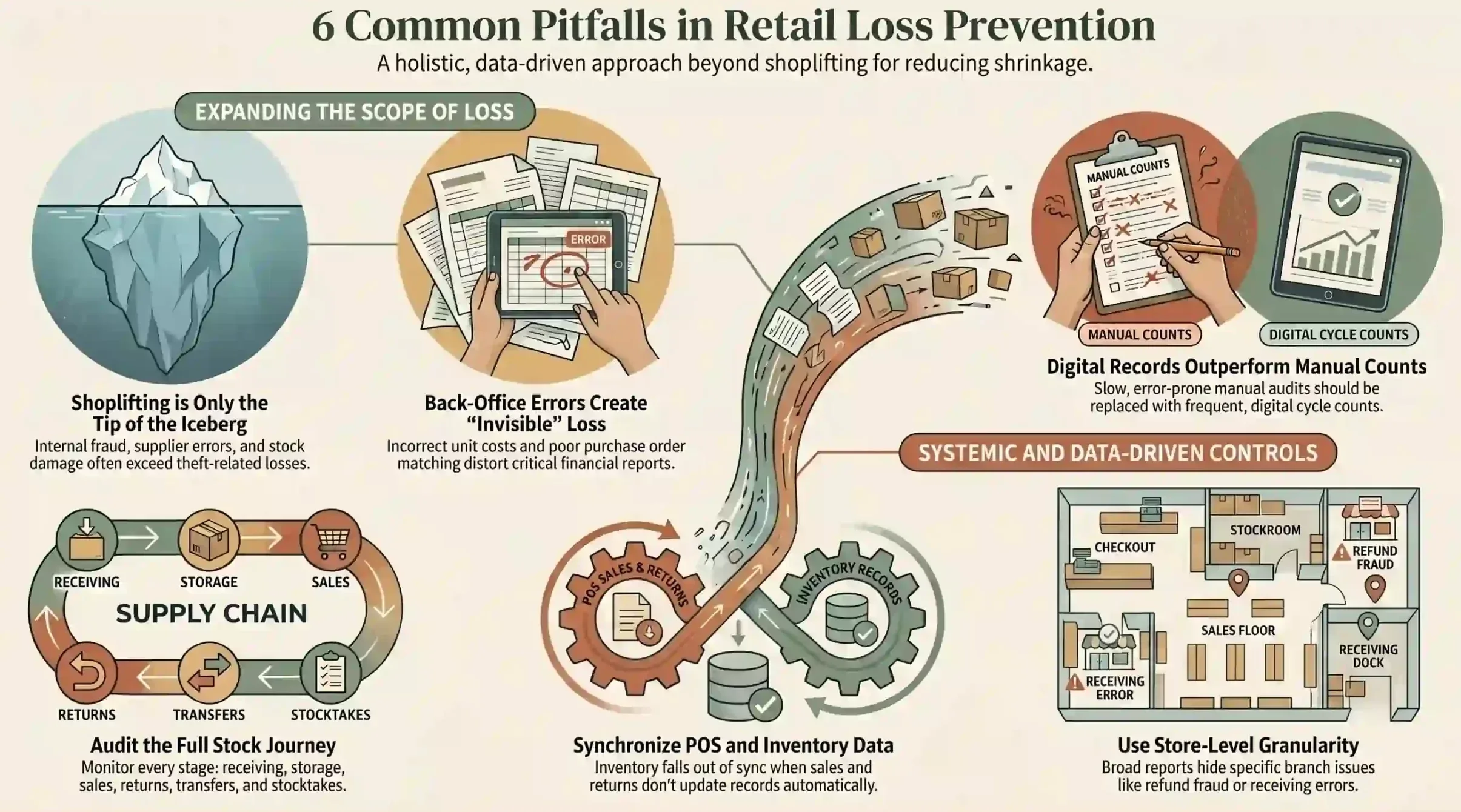
Many retailers invest in security but still miss preventable losses. The problem often comes from disconnected data, weak routines, or narrow assumptions about shrinkage.
1. Focusing only on shoplifting
Shoplifting is visible, but it is not the only cause of retail loss. Internal fraud, supplier errors, stock damage, and checkout mistakes can also reduce profit.
A balanced strategy reviews the full stock journey. Retailers should check what happens during receiving, storage, sales, returns, transfers, and stocktakes.
2. Ignoring back-office errors
Back-office errors can create large stock and margin issues over time. Incorrect product setup, wrong unit costs, and poor purchase order matching can distort reports.
These errors may not look like theft, but they still create loss. Finance, purchasing, and store teams need shared controls to keep records accurate.
3. Relying on manual stock counts
Manual stock counts are slow and easy to misread, especially in busy stores. They also depend heavily on staff availability and consistent procedures.
Cycle counts and digital stock records give retailers better control. They help teams find variances earlier instead of waiting for a full stocktake.
4. Not connecting POS and inventory data
When POS and inventory systems do not connect, stock records can fall out of sync. Sales, returns, discounts, and adjustments may not update inventory properly.
This makes shrinkage harder to measure and investigate. Connected systems help managers trace stock movement from purchase to final sale.
5. Failing to review store-level trends
Overall shrinkage reports can hide store-level problems. One branch may have repeated refund issues, while another may struggle with receiving errors.
Retailers need reporting by location, category, staff role, and period. This detail helps managers apply the right fix instead of using broad controls everywhere.
How HashMicro Helps Reduce Retail Loss
HashMicro helps retailers reduce stock loss by connecting inventory, POS, purchasing, accounting, and reporting in one ERP platform. As a comprehensive system for reducing retail shrinkage, it provides greater visibility across stock movements and store operations
Retailers can track receiving, transfers, sales, returns, stock adjustments, and branch-level inventory in real time. This gives teams clearer control over stock movement while connecting sales channels and inventory records within a single system.
The retail sales system also supports exception reporting, approval workflows, barcode tracking, and automated stock reports. Managers can review loss patterns faster and act with better data.
For multi-store retailers, HashMicro helps compare stock performance across branches. Finance and operations teams can see where losses happen and which controls need improvement.
Conclusion
Retail loss prevention helps businesses reduce shrinkage, protect margins, and keep stock records accurate. It covers theft, fraud, supplier issues, errors, damage, and process gaps. Australian retailers need a practical strategy that connects all data.
With integrated retail software, businesses can monitor stock movement, review exceptions, and compare branch-level trends. Stronger visibility helps managers reduce loss with more confidence.
IF you are interested in learning further, you can book a free consultation with us today and start scaling your business.

Frequently Asked Questions
What is loss prevention in retail?
Loss prevention in retail is the process of reducing stock loss, theft, fraud, inventory errors, damaged goods, and operational mistakes. It helps retailers protect profit margins and keep inventory records accurate across stores, warehouses, and sales channels.
What causes retail shrinkage?
Retail shrinkage can be caused by shoplifting, employee theft, supplier fraud, receiving errors, stocktake mistakes, damaged goods, expired products, checkout errors, and unrecorded stock movements. Retailers should identify the cause before choosing a prevention strategy.
How can Australian retailers reduce stock loss?
Australian retailers can reduce stock loss by improving inventory tracking, training staff, monitoring POS transactions, reviewing supplier deliveries, using exception reports, and connecting POS with inventory data. Regular review helps identify repeated loss patterns across stores.
What is the difference between shrinkage and loss prevention?
Shrinkage is the stock loss that has already happened, usually shown as the difference between recorded and actual inventory. Loss prevention is the strategy used to reduce or prevent that stock loss through controls, training, reporting, and technology.
How does inventory software help with retail loss prevention?
Inventory software helps retailers track stock movement, transfers, adjustments, receiving, returns, and discrepancies. When connected with POS and reporting tools, it gives managers clearer visibility over where losses occur and which processes need attention.