















Financial management software has become an essential infrastructure for Australian businesses. With GST reporting, STP Phase 2, and AASB standards, platforms are required to be accurate for all stored data.
Rather than waiting on end-of-month spreadsheets, businesses now manage automated finance operations through live dashboards, automated reconciliation, and integrated compliance tools from a single platform.
This review covers 12 leading business financial management software options available to Australian businesses in 2026. Each tool is assessed on its level of compliance, automation features, and local integrations.
Key Takeaways
Financial management software is an integrated suite of tools for managing income, expenses, assets, cash flow, and compliance.
Key features to look for include real-time dashboards, AP and AR automation, multi-currency support, API integrations with CRM and payroll systems, and built-in Australian compliance.
These platforms are chosen based on their compliance depth, automation features, local integrations, and fit for the Australian market across different business sizes.


Best Because
A unified platform combining HR, payroll, and financial management with automated compliance for STP Phase 2 and superannuation.

Best Because
Australia's most widely used cloud accounting platform, with direct bank feed integration, BAS compliance, and a broad app ecosystem.
 HashMicro
Best Because
An Australian-built platform with deep local payroll expertise, industry award calculations, and built-in BAS and Peppol e-invoicing support.

Best Because
A cloud-native platform built for mid-market businesses managing multiple entities, cross-border operations, and AASB-aligned reporting.
What Is Financial Management Software?
Financial management software is an integrated suite of tools for managing income, expenses, and assets.
It extends beyond bookkeeping into financial planning, cash flow forecasting, and strategic reporting across the entire business. In 2026, these platforms increasingly use AI for predictive modelling.
They forecast cash flow based on historical data and market conditions, helping finance teams shift from reactive to proactive financial management.
For businesses in Australia, financial management software bridges finance with operations across sales, procurement, and HR.
This ensures every transaction aligns with company objectives and supports ongoing compliance. Cloud architectures have made these tools accessible to all business sizes.
From sole traders to large enterprises, real-time visibility and automation have become standard expectations across the Australian market.

Key Features to Look for in Australian Financial Management Software
1. Real-time reporting and dashboards
Finance teams need live visibility into liquidity, debt ratios, and burn rates rather than waiting for end-of-month summaries to flag issues.
2. Advanced automation
This covers AP and AR workflows, OCR invoice processing, and payment scheduling based on cash flow timing, reducing manual effort across the finance team.
3. Multi-currency and multi-entity support
Essential for Australian businesses expanding into Asia-Pacific. The software must handle real-time conversions and consolidate financials across subsidiaries efficiently.
4. Integration capabilities
The platform must connect to CRM, inventory, and payroll systems through APIs to prevent manual data entry and keep financial data accurate across all business units.
5. Australian compliance features
Any platform used locally must support STP Phase 2, GST calculations, BAS reporting, and Peppol e-invoicing to meet ATO requirements.
Australian Tax & Compliance Requirements for Financial Software
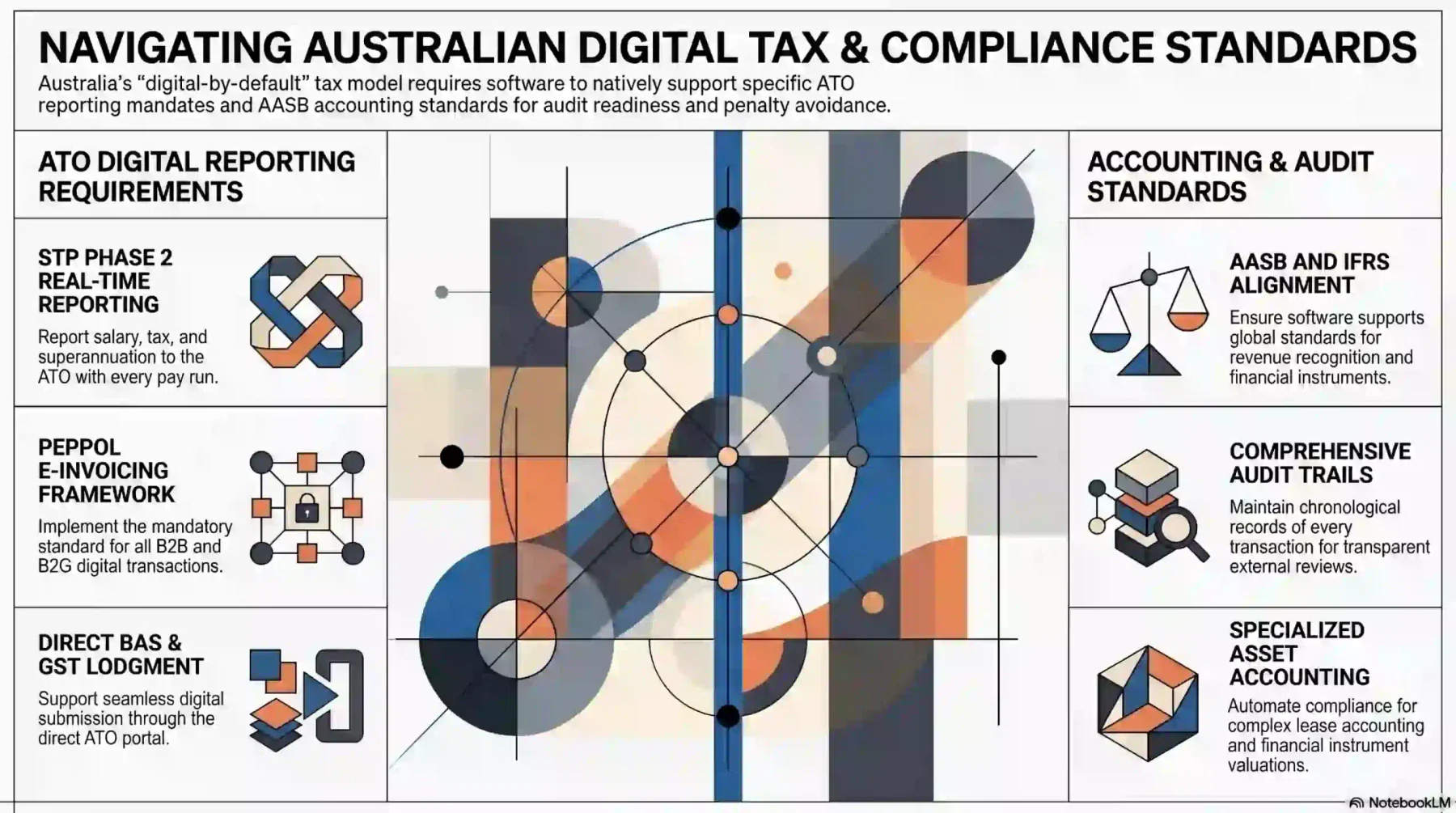
Australia has one of the most digitised tax environments in the world. Non-compliance results in significant ATO penalties, making native support for local tax requirements essential in any software used here.
1. ATO digital reporting requirements
The ATO has adopted a digital-by-default model for business reporting. STP Phase 2 requires employers to report salary, wages, withheld tax, and superannuation to the ATO with every pay run.
BAS and GST reporting are integral to Australian business operations. Software should support direct ATO portal lodgment and the Peppol e-invoicing framework, now the B2B and B2G standard in Australia.
2. Accounting standards
Compliance also extends to AASB standards, which align with IFRS. Any platform used by companies requires scalable financial systems that support lease accounting, revenue recognition, and financial instrument valuation.
For audit-ready financials, the software must maintain a comprehensive audit trail. This is a chronological record of every transaction and system change, ensuring transparency during reviews.
12 Best Financial Management Software for Australian Business in 2026
The following 12 tools represent the strongest financial management software options for Australian businesses in 2026, assessed by capabilities, compliance features, and suitability across business sizes.
1. Rippling
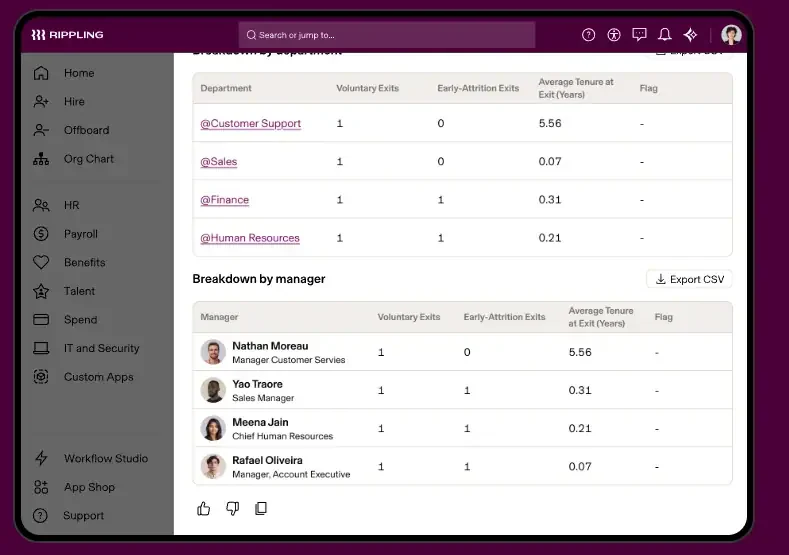
Rippling unifies HR, payroll, and financial management into a single platform. When a new employee is hired, payroll, superannuation, expense access, and corporate card settings are configured automatically.
In Australia, Rippling handles STP Phase 2 reporting and superannuation calculations while supporting global payroll for international teams. This removes typical friction between finance and HR operations.
The platform suits fast-scaling technology companies and professional services firms. Its unified data model ensures finance and HR work with unified information, reducing reporting and reconciliation delays.
Best for: Rippling works best for technology companies and professional services firms that want a single platform for workforce and financial management, including multi-country payroll and automated compliance.
| Pros | Cons |
| ✓ Unified HR, payroll, and finance in one platform. | ×No public pricing; requires direct sales contact. |
| ✓ Automates STP Phase 2 and superannuation compliance. | ×Complexity can exceed the needs of smaller businesses. |
| ✓ Strong multi-country payroll for international teams. | ×Australian localisation still maturing compared to local alternatives. |
Pricing: Rippling uses a modular pricing model, and Australian businesses will need to contact the sales team for a custom quote based on the modules required and the number of employees managed.
2. Xero
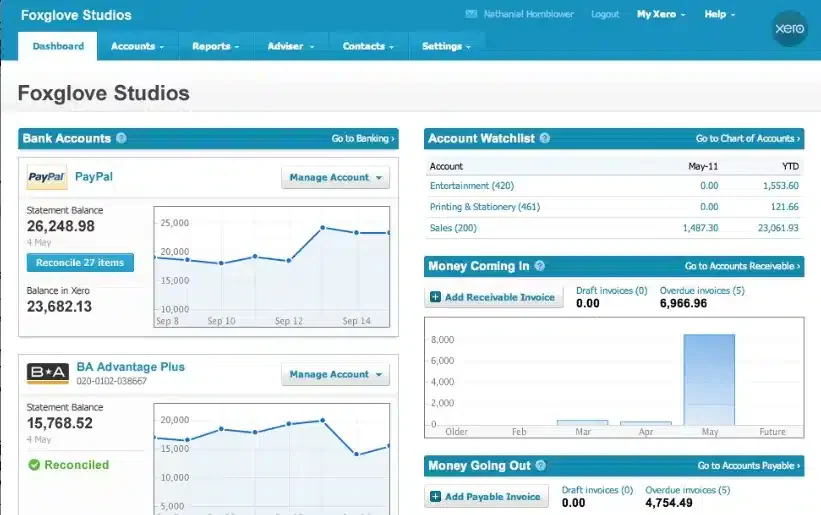
Xero is the most widely used cloud financial management tool for small and medium businesses in Australia. Its bank feed technology integrates directly with all four major banks, making reconciliation largely automatic.
The platform connects to over 1,000 third-party apps, allowing businesses to build a tailored stack around their needs. Xero has also added AI-driven cash flow tools to help owners identify potential shortfalls earlier.
Xero supports STP Phase 2, GST reporting, and direct BAS lodgment. Combined with transparent pricing and a low learning curve, it remains a strong choice for Australian businesses in retail, hospitality, and services.
Best for: small and medium businesses in Australia seeking a low-cost cloud accounting solution with strong bank feed integration, BAS compliance, and a broad ecosystem of add-on applications.
| Pros | Cons |
| ✓ Intuitive interface with a low learning curve. | ×Payroll is a paid add-on, not bundled. |
| ✓ Direct bank feeds with all Big Four Australian banks. | ×Inventory management is limited without third-party apps. |
| ✓ Over 1,000 third-party app integrations. | ×Costs increase quickly as teams and modules grow. |
Pricing: Xero plans in Australia start from AUD $29 per month for the Starter plan, with Standard at $57 per month and Premium 5 at $85 per month. Payroll and other add-ons are priced separately.
3. MYOB Business
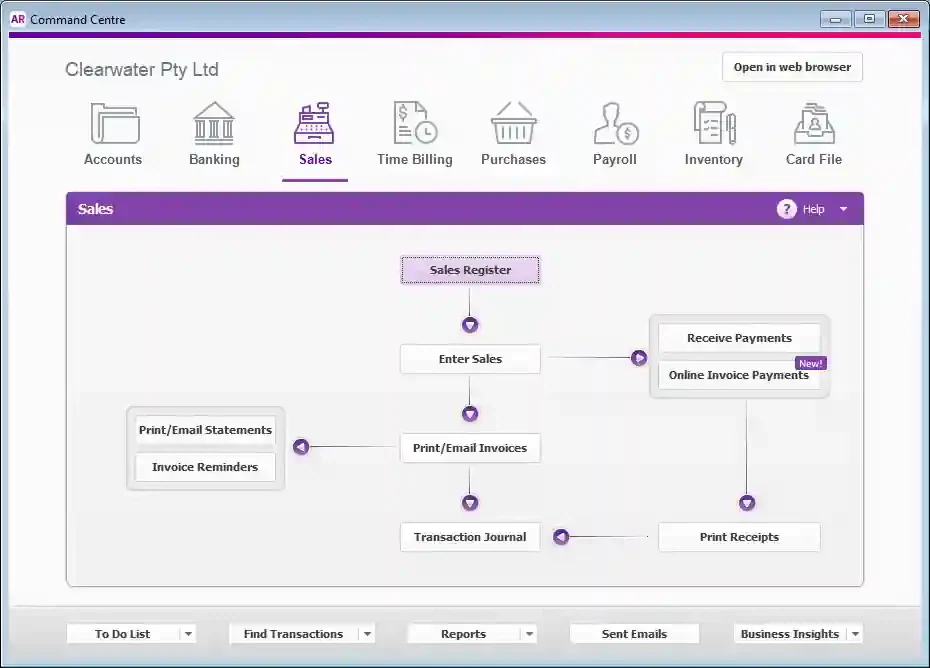
MYOB is an Australian-built platform with deep expertise in local payroll and compliance. It handles industry award calculations and superannuation contributions with accuracy that offshore platforms often lack.
Recent MYOB updates have streamlined BAS lodgment and improved the mobile experience for business owners managing finances on the go. The platform also supports Peppol e-invoicing for compliant B2B transactions.
Unlike Xero, MYOB Business prioritises built-in functionality over third-party integrations. This suits businesses that prefer a more self-contained integrated finance framework with fewer external dependencies.
Best for: Australian SMEs with complex payroll needs, including businesses managing multiple award types and superannuation structures that benefit from locally supported, compliance-ready software.
| Pros | Cons |
| ✓ Deep local payroll compliance including award rates. | ×Fewer third-party integrations than Xero. |
| ✓ Payroll built into most plans at no extra cost. | ×Interface is less modern than newer cloud-native platforms. |
| ✓ Direct BAS lodgment via ATO portal. | ×Advanced reporting requires higher-tier plans. |
Pricing: MYOB Business plans start from AUD $15 per month for the Lite plan, with AccountRight Plus starting at around $59 per month. Payroll is included in most plans, with pricing varying by business size.
4. Sage Intacct
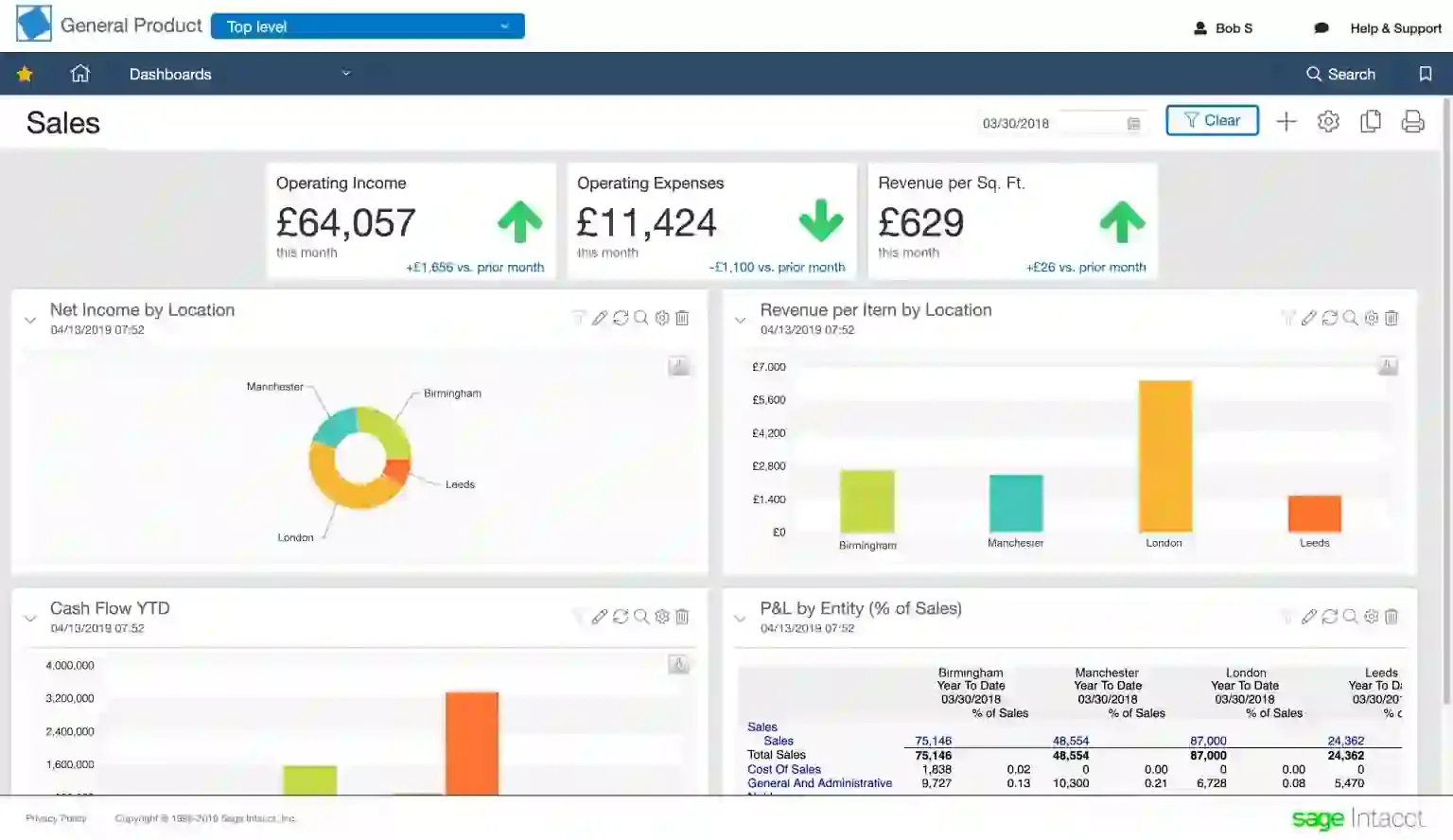
Sage Intacct is a cloud-native platform built for growing mid-market businesses. It excels in multi-entity environments where subsidiaries operate across different currencies, tax regimes, and reporting structures.
Its dimensional reporting lets finance teams slice data by department, project, or location without expanding the chart of accounts. This suits Australian businesses with operations across multiple markets.
Sage Intacct supports complex revenue recognition and lease accounting aligned with AASB standards, making it a strong fit for SaaS companies, professional services firms, and non-profits operating in Australia.
Best for: Sage Intacct is best for mid-market businesses managing multiple entities or subsidiaries, particularly those with cross-border operations that need consolidated reporting aligned to AASB and IFRS standards.
| Pros | Cons |
| ✓ Powerful multi-entity and multi-currency consolidation. | ×No public pricing; custom quote required. |
| ✓ Dimensional reporting without expanding the chart of accounts. | ×Steep learning curve for new finance teams. |
| ✓ Strong AASB and IFRS compliance out of the box. | ×Implementation typically requires specialist support. |
Pricing: Sage Intacct pricing is available on a custom quote basis. Costs vary based on modules selected, number of users, and level of implementation support required.
5. QuickBooks Online
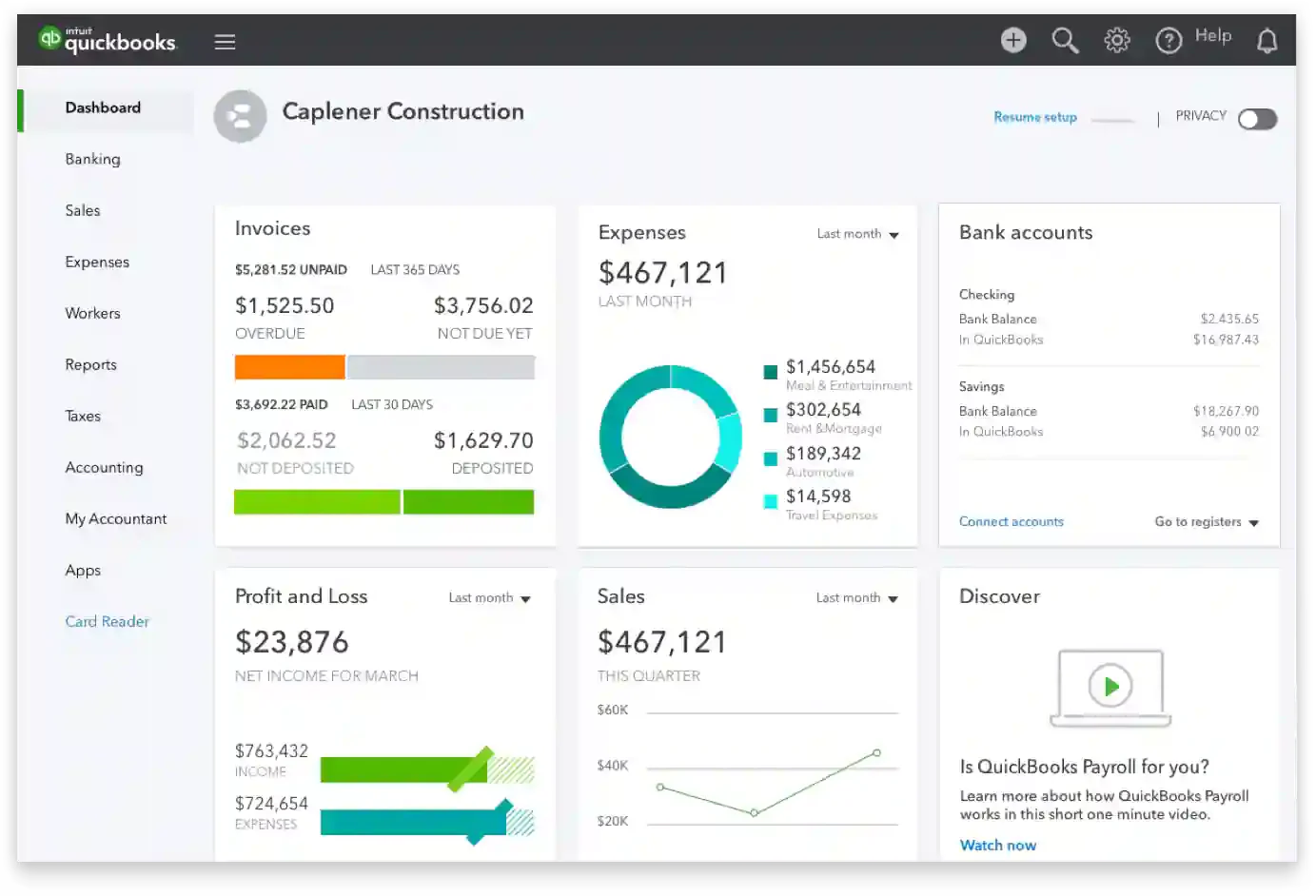
QuickBooks Online competes directly with Xero and MYOB in the Australian small business market. It offers GST support, BAS preparation, and intuitive mobile functionality at competitive price points.
The platform includes mileage tracking and receipt capture to support ATO deduction claims. These tools make QuickBooks Online popular among freelancers, contractors, and micro-businesses across Australia.
QuickBooks has also expanded its Live Bookkeeping feature in Australia, connecting owners with bookkeeping experts through the platform. This benefits small businesses without a dedicated finance function.
Best for: QuickBooks Online is best for freelancers, sole traders, and small businesses in Australia seeking affordable financial management software with solid GST compliance, mobile access, and access to bookkeeping support.
| Pros | Cons |
| ✓ Affordable entry-level pricing for sole traders and freelancers. | ×Limited scalability for growing mid-market businesses. |
| ✓ Mileage tracking and receipt capture built in. | ×Some AU-specific features lag behind Xero and MYOB. |
| ✓ Live Bookkeeping connects users with certified experts. | ×Advanced plan pricing increases significantly. |
Pricing: QuickBooks Online Australia plans start from AUD $15 per month for Simple Start, $30 per month for Essentials, and $55 per month for Plus. Advanced plans are available from approximately AUD $100 per month.
6. HashMicro
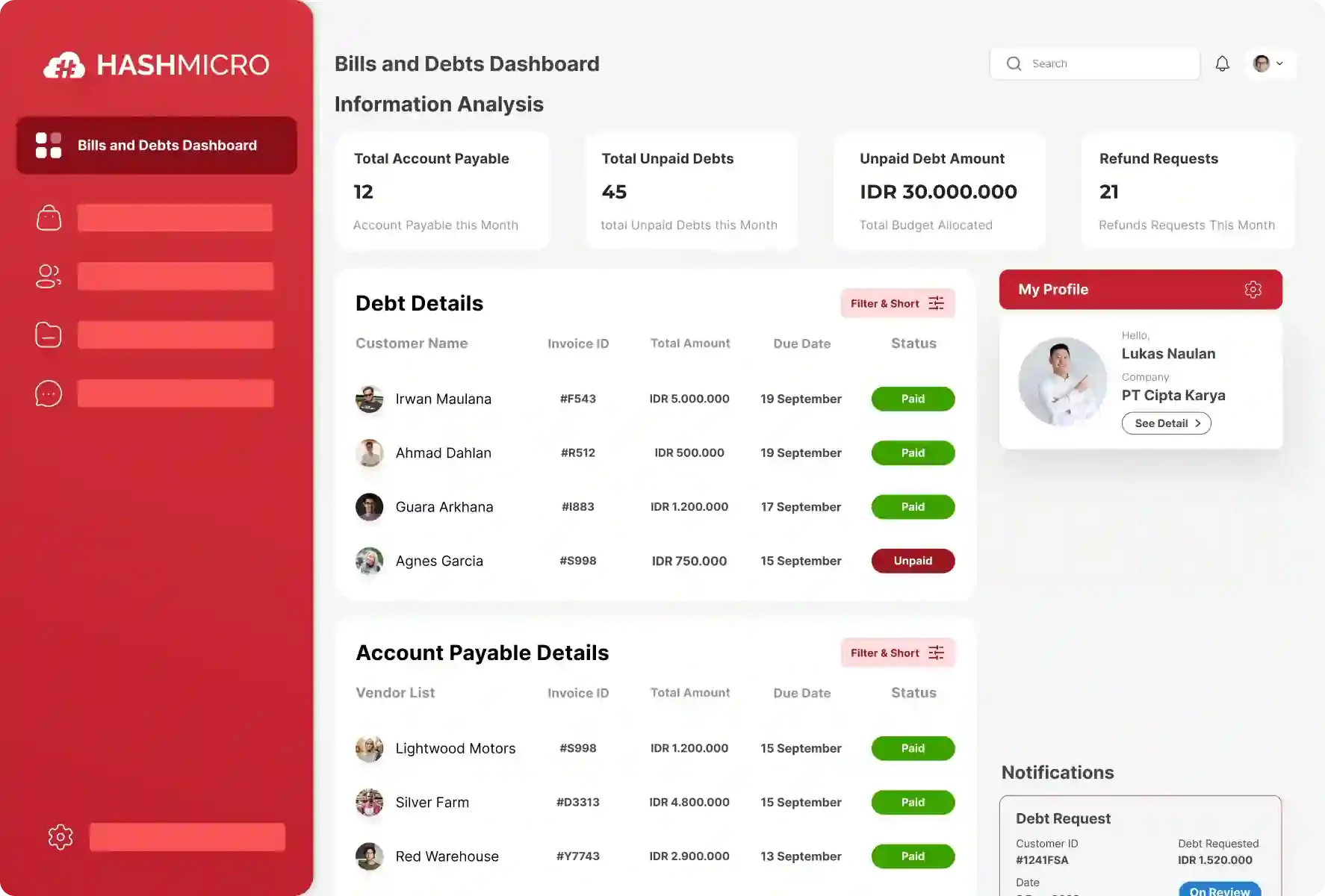
HashMicro is a comprehensive ERP platform that places financial management at the core of business operations. It integrates finance with inventory, procurement, manufacturing, and sales in one connected system.
This integration suits mid-market Australian businesses that have outgrown basic software. Finance teams gain real-time financial visibility into supply chain costs, project margins, and operational spend from one platform.
HashMicro is highly customisable, letting businesses adapt workflows to their operations while staying compliant with Australian tax requirements. It also supports multi-currency transactions across the Asia-Pacific region.
Best for: HashMicro is best for Australian mid-market businesses with operational complexity, where financial data must connect directly to inventory and production systems.
| Pros | Cons |
| ✓ Finance integrated with inventory, procurement, and production. | ×Custom pricing requires direct contact for a quote. |
| ✓ Highly customisable to specific operational workflows. | ×Implementation timeline longer than standalone accounting tools. |
| ✓ Multi-currency support across Asia-Pacific markets. | ×Better suited to mid-market than micro or solo businesses. |
Financial Management Software by Industry
The best software for a business often depends on the sector it operates in. Different industries have unique financial workflows and compliance requirements that a generic accounting platform may not handle efficiently.
1. Construction
In construction, financial management and project management are closely linked. Australian firms need to track progress claims under the Security of Payment Act, manage retention sums, and monitor job profitability in real time.
MYOB Advanced Construction and Procore integrations for Xero are widely used in this space. Verifying subcontractor ABN status and insurance coverage before payment is a key compliance step for builders in Australia.
2. Property and real estate
Property agencies and developers require trust accounting capabilities. This means managing client funds such as deposits and rent in compliance with state legislation, with audit trails to prevent commingling.
Specialised platforms with trust accounting modules are essential in this sector. Mismanaging trust funds can result in severe penalties under legislation, making software selection a compliance priority.
3. Manufacturing
For manufacturers, financial data must link directly to inventory and production. This includes work-in-progress tracking, bills of materials management, and cost of goods sold calculations.
A professional finance management platform gives manufacturing finance teams real-time visibility into the cost impact through out production. This is important for maintaining margins as costs continue to rise.
4. Professional services
Law firms, consultancies, and engineering firms depend heavily on time-and-materials billing. Financial management centres on time tracking, resource utilisation, and project-based invoicing to capture all billable work.
Strong integration between project management and the financial system is essential. Platforms is required to handle complex billing structures and give clear visibility into project margins and consultant utilisation.
Conclusion
Selecting the right financial performance management software is a consequential business decision. The best platforms in 2026 provide real-time visibility, compliance precision, and strategic insight.
For Australian businesses, the right platform balances global capability with local compliance depth. The core goal remains clarity, control, and compliance.
If you want to learn further about the best financial management softwares in Australia, consult the experts with our team today. You can start anywhere, anytime.

Frequently Asked Question
Xero and MYOB are the most widely used financial management tools in Australia, particularly among small and medium-sized businesses. Xero is preferred for its cloud-native design and app ecosystem, while MYOB is chosen for its deep local compliance and payroll capabilities.
Large Australian businesses and ASX-listed companies typically use enterprise-grade solutions such as SAP S/4HANA, Oracle NetSuite, or Sage Intacct. These platforms offer the scalability, multi-entity consolidation, and compliance depth required for complex global operations.
Accounting software focuses on recording transactions, bookkeeping, and basic reporting. Financial management software is broader, covering financial planning and analysis, risk management, asset tracking, and integration with HR and supply chain operations.
Yes, it is a practical necessity. In Australia, software must support STP Phase 2, GST calculations, and BAS reporting to meet ATO requirements. Using non-compliant software can result in reporting errors and significant penalties from the ATO.
Costs vary by business size. Small business plans for tools like Xero or QuickBooks typically range from AUD $15 to $85 per month. Mid-market and enterprise platforms like Wiise, NetSuite, or HashMicro are priced on modules and user count, requiring a custom quote.