















For many Australian businesses, transport problems do not start with trucks on the road, but with limited visibility, delayed decisions, and costs that are harder to control each day. When delivery expectations keep rising, relying on manual coordination or disconnected systems can quietly drain margin and weaken service quality.
That pressure is becoming harder to ignore in Australia, where the freight and logistics sector accounts for 8.6% of GDP, more than 75% of non-bulk domestic freight moves by road, and the total domestic freight task is projected to grow by 26% between 2020 and 2050.
This is why transportation management software is no longer just a logistics tool, but a smarter way to stay in control as transport complexity grows. With better route planning, carrier coordination, and shipment visibility, transportation management transportation management system helps businesses reduce friction, manage freight costs, and move goods with more confidence.
Key Takeaways
Transportation management software helps Australian businesses reduce freight costs, improve shipment visibility, and make faster transport decisions as logistics complexity continues to grow.
The best transport management software should support route optimisation, carrier coordination, real-time tracking, system integration, and daily usability rather than just basic transport execution.
Choosing the right transportation management system depends on how well the platform fits your operational scale, integration needs, transport model, and long-term business growth.
Emerging Trends Shaping the Future of Transportation Management
Transportation is no longer managed with static systems that only track shipments after problems appear. Modern transportation software solutions are evolving into more intelligent platforms that help businesses improve visibility, speed, and decision-making in real time.
- Artificial intelligence and machine learning: Modern transportation management system now uses AI to predict transit times more accurately and help teams respond faster to delays. Some systems can even recommend better routing decisions automatically based on real-time and historical data.
- IoT and telematics integration: Connected sensors give businesses real-time visibility into shipment conditions such as temperature, humidity, and shock exposure. This is especially important for industries like food, beverage, and pharmaceuticals, where product quality can change during transit.
- Sustainability and carbon tracking: Many businesses now expect transport management software to measure emissions as part of daily transport planning. Advanced platforms can track carbon emissions by shipment, helping companies reduce their environmental impact while supporting ESG goals and reporting requirements.
Measuring the ROI of Your Transportation Software
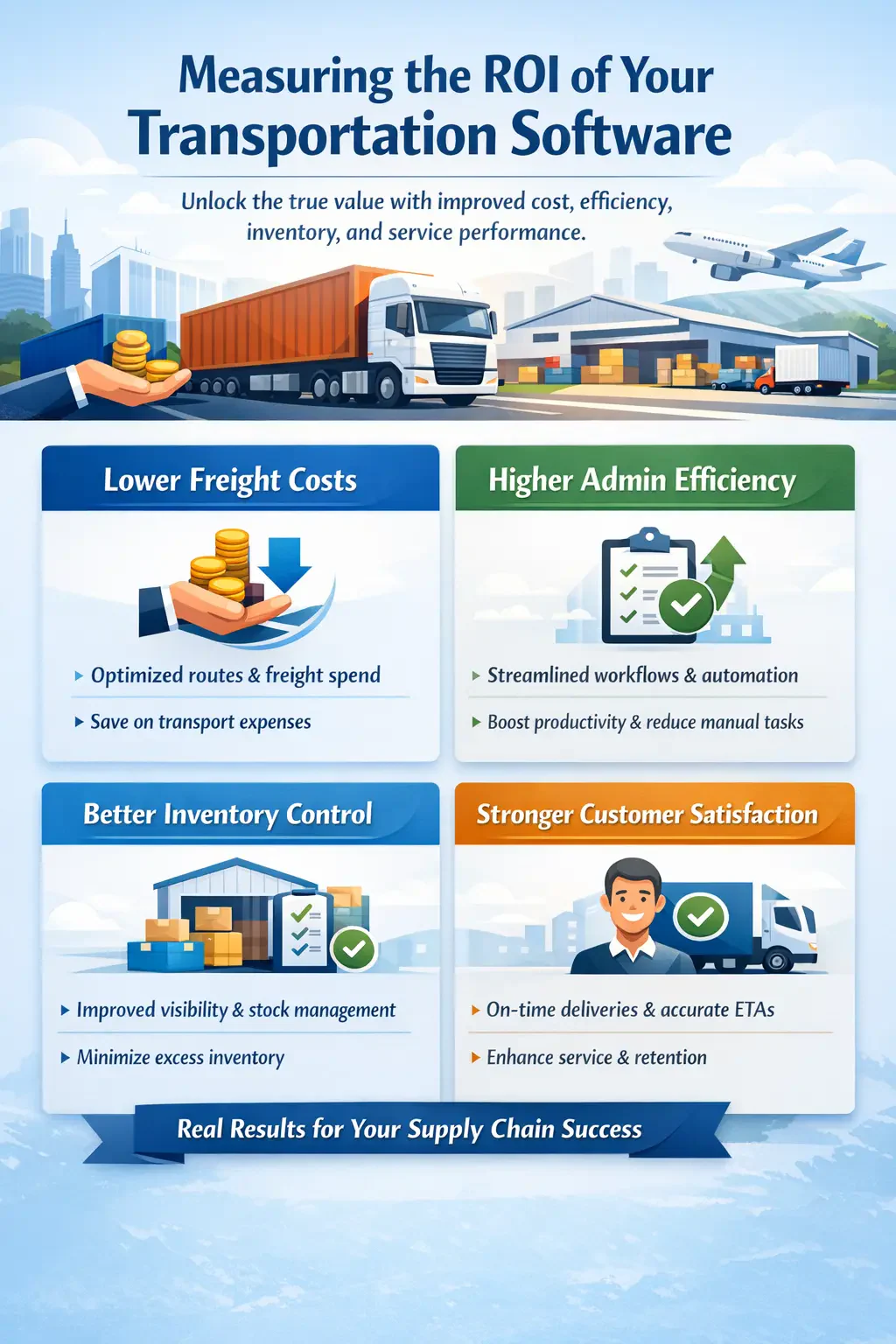
The value of transportation management system software should be measured not only by system usage, but by the business impact it creates over time. When implemented well, the right platform can improve cost efficiency, strengthen operations, and support better service performance across the supply chain.
- Lower freight costs: One of the clearest returns comes from reducing transport spend through better route planning, load consolidation, routing compliance, and freight audit controls.
- Higher administrative efficiency: Transportation management system software reduces manual work in tendering, tracking, and invoice checking, so teams can handle more shipments without adding the same level of headcount.
- Better inventory control: With more reliable inbound visibility, businesses can reduce safety stock and avoid holding excess inventory just to prepare for shipment uncertainty.
- Stronger customer satisfaction: Better delivery performance, proactive updates, and more accurate ETAs help improve the customer experience and support long-term retention.
How We Selected the Best TMS for Australian Businesses

Choosing the right transportation management transportation management system takes more than comparing brand names or checking who appears on a “top 10” list. We focused on the capabilities that help Australian businesses manage freight more efficiently today while staying ready for higher shipment volume, tighter delivery expectations, and more complex transport operations.
- We prioritised platforms that fit Australia’s transport reality, not just generic global use cases: With more than 75% of Australia’s non-bulk domestic freight moving by road, we focused on transportation management system software that can handle road-heavy operations, regional delivery complexity, and greater control across long distances.
- We looked beyond polished demos and vendor rankings: A system should prove its value in daily operations, not only during a sales presentation. That is why we favoured transportation management transportation management system that can improve routing, carrier coordination, tracking, and freight cost control in practical use.
- We gave strong weight to integration readiness: Software creates far more value when it connects smoothly with ERP, WMS, finance, and carrier systems. For that reason, we prioritised transport management software that supports easier integration and a faster path to operational results.
- We favoured systems that support smarter decision-making, not just basic execution: Modern transport teams need more than load tendering and static reports. The strongest transportation management transportation management system should help users flag exceptions early, recommend better actions, and respond faster when disruptions appear.
- We treated user adoption as a serious buying factor: Even the most advanced transportation management system software can underperform when teams still rely on spreadsheets, emails, and manual calls. We therefore prioritised platforms with a practical interface and a user experience that supports day-to-day adoption.
- We considered long-term fit, not just short-term functionality: Transport operations rarely stay simple for long. We selected transportation management transportation management system that can support business growth, broader carrier networks, additional freight modes, and stronger operational control without forcing a complete system replacement later.
- We treated multi-site visibility and real-time tracking as baseline requirements: Australian businesses operating across multiple depots or distribution centres need a TMS that maintains real-time visibility across all sites at once, not just a single hub. This is especially critical for interstate freight, regional distribution, or coordination with third-party carriers across different locations.
Conclusion
In today’s fast-moving business environment, managing freight efficiently is no longer optional. Transportation management transportation management system helps businesses improve visibility, control transport costs, and keep deliveries moving faster and with greater confidence.
The right platform does more than support daily operations. It gives businesses a stronger foundation to handle disruption, improve service performance, and scale transport operations with better control over time.
If your business is evaluating the next step, this is the right time to speak with specialists who understand both the technology and the operational challenges behind it. Get a free consultation with our experts to find the transportation management software that fits your business needs and helps you move freight more strategically.
FAQ About Transportation Management Software
Which TMS has the best NHVR Chain of Responsibility compliance features?
No single TMS is automatically the best for every Australian operator. A strong option is one that helps you manage NHVR-related obligations with features such as fatigue and driver records, load and mass checks, maintenance workflows, document retention, proof of delivery, and clear audit trails.
Can I switch TMS providers without losing historical shipment data?
Yes, in many cases you can switch providers without losing historical shipment data, as long as your current system can export records and your new TMS supports import or structured migration. Before switching, confirm what data can be moved, such as shipments, PODs, customer records, rate cards, and attachments, then keep a read-only backup of the old system until the migration is fully verified.
How long does TMS implementation take in Australia?
In Australia, cloud TMS implementation often takes days or weeks for simpler rollouts, while larger operations with ERP integrations, custom workflows, multiple depots, or change-management needs may take several weeks or longer. The timeline usually depends more on data quality, integrations, and process complexity than on software setup alone.
Do I need a TMS if I already use a 3PL provider?
Often yes, especially if you still need better visibility, carrier performance tracking, freight cost control, customer service, or coordination across multiple 3PLs and in-house transport. A 3PL handles execution, while a TMS helps you plan, monitor, audit, and optimise transport operations from your side.
What is the best cloud TMS in Australia?
The best cloud TMS in Australia depends on your business needs and operational complexity. Large enterprises often use SAP or Oracle Transportation Management, while businesses seeking integrated ERP and logistics capabilities may prefer HashMicro. Australian transport operators also commonly choose platforms like Kynection, TransVirtual, or Allotrac.io for local fleet and compliance management.
What’s the difference between TMS software and a freight broker portal?
TMS software manages end-to-end transport processes such as planning, carrier selection, booking, tracking, documentation, freight settlement, and reporting. A freight broker portal is usually narrower, focusing on accessing broker capacity, rates, and job bookings rather than giving you full operational control across your transport network.