














A procurement management system is an all-in-one digital platform that manages the procure-to-pay process in one place. It helps businesses handle vendor onboarding, purchase orders, invoicing, contracts, and spend analysis without relying on scattered spreadsheets or emails.
Managing procurement efficiently matters more as businesses navigate complex supply chains and tightening budgets. Procurement systems centralise purchasing, automate approvals, and give teams real-time visibility into spending.
A well-structured procurement system reduces costs, limits maverick spending, and improves supplier accountability. The Department of Finance outlines how procurement governance supports value for money across Australian businesses.
This guide covers the key features and benefits of procurement systems and explains how they help streamline purchasing, reduce errors, and support smarter spend management in your business.
Key Takeaways
Procurement plays a key role in improving operational efficiency, controlling costs, and ensuring timely delivery of goods and services, which ultimately drives business success.
Businesses often struggle with issues like maverick spending, supplier management, and inefficient procurement workflows, which can lead to cost overruns and delays.
Using a procurement management system in Australia helps streamline purchasing, improve supplier relationships, and ensure compliance with local regulations, resulting in cost savings and greater efficiency.
What is a Procurement Management System?
A procurement management system streamlines the entire purchasing process, from identifying needs to final payment. Unlike traditional methods, it proactively controls spending, ensuring real-time compliance with budgets and policies, helping businesses stay on track and reduce costs.
Over time, procurement has evolved from fragmented manual processes into digital systems. Modern platforms act as a unified procurement solution, connecting departments, automating approvals, and improving purchasing speed and accuracy.
Today’s procurement system goes beyond buying goods. It is a strategic tool for managing spend and mitigating risks. With full visibility into procurement activities, these systems help businesses optimise supplier relationships and achieve better terms, driving both efficiency and profitability.
How Does a Procurement System Work?

A procurement management system streamlines and automates the entire purchasing lifecycle, ensuring that every step is efficient, compliant, and transparent. Below is a breakdown of the key steps involved in the procurement process:
- Requisition and intake: The procurement process starts when an employee identifies a need for a product or service. In a procurement management system, users access a centralised portal, browse a catalogue of pre-approved items, or submit a free-text requisition if the item is not listed.
- Automated approval workflows: Once the requisition is submitted, the procurement system routes it through an automated approval process based on pre-set rules, such as cost or department. Approvers receive notifications and can quickly approve or reject requests in real time, reducing delays and bottlenecks.
- Purchase Order (PO) generation: Upon approval, the procurement system automatically converts the requisition into a formal Purchase Order (PO), detailing the specifications, price, and terms. The PO is then sent to the supplier, creating a financial commitment for accurate cash flow forecasting.
- Goods receipt and three-way matching: When goods are received, the system logs the delivery details and generates a digital receiving report. The procurement management system then compares the PO, receiving report, and invoice to ensure accuracy through a three-way match before approving the invoice.
- Invoice processing and payment: If the three-way match is successful, the procurement system automatically sends the invoice for payment, bypassing manual review. Any discrepancies trigger an exception process, allowing the team to address issues while compliant transactions move swiftly to payment.
The 7 Steps of the Procurement Process
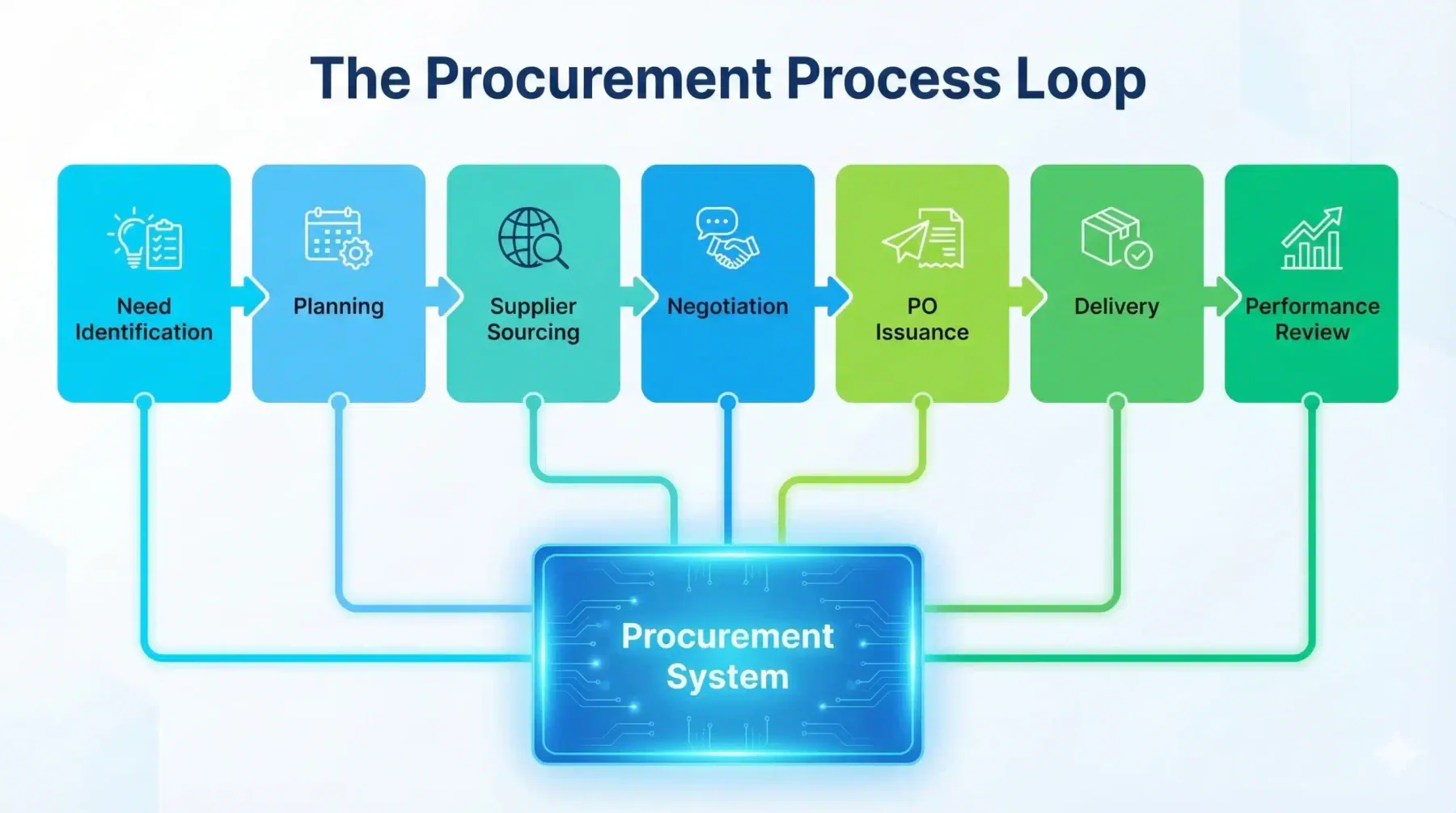
The procurement process ensures that businesses acquire the right goods and services at the best prices, while maintaining control over spending and supplier relationships. By following a structured approach, businesses reduce risks, improve operational efficiency, and build lasting supplier partnerships.
With the support of modern procurement systems, these steps are streamlined, automated, and managed more effectively, helping businesses stay on track from start to finish. Below are the seven key stages that make up the procurement journey:
1. Identifying business needs and requirements
The procurement journey begins when a business identifies its internal needs for goods or services essential for day-to-day operations or specific projects. This stage includes defining detailed specifications, quantities, and budgets, ensuring the procurement process starts with clear and aligned goals.
A procurement management system helps teams capture these needs in a structured way, providing a central point of reference for all stakeholders. This ensures that only necessary items are procured, avoiding waste and budget overruns.
2. Developing a procurement plan
Once needs are identified, the next step is to translate them into a formal procurement plan. This plan outlines procurement timelines, budget allocation, supplier expectations, and necessary approvals.
It serves as a roadmap for the procurement process, ensuring all aspects of the purchase are well-documented and aligned with the business’s goals. Using a procurement system allows teams to create and monitor detailed procurement plans, offering real-time tracking and budget oversight.
3. Sourcing and evaluating suppliers
At this stage, procurement teams begin searching for suppliers who can meet the specified requirements. Suppliers are evaluated based on several factors, including cost, reliability, delivery capability, and past performance.
Procurement systems provide a database of qualified suppliers and tools for comparison, making it easier to select the best-fit vendors. This ensures the business finds a supplier that meets technical and budgetary requirements while contributing to the business’s long-term success.
4. Negotiating terms and finalising contracts
Once a preferred supplier is identified, the negotiation process begins. Procurement teams work with suppliers to finalise pricing, delivery schedules, payment terms, and service agreements.
A procurement management system ensures all negotiation details are recorded and accessible to the relevant parties. This step focuses on securing favourable terms while building a strong, long-term relationship with the supplier.
5. Issuing purchase orders and confirming purchases
After agreements are in place, a formal purchase order (PO) is created to confirm the order details, including specifications, quantities, and prices. The PO serves as the official contract for the transaction, and the procurement system automates the creation and dispatch of these orders, ensuring accuracy and reducing manual errors.
This step establishes a clear record of commitment, aligning all stakeholders on the financial and operational aspects of the procurement.
6. Receiving goods and verifying deliveries
Once goods or services are delivered, the receiving team verifies that the order matches the original purchase order in terms of quantity, quality, and specifications. Using a procurement management system, the team records the receipt and flags any discrepancies for resolution.
This step ensures that the supplier meets their obligations and that the business only pays for what has been delivered as agreed.
7. Evaluating supplier performance and managing relationships
The final step involves reviewing the supplier’s performance, including the quality of goods, timeliness of delivery, and overall service. This evaluation helps identify areas for improvement, ensures compliance, and strengthens the relationship for future purchases.
Procurement systems provide valuable data on supplier performance, allowing teams to make informed decisions about future collaborations. This ongoing assessment helps businesses refine their procurement strategies and optimise their supply chain.

Types of Procurement Systems
Choosing the right procurement management system is crucial for businesses looking to optimise their purchasing processes. Each type of procurement system offers different advantages depending on the business’s size, industry, and technological needs.
Below are the key types of procurement systems to consider:
- Standalone procurement software: These systems focus solely on procurement functions such as e-sourcing and contract management, offering specialised, advanced features. However, they require integration with other systems, like ERP, to ensure seamless data flow.
- Integrated ERP procurement modules: These modules are embedded in broader ERP systems, linking procurement with finance, inventory, and other functions. For example, when a purchase order is approved, inventory records are updated automatically upon goods receipt, while the finance module simultaneously records committed costs and supplier liabilities in real time.
- Cloud-based procurement systems: Cloud-based systems provide flexibility, accessibility, and automatic updates, making them ideal for remote teams. They offer lower upfront costs and a subscription model, making them accessible to businesses of all sizes.
- On-premise procurement solutions: On-premise solutions give businesses full control over their data and infrastructure. However, they come with high upfront costs, maintenance requirements, and limited scalability compared to cloud-based systems.
- Hybrid procurement systems: Hybrid systems combine cloud and on-premise solutions, offering flexibility and security. They suit businesses that need to comply with regulations while benefiting from cloud scalability.
- E-procurement systems for B2B transactions: E-procurement systems streamline B2B transactions, allowing businesses to manage orders and supplier relationships electronically. They automate and simplify purchasing processes, improving efficiency and collaboration.
If you are ready to compare specific platforms, our dedicated guide to procurement software in Australia covers the top-rated systems by category, pricing model, and industry fit.
Key Features to Look For in Procurement Management Software

Choosing the right purchasing management software is essential for improving efficiency and maintaining budget control. Below are the key capabilities that streamline procurement and deliver greater value to your business.
- Speedy purchase order creation that eliminates manual work: Automate your purchase order process to quickly generate and send POs, eliminating the need for manual data entry. A procurement system auto-fills details using pre-approved templates, ensuring accuracy and saving time.
- Efficient supplier management for stronger vendor relationships: Keep track of supplier performance, contracts, and pricing history all in one place. A procurement management system helps you make data-driven decisions and easily manage vendor relationships, ensuring smooth operations.
- Budget control to keep spending in check: Set clear spending limits within your procurement system to prevent budget overruns. The system automatically blocks purchases that exceed these limits, giving you greater control over your finances.
- Real-time order tracking for transparency and peace of mind: Track the status of each order, from approval to delivery, in real time. With a procurement system, you can stay up to date on every order and ensure timely deliveries, avoiding surprises and delays.
- Powerful reporting and analytics for smarter decision-making: Turn procurement data into valuable insights with customisable reports and dashboards. A procurement system lets you analyse trends, track performance, and identify opportunities for savings and efficiency improvements.
- Mobility for procurement management anywhere: With mobile access to your procurement system, you can approve orders, check inventory, and communicate with suppliers from anywhere. This flexibility ensures that procurement tasks continue to run smoothly, even when you are on the move. This is particularly critical for manufacturing and distribution businesses managing high-volume goods movement
-
Procure-to-pay automation that connects purchasing to payment: A procure-to-pay feature links every stage of the purchasing cycle, from requisition and approval through to goods receipt and final payment. Teams gain full visibility over committed spend, pending invoices, and payment status without switching between systems.
Benefits of Using a Procurement Management System

A procurement management system delivers measurable results when it replaces manual processes. The benefits below reflect what Australian businesses typically see within the first year of implementation.
1. Reduced maverick spending and budget overruns
When purchasing happens outside approved channels, budget visibility breaks down. A procurement system enforces approved supplier lists and spending limits at the point of requisition, before a purchase is committed rather than after the invoice arrives.
For Australian businesses with multiple cost centres or project-based budgets, this control is particularly valuable. Budget managers see committed spend in real time instead of discovering overruns at month-end.
2. Faster procure-to-pay cycles
Manual three-way matching between purchase orders, goods receipts, and invoices is one of the slowest parts of accounts payable. A procurement system automates this process, clearing compliant invoices for payment without human intervention and routing exceptions for review.
Businesses that automate three-way matching typically cut invoice processing time by 30 to 45 per cent. Suppliers receive payment faster, which often supports better pricing negotiations at contract renewal.
3. GST and compliance documentation handled automatically
Every purchase in a GST-registered business generates a tax record that must be accurate, time-stamped, and retrievable for up to five years. A procurement system creates this audit trail at the point of purchase, not retrospectively.
For businesses subject to the Commonwealth Procurement Rules, Modern Slavery Act reporting, or state-level procurement frameworks, this automatic documentation significantly reduces compliance preparation time ahead of audits or annual reporting deadlines.
4. Supplier performance visibility that improves contract outcomes
Without structured data, supplier reviews are subjective and inconsistent. A procurement system tracks delivery times, invoice accuracy, quality rejection rates, and contract compliance across every supplier and every purchase.
Procurement teams use this data to renegotiate terms with underperforming suppliers, consolidate spend with high performers, and make evidence-based decisions at contract renewal. Over time, this visibility improves supply chain reliability and reduces the cost of supplier disputes.
5. Enhanced transparency and accountability
Transparency in procurement activities is vital for internal oversight and external audits. A procurement system centralises all purchase records, providing clear visibility into every stage of the procurement process.
This increases accountability by ensuring that all transactions are tracked and approvals are documented in real time. With this transparency, businesses can detect irregularities early, prevent unauthorised spending, and maintain compliance with internal policies and regulatory requirements.
6. Data-driven decision making for strategic growth
A procurement management system provides timely and accurate data on suppliers, contracts, and spending patterns, which helps businesses make informed decisions. By consolidating procurement data into actionable insights, businesses can identify cost-effective suppliers, negotiate better terms, and reduce inefficiencies.
The system enables teams to monitor key metrics and trends, guiding strategic decisions that drive business growth. This data-driven approach allows businesses to optimise their procurement strategies and stay competitive in the marketplace.
How a Queensland Building Contractor Cut Procurement Costs by 22%
Company profile: Mid-sized construction contractor based in Brisbane (company name withheld by request). Annual revenue: approximately $28 million. Workforce: 85 employees across four active project sites. Annual procurement volume: $6.2 million across materials, subcontractors, and equipment hire.
The problem: The business managed procurement across multiple sites using spreadsheets and email-based approvals. Purchase orders were inconsistent between project managers, three-way matching happened manually, and the accounts team ran 30 to 45 days behind on invoice reconciliation. Budget overruns on individual site budgets only became visible at month-end, by which point the damage was already done.
What they implemented: The business deployed a centralised cloud-based procurement system in Q1 2024. Every purchase order linked directly to a project cost code, giving site managers and the CFO a real-time view of committed spend versus approved budget. Approval workflows became standardised across all four sites, and three-way matching automated the invoice verification process.
Results within 12 months:
- Procurement costs dropped 22% against the prior year
- Invoice processing time fell 43%, from an average of 18 days to 10 days per invoice
- On-time supplier delivery improved from 71% to 88%
- The finance team recovered approximately six hours per week previously spent chasing approvals
The procurement lead described the most significant win not as the cost saving itself, but as the ability to catch budget overruns within the same week rather than discovering them at month-end.
What Australian Businesses Need to Know Regarding Procurement
Procurement in Australia operates within a layered compliance environment that goes beyond simply finding the lowest price. Businesses that understand the relevant frameworks avoid costly penalties, qualify for more government contracts, and build supply chains that hold up under scrutiny.
Commonwealth Procurement Rules (CPRs)
The Commonwealth Procurement Rules apply to all Australian Government entities and set mandatory requirements for value for money, open competition, and record-keeping. Businesses that supply to federal government agencies must understand these rules because government buyers are legally required to follow them in every purchasing decision.
A procurement management system helps businesses align their own processes with CPR expectations, making it easier to win and retain government contracts. Procurement teams can track compliance documentation, maintain supplier records, and produce audit-ready reports without manual effort.
Queensland Procurement Policy (QPP) 2026
Queensland updated its procurement policy framework in January 2026 under the Queensland Procurement Policy 2026. The new framework places greater emphasis on local content, First Nations supplier participation, and social procurement outcomes alongside value for money. Businesses supplying to Queensland Government entities now face stricter expectations around reporting local spend and demonstrating community benefit.
For businesses operating in Queensland, a procurement system that tracks supplier origin, contract value, and local content percentages makes QPP 2026 compliance far more manageable. Manual tracking across large supplier bases is neither accurate nor scalable.
GST compliance in procurement workflows
Every purchase in a GST-registered business generates a tax obligation that must be accurately recorded and reported on the BAS. A procurement management system automates GST calculations at the point of purchase order creation, reducing the risk of under-reporting or over-claiming input tax credits.
The ATO can audit procurement records for up to five years, so maintaining a clean, time-stamped record of every purchase order, invoice, and three-way match is essential. Digital procurement systems create this audit trail automatically.
AusTender and state procurement portals
Businesses tendering for Commonwealth contracts must register on AusTender, the Australian Government’s procurement information system. New South Wales businesses working with government use buy.nsw, while Victoria, Queensland, and Western Australia each run their own platforms.
A procurement management system that integrates with these portals reduces the administrative burden of managing multiple tender submissions, tracking contract milestones, and reporting supplier performance back to the relevant procurement authority.
Modern Slavery Act 2018
Businesses with annual consolidated revenue above $100 million must submit an annual Modern Slavery Statement under the Modern Slavery Act 2018. The statement must identify modern slavery risks in operations and supply chains and describe the actions taken to address them.
For procurement teams, this means supplier due diligence cannot stop at price and delivery capability. A procurement system that logs supplier information, flags high-risk supply chain relationships, and stores evidence of due diligence activities supports compliance and reduces the risk of a non-compliant statement.
PPSR (Personal Property Securities Register)
When procuring assets or entering supply agreements, businesses should check the Personal Property Securities Register to confirm there are no existing security interests over the goods. Buying encumbered goods without checking the PPSR can expose a business to significant legal and financial risk.
Building a PPSR verification step into your procurement workflow, supported by your procurement system’s checklist and approval controls, protects the business from this exposure at the point of purchase rather than after a dispute arises.
ISO 20400 — Sustainable Procurement
ISO 20400 provides internationally recognised guidance for embedding environmental and social sustainability into procurement decisions. Australian businesses adopting the standard can meet growing ESG reporting expectations, reduce supply chain environmental impact, and demonstrate supplier accountability to investors and customers.
A procurement management system supports ISO 20400 adoption by enabling sustainability criteria to be embedded into supplier evaluation, tender assessment, and ongoing performance monitoring.
How to Choose the Right Procurement Management System for Your Business
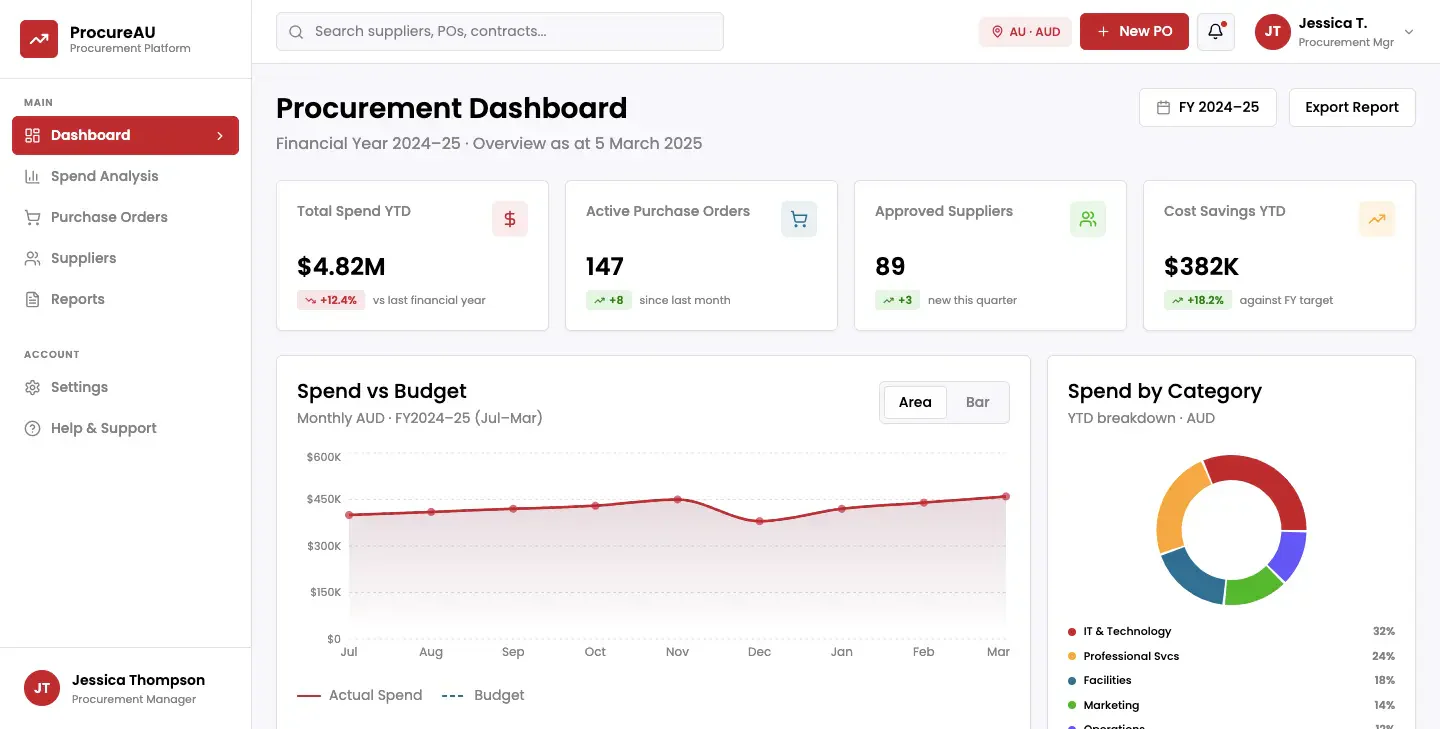
Choosing the right procurement management system is not just about picking the one with the most features, but finding one that fits your workflows, budget control needs, and collaboration style with vendors. Use this checklist to make a quicker, smarter decision and see tangible results in your operations.
- Identify your most critical needs: Define the processes that cause the most delays or require frequent revisions, such as multi-step approvals, budget control, or invoice matching. From there, you can filter out procurement systems that are truly relevant to your needs, rather than just adding “nice to have” features.
- Check integration capabilities with existing systems: Ensure the procurement system can seamlessly connect with your current ERP, accounting, inventory, or HR/payroll systems. Smooth integration with leading ERP and accounting platforms reduces duplicate data entry and makes cost reporting much more organised.
- Test ease of use for non-procurement users: The system should be easy for requesters and approvers to use, not just the procurement team. Look for simple, clear workflows for request, approve, and PO processes with minimal clicks.
- Ensure strong control and governance: Verify whether the system offers approval rules based on value, department, project, or vendor, along with a clear audit trail. These controls help maintain internal compliance without making processes too rigid.
- Check scalability for future growth: Choose a system that remains stable as transactions increase, new branches open, or more categories are added. If it is not scalable, your team will end up back in manual workarounds.
- Compare costs with business impact: Do not focus only on licensing fees; calculate the potential time savings, error reductions, and visibility into spending. The right procurement management system typically delivers quick ROI through more organised approval and purchasing processes.
- Check vendor support and implementation: Ensure the system provides proper onboarding, training, support SLA, and a clear development roadmap. A smooth implementation ensures faster adoption and consistent results across teams.
Conclusion
Choosing the right procurement management system is essential for improving efficiency, cost control, and supplier relationships. Aligning the system with your business needs streamlines the procurement process and creates the compliance documentation Australian regulations require.
A well-implemented system delivers measurable results: lower maverick spending, faster invoice cycles, GST-ready audit trails, and supplier data that supports better contract outcomes. Automation and real-time visibility reduce risk and free procurement teams to focus on strategic sourcing rather than chasing paperwork.
HashMicro’s procurement module covers the full procure-to-pay cycle, from requisition and approval to three-way matching and BAS-ready reporting. Schedule a free demo with our team to see how it fits your workflows.
FAQ About Procurement Management System
What are the 5 P’s of procurement?
The 5 P’s of procurement refer to Price, Place, Product, Process, and People. These elements guide a successful procurement strategy:
– Price: Ensuring competitive pricing for goods or services.
– Place: Selecting reliable suppliers and distribution channels.
– Product: Ensuring the correct quality and specifications of the product.
– Process: Establishing clear and effective procurement procedures.
– People: Managing supplier relationships and ensuring skilled procurement staff.
What is the difference between procurement and purchasing in Australia?
Purchasing refers to the transactional act of buying goods or services, while procurement covers the full process including supplier selection, contract negotiation, compliance, and spend management. In Australia, procurement also involves adhering to frameworks such as the Commonwealth Procurement Rules and relevant ATO obligations.
Does the procurement management system support Peppol eInvoicing for Australian government suppliers?
Yes. The system supports Peppol eInvoicing in line with the ATO’s eInvoicing framework, allowing businesses to send and receive structured invoices electronically. This reduces manual data entry, speeds up payment cycles, and supports compliance for businesses supplying to Australian government agencies.
Can the procurement system integrate with AusTender, buy.nsw, and other Australian government tender platforms?
Yes. The system can integrate with government procurement platforms including AusTender and buy.nsw, helping businesses manage tender submissions, track opportunities, and maintain compliance with Australian government procurement requirements from a single platform.
Does the system support 3-way matching?
Yes. The system automates three-way matching by comparing the purchase order, goods receipt, and supplier invoice before approving payment. This reduces invoice errors, prevents overpayment, and ensures every transaction is verified before funds are released.