















Modern organizations must balance business performance with employee development. Performance management today is no longer limited to annual reviews, but has evolved into a continuous process that focuses on feedback, improvement, and professional growth.
One important tool within this process is the Performance Improvement Plan (PIP). When used correctly, a PIP helps organizations address performance gaps while giving employees a clear opportunity to improve and realign with expectations.
This guide explains what a Performance Improvement Plan is, when it should be used, and how organizations can implement it effectively to support both employee development and business performance.
Key Takeaways
Understand what a Performance Improvement Plan is and how organizations use it to address performance gaps and guide employee improvement.
Identify the warning signs that indicate an employee may require structured performance intervention.
Learn the main objectives of a Performance Improvement Plan and how it supports employee development.
Explore the key components of an effective Performance Improvement Plan including goals, timelines, and support resources.
Industry Specific Use Cases for Performance Improvement Plans
Although the core principles of a Performance Improvement Plan remain consistent, its application often varies across industries. Different roles rely on distinct performance metrics, operational workflows, and regulatory standards.
Because of this, organizations typically tailor PIPs to match the specific responsibilities and performance indicators of each role. Aligning the plan with industry expectations ensures that improvement goals remain practical and relevant.
The following examples illustrate how PIPs are commonly used across several major industries.
Technology and Software Development
In technology teams, performance challenges often appear through missed sprint goals, low development output, or recurring software defects. Because technical work is highly measurable, improvement plans usually rely on clear productivity metrics.
For example, a developer may be expected to complete a certain number of story points per sprint or reduce the number of code revisions during peer reviews.
A PIP in this environment typically focuses on technical training, stronger code review practices, and improved collaboration with engineering teams.
Sales and Business Development
Sales roles are heavily driven by measurable performance targets. When employees consistently miss quotas or struggle to build a reliable sales pipeline, organizations may introduce a Performance Improvement Plan.
Sales PIPs often include specific activity targets such as call volumes, meetings scheduled, or proposals delivered within a defined timeframe.
In addition to numerical targets, improvement plans may include coaching sessions, sales training, and closer supervision from experienced sales managers.
Healthcare and Clinical Settings
In healthcare environments, performance management must prioritize patient safety and regulatory compliance. Even small mistakes can have significant consequences for both patients and healthcare providers.
A PIP in this sector may focus on improving clinical documentation accuracy, adherence to medical protocols, or communication with patients and colleagues.
Improvement plans frequently involve additional supervision, compliance training, and ongoing performance reviews to ensure healthcare standards are consistently maintained.
Customer Service and Support
Customer service teams are typically evaluated based on communication quality and service efficiency. Metrics such as response time, customer satisfaction scores, and issue resolution rates are commonly used indicators.
When performance falls below expectations, a PIP may require employees to improve response times, enhance communication with customers, or follow service protocols more consistently.
Coaching sessions, call monitoring, and targeted training programs are often used to support employees during the improvement period. A unified customer support platform can also help improve the employees performance and their productivity overall.
Step by Step Process to Implement a PIP
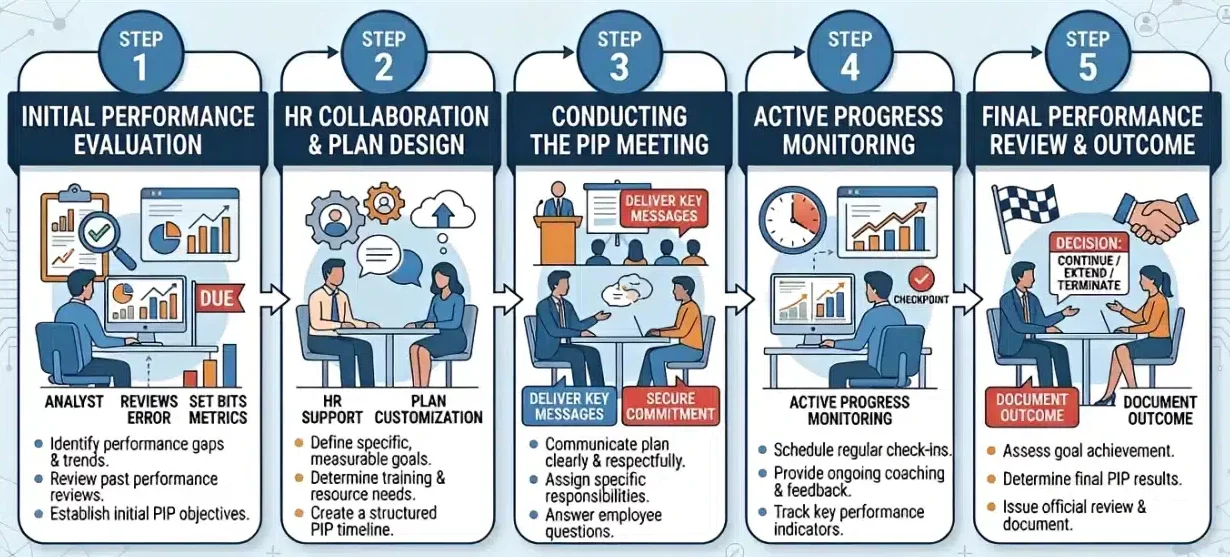
Implementing a Performance Improvement Plan requires careful planning and consistent communication. A structured process ensures that the intervention remains fair, transparent, and supportive for both managers and employees.
Rather than being treated as a sudden disciplinary measure, a PIP should follow a clear sequence of steps. This approach helps organizations diagnose performance problems, provide meaningful support, and evaluate results objectively.
The following steps outline a common process used by HR teams when introducing a Performance Improvement Plan.
Step 1: Preliminary Analysis and Evidence Gathering
Before initiating a PIP, managers must gather clear evidence of the employee’s performance challenges. This may include performance reports, project outcomes, client feedback, or documented discussions from previous evaluations.
Collecting objective data ensures that the improvement plan is based on measurable performance indicators rather than personal opinions.
This preparation stage also helps managers identify the root causes of the issue before designing the improvement strategy.
Step 2: Collaborative Drafting with Human Resources
Managers should work closely with the human resources department when drafting a Performance Improvement Plan. HR ensures that the document follows company policy and maintains fairness across the organization.
During this stage, managers define clear performance goals, evaluation timelines, and the support resources available to the employee.
Collaboration with HR also helps ensure that the plan is legally compliant and aligned with broader organizational standards.
Step 3: The Delivery Meeting
Once the plan is prepared, managers should schedule a formal meeting with the employee to present the document. This discussion must be handled with clarity, professionalism, and empathy.
Managers should explain the performance concerns, review each improvement goal, and clarify the resources available to support the employee.
The purpose of this meeting is to ensure that the employee understands the expectations and feels encouraged to engage in the improvement process.
Step 4: Regular Monitoring and Feedback
A PIP requires consistent monitoring throughout the evaluation period. Managers should schedule regular check ins to review progress and provide constructive feedback.
These meetings allow both parties to discuss improvements, address obstacles, and adjust strategies when necessary.
Frequent communication helps maintain transparency and ensures the employee remains focused on achieving the improvement goals.
Step 5: Final Evaluation and Outcome Determination
At the end of the evaluation period, managers conduct a formal review to determine whether the employee has met the objectives outlined in the PIP.
If the employee successfully meets the required goals, they may return to normal performance monitoring. Continued development support may also be provided to sustain improvement.
However, if performance remains below expectations, organizations may consider reassignment, extended improvement plans, or further disciplinary action according to company policy.
Common Pitfalls When Managing a PIP
Even when organizations intend to support employee development, Performance Improvement Plans can fail if they are implemented incorrectly. Poorly designed plans may create confusion, reduce trust, and make improvement difficult to achieve.
Understanding the most common mistakes helps managers administer PIPs more effectively while maintaining fairness and transparency throughout the process.
Common pitfalls include:
- Creating vague goals
Improvement plans must contain clear and measurable objectives. Vague expectations such as “improve communication” or “perform better” make it difficult for employees to understand what success looks like. - Using a PIP only as termination documentation
Some organizations misuse PIPs as a formal step before termination rather than a genuine opportunity for improvement. When employees feel the outcome is predetermined, motivation and engagement decline. - Lack of managerial support
A PIP requires active involvement from managers. Without regular guidance, feedback, and coaching, employees may struggle to meet improvement goals. - Changing expectations during the process
Adjusting targets or adding new requirements during the evaluation period creates confusion and undermines trust. Expectations should remain consistent throughout the plan.
Advanced Practices in Modern Performance Management
Modern organizations are evolving beyond traditional performance management models. Instead of relying only on formal interventions, many companies adopt proactive strategies that support employee growth earlier in the process.
These advanced practices help reduce the need for formal PIPs while strengthening employee development and organizational performance.
Pre PIP or Early Performance Warnings
Some organizations implement early intervention steps before initiating a formal Performance Improvement Plan. These informal coaching periods are sometimes referred to as “Pre PIPs.”
During this stage, managers provide clear feedback and short term improvement goals. This allows employees to address performance concerns before a formal HR process becomes necessary.
Early intervention often reduces stress for employees while preventing minor issues from becoming long term performance problems.
Peer Mentorship Programs
Peer mentorship is another strategy that supports employee development during performance improvement. Instead of relying solely on managers, organizations pair struggling employees with experienced colleagues.
Mentors can provide practical guidance, share effective work strategies, and offer daily feedback. This collaborative approach often feels less formal and more supportive than traditional supervision.
Peer mentorship also strengthens knowledge sharing and team collaboration across the organization.
Psychological Safety During PIP
Being placed on a PIP can create significant stress for employees. Anxiety and fear of failure may actually reduce performance if the process is not handled carefully.
Organizations that prioritize psychological safety ensure that employees feel respected and supported throughout the improvement period.
Managers play a key role by encouraging open communication, providing constructive feedback, and focusing on development rather than punishment.
Post PIP Maintenance Plans
Even after successfully completing a PIP, continued support is important to maintain performance improvements. Some organizations implement short post PIP monitoring periods to ensure progress remains consistent.
During this phase, managers conduct periodic check ins and provide additional guidance if necessary. This helps reinforce positive behaviors and prevents employees from returning to previous performance challenges.
By maintaining structured follow up support, organizations can ensure long term performance improvement and stronger employee development.
Conclusion
Performance Improvement Plans help organizations address performance challenges in a structured and professional way. By clearly defining expectations, measurable goals, and evaluation timelines, companies can guide employees toward meaningful improvement.
When implemented correctly, a PIP becomes more than a corrective measure. It encourages transparency, strengthens accountability, and supports employee development while maintaining organizational performance standards.
If your organization is looking to improve performance management processes, request a free consultation with our professional team to explore how integrated HR software can help manage employee performance more effectively.
Frequently Asked Questions About Performance Improvement Plans
What is a Performance Improvement Plan (PIP)?
A Performance Improvement Plan (PIP) is a structured document used by managers and HR teams to address employee performance issues. It outlines specific performance gaps, improvement goals, timelines, and support resources to help employees meet organizational expectations.
When should a manager use a Performance Improvement Plan?
Managers typically use a Performance Improvement Plan when an employee consistently fails to meet performance expectations, such as declining work quality, missed deadlines, or behavioral issues that affect team collaboration.
How long does a Performance Improvement Plan usually last?
Most Performance Improvement Plans last between 30 and 90 days. The timeline depends on the role, the severity of the performance issues, and the amount of improvement required.
What happens if an employee fails a Performance Improvement Plan?
If an employee does not meet the required improvement goals within the evaluation period, organizations may consider further disciplinary action, role reassignment, or termination according to company policy.
Can employees succeed after being placed on a PIP?
Yes. Many employees successfully complete a Performance Improvement Plan when clear goals, regular feedback, and proper support are provided. A well implemented PIP focuses on development rather than punishment.