















Managing employees in Australia means working within one of the more detailed industrial relations systems globally. For business owners and HR managers, payroll is not just about sending salaries on time. It directly affects compliance, financial reporting, and employee trust.
Australia’s regulatory framework includes the Fair Work Act, modern awards, and ongoing tax and reporting obligations, all of which employers must follow carefully. Errors in wage calculations or submissions can lead to penalties, which is why payroll management remains a key part of staying compliant in 2026.
Key Takeaways
Payroll in Australia requires constant compliance monitoring, as tax tables, superannuation rates, and award conditions change frequently.
Modern payroll systems must prioritise automation, integration, and real-time accuracy to reduce errors and administrative burden.
Industry specific payroll challenges such as RDO tracking, higher duties, and driver fatigue compliance require tailored system configuration.
When managed strategically, payroll strengthens company trust, improves operational efficiency, and supports long-term business growth.

What Is Payroll Management?
Payroll management covers the administration of a company’s financial obligations to its employees. This includes calculating wages, withholding taxes, and processing payments in line with employment contracts and legal requirements. In Australia, however, payroll goes beyond basic calculations.
On a practical level, payroll means tracking ordinary hours, overtime, leave balances, and allowances under the relevant awards or agreements. Pay rates and classifications must stay accurate, especially when regulations change. Even small mistakes can create compliance issues over time.
Payroll also has a direct impact on budgeting. Wages and related costs often make up a large portion of total expenses, so clear records help businesses plan hiring and manage cash flow more carefully.
In Australia, payroll is closely tied to government reporting. Employers must handle PAYG withholding, superannuation contributions, and submissions to the Australian Taxation Office. Proper record-keeping is necessary for both compliance and audit purposes.
Payroll management serve as the solution for people management of many large companies and has been considered as a point-of-parity (POP).
The 5 Steps of the Payroll Process
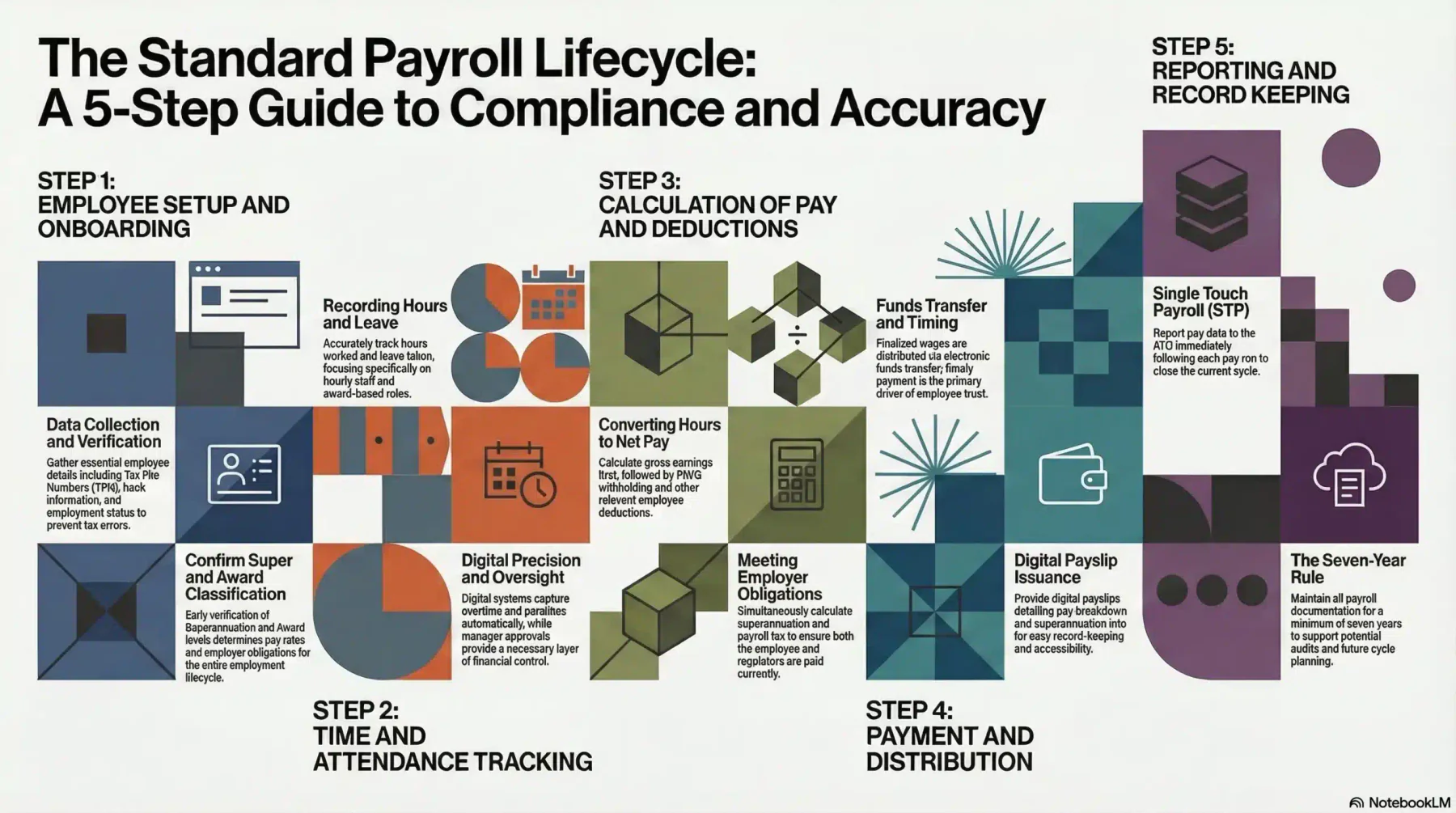
The payroll process generally follows a consistent structure across businesses, regardless of the system used. Its purpose is to ensure employees are paid accurately, on time, and in line with compliance requirements.
Understanding these core steps helps businesses identify inefficiencies and improve payroll accuracy. A clear process also reduces compliance risks and operational delays.
1. Employee Setup and Onboarding
Payroll begins during onboarding, when employee details such as TFN, bank information, and employment status are collected and verified. Incorrect or missing data at this stage can lead to tax errors and compliance issues.
Superannuation and Award classification must also be confirmed early. These factors determine pay rates, entitlements, and employer obligations throughout the employment lifecycle.
2. Time and Attendance Tracking
Once employees start work, businesses must accurately record hours worked and leave taken. This is especially important for hourly staff and award-based roles.
Digital time-tracking systems help capture overtime, penalties, and public holiday work correctly. Manager approval of timesheets adds a layer of control before payroll is processed.
3. Calculation of Pay and Deductions
This stage converts approved hours into net pay. Gross earnings are calculated first, followed by PAYG withholding and other deductions.
At the same time, employer obligations such as superannuation and payroll tax are calculated. Accurate calculations ensure both employees and regulators are paid correctly.
4. Payment and Distribution
After calculations are finalised, wages are paid to employees, usually via electronic funds transfer. Timely payments are critical for maintaining employee trust.
Payslips must also be issued, showing pay details and superannuation information. Most businesses now deliver payslips digitally for easier access and record keeping.
5. Reporting and Record Keeping
Payroll reporting closes the cycle. Under Single Touch Payroll, pay data is reported to the ATO after each pay run.
Businesses must also maintain payroll records for seven years. Proper documentation supports audits and ensures the next payroll cycle starts smoothly.
Payroll Compliance in Australia

Australia has one of the stricter payroll compliance environments, built to protect employee rights and maintain proper tax collection. Compliance requirements change regularly, so employers must review payroll processes and regulatory updates consistently.
1. Fair Work Act and Awards
The Fair Work Act 2009 lays the groundwork for employment in Australia through the National Employment Standards (NES). These cover the basics like maximum weekly hours, leave entitlements, and flexible work arrangements.
Many roles also fall under Modern Awards, which set minimum pay rates, penalty rates, and allowances by industry. Picking the right Award and classification is one of the trickier parts of running payroll.
Compliance is not just about hitting the base rate. Awards also cover rostering, overtime, and minimum breaks, and some businesses operate under Enterprise Agreements that tweak Award conditions under the BOOT test.
2. Single Touch Payroll (STP)
STP requires businesses to report tax and super information to the ATO every pay run. STP Phase 2 went further, requiring a gross pay breakdown into categories like ordinary earnings, overtime, and allowances.
Employees can check their year-to-date figures through myGov, and payroll software must be STP-enabled to keep up.
3. Superannuation
Employers must contribute a set percentage of each employee’s Ordinary Time Earnings into their super fund. As of 2026, that rate keeps climbing toward 12 percent.
From 1 July 2026, businesses must pay the super guarantee at the same time as salary and wages under the new Payday Super reform. This replaces the older quarterly cycle, so super can no longer sit until the next deadline.
Miss a payment and the Superannuation Guarantee Charge kicks in, adding interest and penalties on top. Businesses also need to check for a stapled super fund if a new employee does not nominate one.
4. State/Territory Payroll Tax
Each state and territory sets its own payroll tax, which kicks in once total wages cross the local threshold. Rates and thresholds vary across NSW, VIC, QLD, and beyond, so businesses need to check the rules for every state they operate in.
Wages here covers more than just salaries, pulling in bonuses, super, fringe benefits, and some contractor payments. Grouping rules can also combine wages across related businesses when assessing thresholds.
Common Payroll Compliance Mistakes in Australia

Payroll mistakes still occur in many Australian businesses, even with modern systems in place. In most cases, the issue is not deliberate misconduct but gaps in understanding complex rules. The consequences can include back payments, penalties, and possible legal action.
- Underpayment and Annualised Salaries
Issues often arise with annualised salary arrangements. Employers may not reconcile the salary against Award entitlements such as overtime and penalties. Any shortfall must be repaid. - Sham Contracting
Misclassifying an employee as a contractor is a serious breach. Authorities assess the real working relationship, including control over hours and equipment. If the arrangement reflects employment, full entitlements apply. - Misinterpreting Allowances
Modern Awards contain various allowances that are sometimes overlooked. If not reviewed regularly, missed payments can build up over time and result in underpayment. - Record-Keeping Failures
Incomplete payslips or missing records are common compliance issues. Employers must keep accurate records for seven years and include required details on each payslip. Errors can lead to fines.
Types of Payroll Systems
Businesses in Australia can manage payroll in several ways. The right approach depends on workforce size, Award complexity, and available internal resources. Each option involves a balance between cost, control, and compliance risk.
1. Manual Systems (Spreadsheets)
Some small businesses previously relied on spreadsheets or manual records. While the upfront cost is low, manual tax calculations and Award interpretations increase the risk of error. With STP reporting requirements, fully manual systems are now largely impractical.
2. Outsourced Payroll (Bureaus and Bookkeepers)
Outsourcing means engaging a third party to process pay and handle reporting. This reduces internal workload and places the task in the hands of specialists. However, it can limit flexibility and may involve higher ongoing costs.
3. In-House Payroll Software
Many mid-sized and larger businesses use licensed payroll software internally. This allows direct control over payroll data and processes. Cloud-based systems often include automatic updates for tax tables and compliance settings.
4. Integrated ERP Solutions
In larger businesses, payroll may operate within a broader ERP platform. This setup connects payroll with HR, rostering, and finance modules so data flows between systems without manual re-entry. Providers such as SAP, Oracle, and HashMicro offer integrated environments designed to centralize these functions.
To further understand the key differences between each approach, see the table below:
| Types | Advantages | Limitations |
|---|---|---|
| Manual Systems (Spreadsheets) | Low upfront cost, simple for very small businesses. | High risk of errors, time-consuming, largely impractical for STP compliance. |
| Outsourced Payroll (Bureaus and Bookkeepers) | Reduces internal workload, handled by specialists. | Less flexibility, ongoing service costs can be higher. |
| In-House Payroll Software | Gives direct control over payroll data, often includes automatic compliance updates. | Requires internal management, software costs and training may still apply. |
| Integrated ERP Solution | Connects payroll with HR, rostering, and finance, and reducing manual re-entry. | More complex to implement, usually best suited for larger businesses. |
What Is a Payroll Management System?
A payroll management system is a wage processing software that handles payroll calculations, reporting, and employee pay records in one platform. It is designed specifically to manage wages, tax rules, and employment regulations.
Modern systems automate Award rules, tax updates, and STP reporting. Integration with accounting and banking systems further reduces manual work and errors.
Statutory Compliance Automation is another key function. Payroll software can update tax tables when new rates are released and generate the required reports for Single Touch Payroll submissions. This supports ongoing compliance without relying on manual updates.
Integration capability is equally important. Payroll systems often connect with accounting software, rostering tools, and banking platforms so data can move between systems smoothly. This reduces double handling and keeps financial records aligned.






Payroll Management Best Practices
Achieving excellence in payroll requires more than good software. It demands diligence, structured processes, and continuous improvement to support efficiency and employee trust. Adopting clear best practices ensures payroll remains accurate, secure, and compliant.
- Regular Audits and Reconciliation: Conduct monthly reconciliations instead of waiting until year-end. Perform spot checks on employee pay rates against the current Award to prevent classification “creep” as duties evolve.
- Data Security and Privacy: Payroll data is highly sensitive. Limit access to authorised personnel only and require multi-factor authentication (MFA) to reduce the risk of cyber breaches.
- Clear Policies and Procedures: Written policies for leave, reimbursements, and overtime approvals reduce ambiguity and errors. Communicate these clearly during employee induction to set expectations.
- Continuous Education: As Australian legislation frequently changes, payroll staff should attend webinars, follow ATO updates, and engage with industry associations to stay compliant.
- Disaster Recovery Planning: Payroll is mission-critical. Prepare contingency plans such as cross-training staff or arranging backup support to ensure payroll continues during absences or system downtime.
Industry-Specific Payroll Management Use Cases

While payroll rules apply nationally, daily payroll operations vary by industry. Workforce structure, awards, and pay conditions shape how payroll is managed.
Understanding industry-specific needs helps businesses choose suitable systems. It also ensures payroll processes remain accurate as operations scale.
1. Manufacturing and Production
Manufacturing payroll is influenced by shift work, EBAs, and overtime rules. Accurate tracking of penalties and allowances is essential.
Systems often integrate with time-clocking tools to ensure pay reflects actual hours worked. This reduces disputes and improves compliance.
2. Retail and Hospitality
Retail and hospitality payroll must handle casual employment, junior rates, and frequent Award changes. High staff turnover adds further complexity.
Payroll systems need to apply different pay rates within the same pay cycle. Accurate superannuation tracking for variable hours is also critical.
3. Distribution and Logistics
Payroll in logistics includes fatigue management, travel allowances, and complex driver pay structures. Errors can lead to both wage issues and regulatory breaches.
Many businesses integrate payroll with driver logs or telematics. This ensures paid hours align with legal driving limits.
4. E-commerce and Digital Services
E-commerce businesses often manage mixed workforces of employees and contractors. Correct worker classification is a major compliance risk.
As teams grow across regions, payroll must handle different tax rules and thresholds. Scalable systems help manage rapid expansion.
Key Steps in Shifting to a New Payroll Model
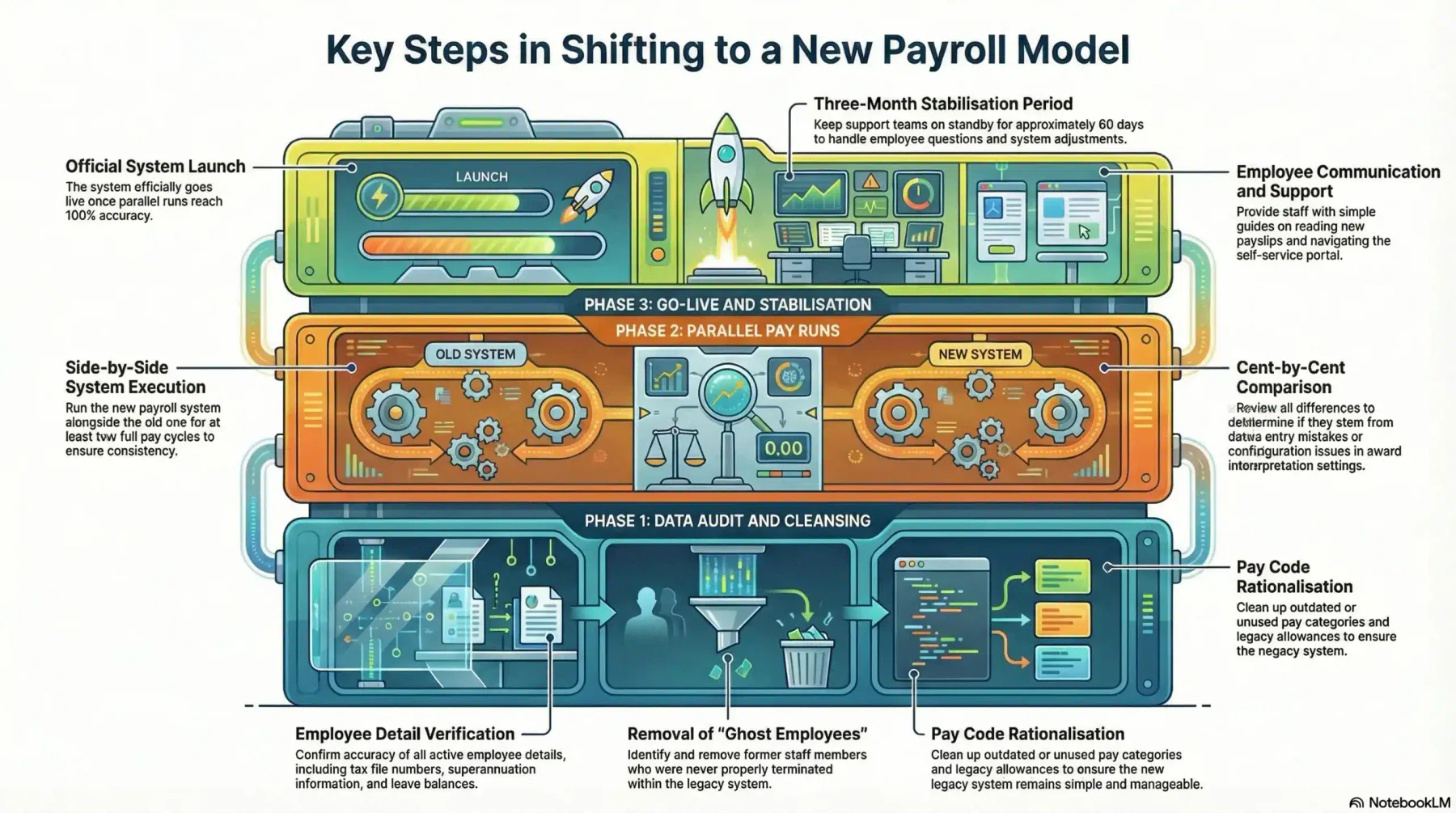
Moving to a new payroll model, whether by adopting new software or outsourcing the function, is a high-stakes decision. If handled poorly, it can lead to payment errors and damage employee trust. That’s why the transition should follow clear phases, with defined milestones and measurable success indicators.
1. Data Audit and Cleansing
Before any migration begins, the data needs a full review. Confirm that all active employee details are accurate, including tax file numbers, superannuation information, and leave balances. Remove “ghost employees,” meaning former staff who were never properly terminated in the system.
This stage should also include pay code rationalisation. Outdated or unused pay categories, such as legacy allowances that no longer apply, should be cleaned up to keep the new system simpler and easier to manage.
2. Parallel Pay Runs
The safest way to implement a new system is through a parallel run. This means running the new payroll system alongside the old one for at least two full pay cycles. The results are then compared down to the cent.
Any differences need to be reviewed carefully to identify whether they come from data entry mistakes or configuration issues in the new system, especially within its award interpretation settings.
3. Go-Live and Stabilisation
Once the parallel runs reach full accuracy, the system can officially go live. The next step is a stabilisation period, usually around three months, where support teams remain on standby to handle employee questions quickly.
Clear communication is critical during this phase. Staff should receive simple guides explaining how to read their new payslips and how to access the self-service portal.
Key Performance Indicators for Managing Payroll
To measure the effectiveness of payroll management, businesses should track specific metrics:
- Payroll Accuracy Rate: The percentage of payslips generated without errors. Best-in-class businesses target above 99.5%.
- Cost Per Payslip: The total cost of the payroll function (software + labor) divided by the number of payments made. This helps benchmark efficiency against industry standards.
- Time to Resolve Queries: The average time taken to resolve an employee’s payroll question. High resolution times correlate directly with low employee engagement.
- Overtime Percentage: Tracking overtime costs relative to total labor costs helps identify rostering inefficiencies or under-staffing issues.
- Manual Intervention Rate: The frequency with which payroll officers must manually override system calculations. A high rate indicates poor system configuration or complex award interpretations that require automation.
Common Pitfalls and Mitigation Strategies
Even with sturdy software, payroll management can fail due to process and human errors. Identifying these pitfalls early allows for proactive mitigation.
1. The “Set and Forget” Mentality
One common mistake is thinking that once payroll is set up, it can run on autopilot. In Australia, tax tables, statutory rates, and award conditions change regularly, often every 1 July. If the system isn’t updated on time, non-compliance happens immediately.
Mitigation: Set up a quarterly compliance review calendar. Stay subscribed to updates from Fair Work and the ATO so changes, such as Superannuation Guarantee increases or new tax tables, are applied before they take effect.
2. Siloed Data Systems
When payroll software doesn’t integrate with HR or Time & Attendance platforms, teams are forced to enter the same data in multiple places. This double handling increases the risk of errors and adds unnecessary administrative workload.
Mitigation: Prioritise an integrated ecosystem. Choose an adaptable human resource software where the Time & Attendance system serves as the single source of truth for working hours, automatically pushing accurate data into payroll without manual input.
3. Misinterpretation of “Annualised Salaries”
Some businesses use annualised salaries to simplify payroll, assuming the fixed amount covers overtime and penalty rates. However, stricter rules now require employers to complete an annual reconciliation to confirm the employee is genuinely better off than they would be under full Award conditions.
Mitigation: Keep accurate start and finish time records, even for salaried staff. Conduct biannual “better off overall test” (BOOT) reviews to detect any shortfalls early, before underpayments build up over time.
Advanced Best Practices for 2026

Leading businesses are moving beyond basic compliance to leverage payroll as a strategic asset. These advanced practices focus on employee financial wellness and predictive analytics.
- Earned Wage Access (EWA)
Earned Wage Access allows employees to access wages they have already earned before payday. It supports financial flexibility without acting as a loan.
To enable EWA, payroll systems must calculate net pay accurately in near real time. This requires strong system integration.
- Continuous Auditing via AI
AI-driven payroll auditing monitors each pay run for anomalies. Issues can be flagged before payments are released.
This approach reduces fraud risk and costly corrections. It also improves overall payroll governance.
- Superannuation Clearing House Optimisation
Optimised clearing house processes help avoid rejected super payments and late penalties. Validation of fund details during onboarding is considered best practice.
Integrated payroll systems simplify super reporting and payment tracking. This ensures contributions are made accurately and on time.
Conclusion
Payroll management in Australia demands accuracy, compliance, and the right systems. As reporting becomes more digital, manual processes are no longer sustainable.
Success depends on automation, regulatory awareness, and process discipline. Payroll in 2026 is a strategic function that supports growth and employee trust.
Businesses that understand the full payroll lifecycle can reduce risk and improve efficiency. You can book a free consultation with our experts to get tailored insights for your payroll strategy.
Frequently Asked Question
STP Phase 2 is an expansion of ATO reporting that requires businesses to report detailed payroll data, such as disaggregated gross income and allowance types, every pay run.
The Superannuation Guarantee rate is scheduled to increase to 11.5% on 1 July 2024 and will reach 12% on 1 July 2025, requiring employers to adjust their budgets accordingly.
Under the Fair Work Act, employers must keep time and wages records for seven years. These records must be legible, in English, and readily accessible for inspection.
Missing the quarterly deadline makes the contribution non-tax-deductible and triggers the Superannuation Guarantee Charge (SGC), which includes the shortfall, interest, and administration fees.
While theoretically possible for micro-businesses, using spreadsheets is highly risky and inefficient due to STP reporting requirements, complex tax calculations, and the high likelihood of human error.