















Manufacturing systems are integrated frameworks that combine machines, tools, processes, people, and data to turn raw materials into finished goods. They support production, quality control, and inventory management to improve efficiency, meet demand, and increase profitability.
Manufacturing has moved far beyond manual production, and Australian businesses now need faster, more connected ways to manage output, cost, and quality. The pressure is real: the ABS reported that Australian manufacturing generated $47.1 billion in EBITDA in 2023–2024, which shows how much value depends on efficient operations and stronger control.
That is why improving production is no longer just about adding new machines to the floor. Businesses also need clearer systems to manage workflows, inventory, labour, and day-to-day decisions with less waste and less delay.
A manufacturing system helps bring those moving parts together in one structured environment. With the right setup, manufacturers can improve productivity, maintain consistency, and turn raw materials into finished goods with better speed and control.
Key Takeaways
A manufacturing system helps Australian businesses improve production control, quality, and efficiency.
The main manufacturing system types support different production volumes, product variety, and operational needs.
The benefits of manufacturing ERP include better visibility, faster decisions, and stronger compliance.
What Is a Manufacturing System?
A manufacturing system is the structured process by which a business turns inputs into finished goods. It connects three core elements, inputs such as materials, labour, and equipment; processes that transform them; and outputs that must meet targets for quality, cost, and speed.
In practice, the system covers more than machines on the floor. It also includes workflow, material movement, and production management software that helps teams monitor production, mantain consistency, and improve efficiency across operations.
This matters in Australia, where manufacturing supports sectors such as food and beverage, defence, and resources technology. A strong manufacturing system helps these businesses stay productive, competitive, and better controlled in a demanding operating environment.
Key Characteristics of a Manufacturing System

The strongest manufacturing systems do more than run production faster. A well-designed manufacturing system helps Australian manufacturers improve efficiency, flexibility, quality, safety, and cost control within a single, connected environment.
- Efficiency: An efficient system keeps materials, labour, machines, and schedules moving in the right sequence so production flows with less waiting time and less waste. When businesses connect shop-floor activity with manufacturing ERP, teams can respond faster to shortages, delays, and output changes without losing control.
- Flexibility: A flexible system helps manufacturers adjust production volumes, product types, or workflow priorities without disrupting the whole operation. This matters even more when manufacturing ERP software enables faster planning, clearer inventory visibility, and smoother cross-team coordination.
- Quality: A strong system builds quality into every stage of production instead of checking it only at the end. With better process control, standardised workflows, and connected data from manufacturing ERP systems, businesses can strengthen their quality assurance processes, reduce defects, and maintain more consistent output.
- Safety: A reliable system supports safer work by establishing clearer procedures, improving visibility into equipment use, and strengthening control over day-to-day operations. In Australia, manufacturers also need to comply with WHS obligations, and Safe Work Australia notes that manufacturing work includes duties related to plant risks, hazardous manual tasks, slips, trips, and falls from height.
- Cost-effectiveness: A cost-effective system helps manufacturers use materials, labour, and equipment more productively without sacrificing output quality. When manufacturing ERP systems Australia give managers clearer cost visibility across procurement, production, and inventory, they can protect margins and make better decisions sooner.
Types of Manufacturing Systems
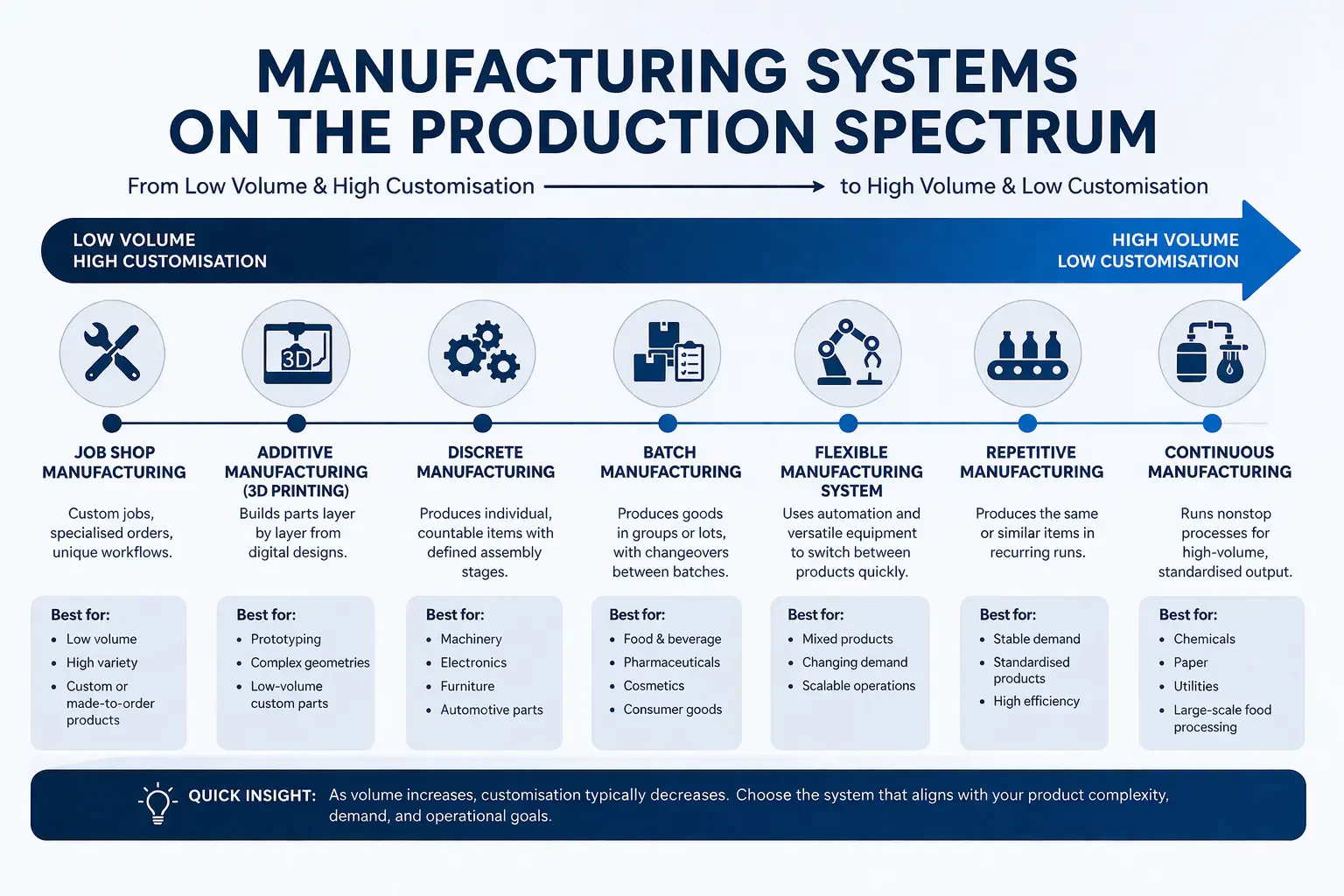
Different manufacturing systems support different production goals, so businesses need to match the system to their product type, output volume, and level of customisation. Some models focus on speed and consistency, while others prioritise flexibility and product variety.
The right choice also affects labour planning, inventory flow, machine usage, and delivery performance. When businesses connect the right manufacturing system with robust planning tools, such as a manufacturing ERP, they can scale operations with greater control.
1. Discrete manufacturing
Discrete manufacturing produces individual, countable items such as machinery, electronics, furniture, or automotive parts. Each product moves through defined stages and can usually be tracked by unit, serial number, or bill of materials.
This model works well when businesses need clear production visibility and structured assembly processes. It becomes even more effective when manufacturing erp systems connect inventory, work orders, and quality control in one platform.
2. Repetitive manufacturing
Repetitive manufacturing produces the same or similar items on a continuous or recurring basis with minimal change between runs. Businesses use this model when demand remains stable, aiming to maintain high output and consistent quality.
Because processes are standardised, teams can reduce setup time, improve efficiency, and more easily control labour. This makes repetitive manufacturing a strong fit for companies that want predictable throughput and lower unit costs.
3. Job shop manufacturing
Job shop manufacturing handles low-volume, high-variety production where each order may require a different process, routing, or specification, usually run in a make-to-order model
This model offers strong flexibility, but it also needs tighter scheduling and clearer job tracking to avoid delays and margin loss. Many businesses support this environment with manufacturing ERP software to manage quotations, materials, timelines, and job costs more accurately.
4. Batch manufacturing
Batch manufacturing produces goods in batches rather than in a continuous flow, making it practical for businesses that need both consistency and some flexibility. Teams complete one batch, clean or reset equipment if needed, and then move to the next product run.
This system is especially relevant in Australia for the food and beverage, pharmaceutical, and consumer goods sectors, where manufacturers often balance compliance, shelf life, and changing demand. A strong batch setup helps businesses control quality, reduce waste, and plan production more efficiently.
5. Continuous manufacturing system
A continuous manufacturing system runs production without interruption and is designed for high-volume output of standardised goods. It is common in industries such as chemicals, mining-related processing, paper, utilities, and large-scale food production.
This model delivers very strong efficiency and low per-unit cost when demand remains high and processes stay stable. However, because the system is highly specialised, businesses need excellent maintenance, monitoring, and risk control to avoid costly downtime.
6. Flexible manufacturing system
A Flexible Manufacturing System combines automation, machine versatility, and centralised control to help businesses adjust output with less disruption. It allows teams to switch between products, reroute work, or respond to changes in demand faster than traditional rigid lines.
This makes it valuable for manufacturers that handle product variation but still need strong productivity and equipment utilisation. For growing operations, manufacturing ERP systems in Australia can strengthen this model by improving coordination between planning, inventory, and production data.
7. Additive manufacturing (3D Printing)
Additive manufacturing builds products layer by layer from digital design files, rather than removing material or using traditional moulds and tooling. It works well for prototyping, low-volume custom parts, complex geometries, and specialised industrial components.
For Australian businesses adopting Industry 4.0 and IIOT, additive manufacturing plays a key role in enabling smarter, more connected, and data-driven production environments.
8. Lean manufacturing
Lean manufacturing focuses on reducing waste across production, whether it comes from excess inventory, waiting time, overproduction, defects, or unnecessary movement. The goal is to make each process more efficient while still maintaining product quality and customer value.
This system works well for businesses that want smoother workflows, lower operating costs, and better use of labour and materials. With the support of manufacturing ERP software, teams can monitor production performance, identify bottlenecks, and make faster improvements across the shop floor.
| Type | Flexibility | Cost Efficiency | Scalability | Setup Time | Common AU Relevance |
|---|---|---|---|---|---|
| Discrete Manufacturing |
Medium | Medium | High | Medium | Machinery, electronics, fabricated products |
| Repetitive Manufacturing |
Low to Medium | High | High | Low | Consumer goods, assembly-based production |
| Lean Manufacturing |
Medium to High | High | High | Medium | Process improvement, waste reduction, high-efficiency production |
| Job Shop Manufacturing |
High | Lower per-unit efficiency | Low to Medium | High | Custom engineering, specialised equipment |
| Batch Manufacturing |
Medium to High | Medium to High | Medium | Medium | F&B, pharma, packaged goods |
| Continuous Manufacturing System |
Low | Very High | Very High | Very High | Processing, chemicals, mining-related production |
| Flexible Manufacturing System |
High | Medium to High | High | Medium | Mixed-product factories, advanced manufacturing |
| Additive Manufacturing (3D Printing) |
Very High | Medium for low volumes | Low to Medium | Low | Prototyping, defence, medical, engineering |
How Does the Manufacturing Process Work?

A strong manufacturing system follows a clear flow from planning to final quality checks, enabling teams to control output, costs, and consistency without creating unnecessary delays. When businesses support that flow with manufacturing ERP systems or software, they can connect decisions across planning, procurement, production, and compliance more effectively.
- Planning and design: Planning and design set the production direction by defining product specifications, workflow, capacity, timelines, and resource needs before work starts on the floor.
- Raw materials and procurement: Raw materials and procurement keep the operation supplied by ensuring the right materials arrive at the right time, in the right quantities, and at the right cost, avoiding shortages or excess stock.
- Production and assembly: Production and assembly turn materials into finished goods through controlled processes, the use of machinery, labour coordination, and standardised work instructions that keep output moving efficiently.
- Quality control and compliance: These help manufacturers check product standards, reduce defects, and maintain consistency. In Australia, many businesses align quality processes with AS/NZS ISO 9001:2016, which adopts ISO 9001 requirements for quality management systems.
Benefits of Manufacturing ERP for Your Business
Unlike basic accounting or standalone inventory software, a manufacturing ERP integrates production, inventory, and financial operations into one system. While basic tools only record transactions after they occur, a manufacturing ERP helps businesses manage and monitor production in real time, ensuring both operational and financial decisions use the same data.
The biggest benefit is visibility. When sales, stock, work orders, and costs sit in one system, managers can spot shortages earlier, reduce excess stock, respond faster to changes in demand, and keep production closer to plan.
A strong ERP also helps businesses tighten compliance and financial control. In Australia, businesses registered for GST must lodge a BAS, and the ATO says digital record-keeping packages can help them meet tax, super, and employer obligations more effectively.
Another major benefit is stronger customer delivery performance. Better planning, clearer inventory visibility, and more reliable order data help manufacturers ship on time with fewer errors and protect margins in a market where cost pressure remains high.
Key Features of a Manufacturing ERP System

A strong manufacturing ERP system does more than store data across departments. It helps teams connect planning, production, inventory, finance, and reporting so the business can operate with greater control and faster decision-making.
- Production planning and scheduling: Teams use this feature to align materials, labour, and machine capacity so production runs smoothly, supported by effective production schedule management.
- Inventory management: Manufacturers use this feature to track raw materials, work in progress, and finished goods more accurately, helping them prevent stockouts and reduce excess carrying costs.
- Quality control and compliance: Teams use these tools to track defects, standardise checks, and keep production aligned with internal standards and external requirements.
- Procurement and supply chain management: Businesses use this feature to manage suppliers, purchasing, material flow, and inbound costs more effectively as supply conditions change.
- Financial management and ATO compliance: Manufacturers use this feature to strengthen costing, reporting, GST records, BAS preparation, and digital record-keeping across the business.
- Manufacturing execution system integration: A Manufacturing Execution System (MES) connects ERP planning with real-time production activities. It tracks work orders, machine usage, and work-in-progress (WIP), then sends live production data back to the ERP so inventory, scheduling, and financial data stay accurate and up to date.
- Reporting and analytics: Leaders use reporting and analytics to turn operational data into clear insights, track performance faster, and make better decisions.
Industry-Specific Manufacturing ERP in Australia
Australian manufacturing is not one uniform market. Different sectors need different ERP strengths, especially when compliance, traceability, engineering complexity, and workforce pressure vary so much across industries.
Food and beverage manufacturing ERP
Food and beverage manufacturers need strong batch control, traceability, and recall readiness because FSANZ says food traceability makes recalls easier and quicker if something goes wrong. ERP is especially useful here because it helps connect batch records, inventory, quality checks, and supplier data in one place.
Discrete and engineering manufacturing ERP
Discrete and engineering manufacturers need better control over BOM complexity, staged assembly, revision management, and job costing. That matters even more in Australia’s defence-linked supply chains, where Defence’s Global Supply Chain Program aims to increase Australian supplier participation in major prime contractors’ global supply chains.
ERP for small manufacturing companies in Australia
Smaller manufacturers often feel the pain of spreadsheets and disconnected tools earlier because they have less room for stock errors, rework, and slow reporting. A digital manufacturing platform can help these businesses digitise core processes without taking on the heavier infrastructure burden of traditional on-premise software.
Pharmaceutical and medical device manufacturing: TGA compliance requirements
Pharmaceutical and medical device manufacturers in Australia must register with the Therapeutic Goods Administration and meet Good Manufacturing Practice under the Therapeutic Goods Act 1989. Non-compliance risks product recall and licence revocation.
Disconnected production systems make TGA documentation manual and error-prone. The right ERP digitises the full chain from raw material receipt and batch production records through to serialisation and product release authorisation.
TGA audits can be unannounced, and documentation must be retrievable immediately. Manufacturers relying on spreadsheets consistently fail documentation readiness checks when audits occur.
Large-scale manufacturers: NGER Act reporting and sustainability compliance
Manufacturers consuming more than 200 terajoules of energy per year must report to the Clean Energy Regulator under the National Greenhouse and Energy Reporting Act 2007. This threshold applies to many mid-to-large food, metal, and chemical manufacturers across Australia.
Without ERP, energy consumption data across production lines, shifts, and production runs sits in separate systems. ERP with energy tracking per cost centre and production order allows NGER reports to be generated directly from operational data without weeks of manual reconciliation.
| NGER Reporting Obligation | How Manufacturing ERP Supports It |
|---|---|
| Total energy consumption per facility (GJ/year) | Captures energy usage per production order and cost centre in real time |
| Scope 1 emissions from on-site combustion | Links fuel consumption data from MES to emissions calculation engine |
| Scope 2 emissions from purchased electricity | Integrates utility billing from Accounting with production volume data from MES |
| Production-linked intensity ratios (emissions per tonne output) | Cross-references KPI dashboard output with energy data automatically |
NGER reports are due by 31 October each year to the Clean Energy Regulator. Manufacturers maintaining real-time production and energy data in an integrated ERP spend significantly less time on compliance reporting than those relying on manual data collection.
How Do You Know When Your Business Is Ready for a Manufacturing System?

Your business is usually ready for a manufacturing system when manual processes begin to slow production and reduce operational control. Common signs include frequent stock discrepancies, production delays, inconsistent workflows, rising order errors, limited visibility across departments, and too much time spent tracking data across separate tools.
Readiness also depends on internal discipline, not just operational pain points. A business should have clear production goals, documented processes, sufficient staff capacity, and leadership support before introducing a more structured manufacturing system.
How to Choose the Right Manufacturing System for Your Business
Choosing the right manufacturing system starts with knowing how your products move, where your constraints sit, and how much change your operation needs to handle. When businesses align production needs with tools such as manufacturing ERP systems, they can build a setup that supports growth without adding unnecessary complexity.
- Production volume and product variation: Businesses with high-volume, standardised output often need more structured manufacturing systems, while businesses with lower volumes or more product variation need a setup that can adapt without slowing production.
- Lead time requirements: If customers expect fast delivery, your manufacturing system should support shorter planning cycles, better material availability, and smoother scheduling across the floor.
- Cost pressure and budget: The right model should align with your cost structure, because some systems reduce unit costs with scale, while others offer flexibility but require higher setup, labour, or coordination costs.
- Space, infrastructure, and workforce capability: Your system needs to fit the reality of your factory layout, equipment capacity, and team capability, especially in Australia where Jobs and Skills Australia says shortages remain most common among Technicians and Trades Workers, and manufacturing relies heavily on occupations such as production managers, metal fitters and machinists, and structural steel and welding trades workers.
- Digital integration readiness: If your business already uses connected planning, inventory, or reporting tools, manufacturing ERP systems in Australia can help you integrate procurement, production, and quality data more effectively, rather than managing each function in isolation.
Conclusion
A strong manufacturing software platform does more than digitise transactions. It helps manufacturers integrate planning, production, inventory, purchasing, quality, and finance into a single system, enabling the business to move faster with better control.
That matters even more in Australia, where businesses need solid records for tax and invoicing, stronger traceability in sectors such as food and beverage, and more resilience in a market that still faces skills pressure.
For manufacturers that want to reduce friction, improve visibility, and build a more scalable operating model, choosing the right manufacturing software is a practical next step. To explore the best fit for your operations, you can request a consultation with the expert and discuss the right approach for your business.
FAQ About Manufacturing Systems
What is a Manufacturing Operation System?
A Manufacturing Operation System is a system that helps manufacturers manage and control day-to-day shop floor activities. It supports production planning, resource allocation, quality control, inventory tracking, and workflow monitoring so companies can keep operations efficient and consistent.
What is a Manufacturing Production System?
A Manufacturing Production System refers to the full structure, process, and method a company uses to produce goods. It covers machines, labour, materials, workflows, and production strategies that work together to turn raw materials into finished products efficiently.
What is Discrete Manufacturing?
Discrete manufacturing is the process of producing distinct individual items such as cars, furniture, electronics, or machinery. Each product can usually be counted, tracked, and often assembled from separate components, unlike process manufacturing which produces goods like chemicals or beverages in bulk formulas.
How Much Does Manufacturing ERP Cost?
Manufacturing ERP costs depend on factors such as business size, number of users, required modules, deployment type, and customization level. In Australia, prices generally start from around AUD $50,000 for basic cloud systems and can exceed AUD $500,000 for large, customised enterprise implementations. Costs typically include implementation, training, data migration, support, and system integration.
What is ERP vs. CRM vs. MRP?
ERP, CRM, and MRP serve different business functions:
- ERP (Enterprise Resource Planning) manages core business processes such as finance, inventory, procurement, and operations.
- CRM (Customer Relationship Management) focuses on sales, customer interactions, leads, and service.
- MRP (Material Requirements Planning) helps manufacturers plan raw materials, production schedules, and purchasing needs.
In many businesses, ERP can include MRP and connect with CRM for a more complete workflow.
Discrete vs process manufacturing, which suits Australian SMBs?
Discrete manufacturing fits Australian SMBs that build countable, assembled products such as furniture, machinery, or electronics. Process manufacturing suits businesses producing blended or formula-based goods like food, beverages, chemicals, or pharmaceuticals. The rule is simple: if you can count finished units (cabinets, bikes, devices), go discrete. If your output is measured by weight, volume, or batch (sauces, cosmetics, dairy products), choose process manufacturing.
Are lean manufacturing principles applied differently in Australia?
The core lean principles stay the same globally, but Australian SMBs adapt them to local conditions: smaller production runs, higher labour costs, and longer supply lines from Asia. Aussie manufacturers tend to prioritise waste reduction and standardised work to offset thin margins, while keeping larger safety stock buffers than overseas peers because shipping delays from Asian suppliers make pure just-in-time risky for most local operations.
How are Manufacturing Systems Classified?
Manufacturing systems are commonly classified based on production method and output type. The main categories include:
- Job shop manufacturing for customized, low-volume production.
- Batch manufacturing for producing goods in groups or lots.
- Mass or repetitive manufacturing for high-volume standardized products.
- Continuous manufacturing for nonstop production, usually in process industries like chemicals or food.
- Discrete manufacturing for individual countable products assembled from parts.