















Financial reporting organises and presents financial data to show business performance. It converts transactions into structured reports that support analysis and decision making, with many companies using accounting reporting software to keep records accurate and consistent.
When managed well, financial reporting improves visibility and helps businesses track performance more accurately. A structured approach ensures clearer insights and better financial control.
Key Takeaways
Provides a structured view of business performance, helping companies analyse financial data and support better decision making.
Explains how different stakeholders use financial data to assess performance, manage risk, and guide strategic decisions.
Clarifies the difference between reports and statements, ensuring better understanding of financial structure and interpretation.
Breaks down the key components of financial reporting, including income statements, balance sheets, and cash flow analysis.

What Financial Reporting Means for Business Performance






Financial reporting is the structured accounting process of recording, analysing, and presenting a company's financial data over a specific period. It gives internal managers, investors, and regulators a clear view of a business's financial health and operational performance.
Financial reporting provides a structured view of a business’s financial position and performance. It brings together financial data into clear reports that can be analysed and used for decision making.
This process goes beyond documentation. It helps businesses evaluate performance, identify trends, and maintain control over financial outcomes.
When applied consistently, financial reporting improves planning and accountability. Many companies adopt financial reporting software Australia businesses commonly use to align reporting with local standards and operational needs.
Who Uses Financial Reports and Why It Matters
Financial reports are used by different stakeholders to assess performance, manage risk, and support decision making. Each group focuses on specific data depending on their objectives.
Management and business owners
Management uses financial reports to monitor performance and guide business strategy. These reports help identify inefficiencies, control costs, and improve profitability.
Investors and shareholders
Investors review financial reports to evaluate returns and assess business potential. They focus on profitability, growth, and long-term value.
Lenders and financial institutions
Lenders use financial reports to assess risk and repayment capacity. They analyse liquidity, cash flow, and overall financial stability before providing funding.
Regulators and government bodies
Regulators rely on financial reports to ensure compliance with reporting standards and tax obligations. Accurate reporting helps maintain transparency and accountability.
A comprehensive financial report is composed of several distinct components, each designed to highlight a different aspect of the organization’s economic reality. Together, these reports provide a holistic, 360-degree view of the business.
Financial Reports vs Financial Statements
Financial reports and financial statements are closely related but not the same. Understanding the difference helps businesses communicate financial information more clearly.
Financial statements are the core numerical documents that present financial data. They focus on figures such as revenue, expenses, assets, and cash flow.
Financial reports provide broader context. They combine statements with explanations and disclosures, forming a complete financial reporting process that links data with insight.
Core Components of a Financial Report
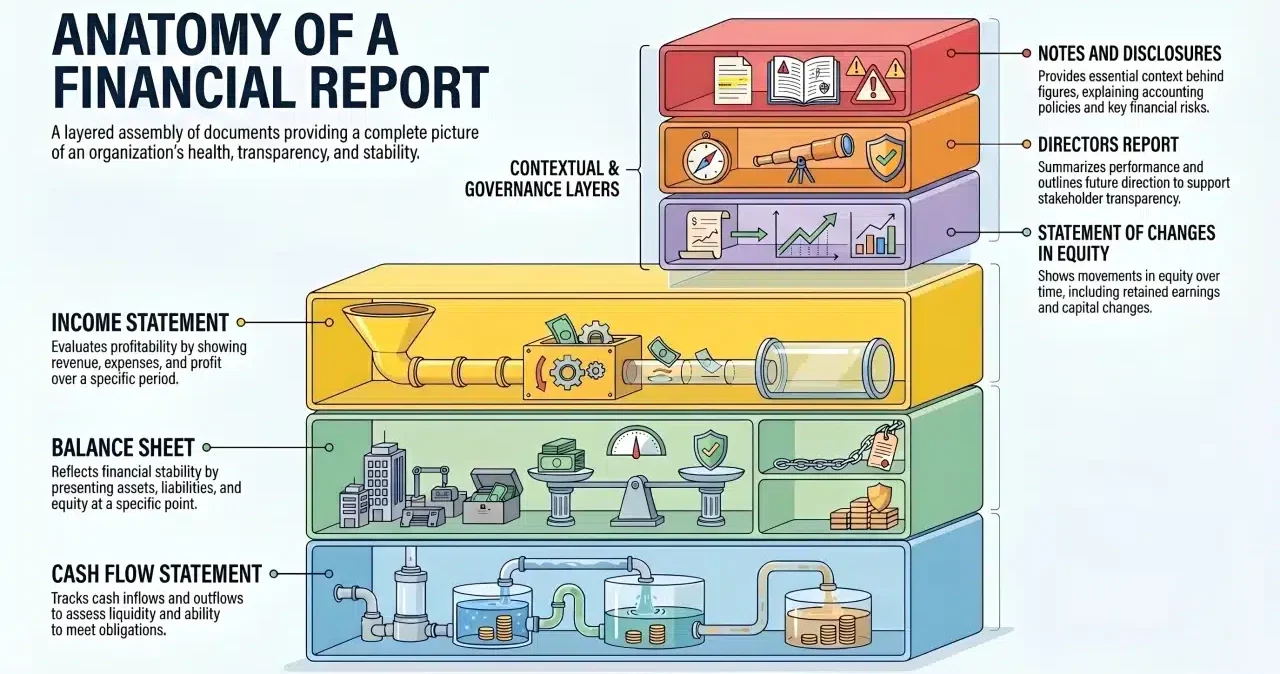
A financial report combines several key components to present a complete financial view. Each part highlights a different aspect of performance and financial position.
Income statement
Also known as the profit and loss (P&L) statement, the income statement shows revenue, expenses, and net profit over a specific period. It helps evaluate performance and profitability.
Balance sheet
Presents assets, liabilities, and equity at a specific point in time. It reflects financial position and stability.
Cash flow statement
Tracks cash inflows and outflows. It helps assess liquidity and the ability to meet obligations.
Statement of changes in equity
Shows movements in equity over time. It reflects retained earnings and capital changes.
Notes and disclosures
Provide context behind financial figures. They explain accounting policies and key risks.
Directors report
Summarises performance and outlines future direction. It supports transparency for stakeholders.
Financial Reporting Requirements and Compliance in Australia
Financial reporting requirements in Australia ensure businesses maintain transparency and meet regulatory standards. Compliance is essential to avoid penalties and maintain trust with stakeholders.
Who must report
Not all businesses are required to submit financial reports publicly. Generally, public companies, large proprietary companies, and certain regulated entities must prepare and lodge financial reports.
Large vs small thresholds
A business is classified as large if it meets specific criteria related to revenue, assets, or number of employees. This classification determines whether full financial reporting and audit requirements apply.
Reporting deadlines
Financial reports must be submitted within a set period after the financial year ends. Meeting these deadlines is critical to avoid penalties and maintain compliance.
AASB and IFRS standards
Reports must follow Australian Accounting Standards aligned with international frameworks. Many businesses use automated financial reporting to reduce errors and meet these requirements more efficiently.
In Australia, businesses can refer to the ASIC Company Financial Reports Guide to ensure their public or large proprietary company meets the relevant legal requirements under the Corporations Act.
Financial Reporting Across Different Industries
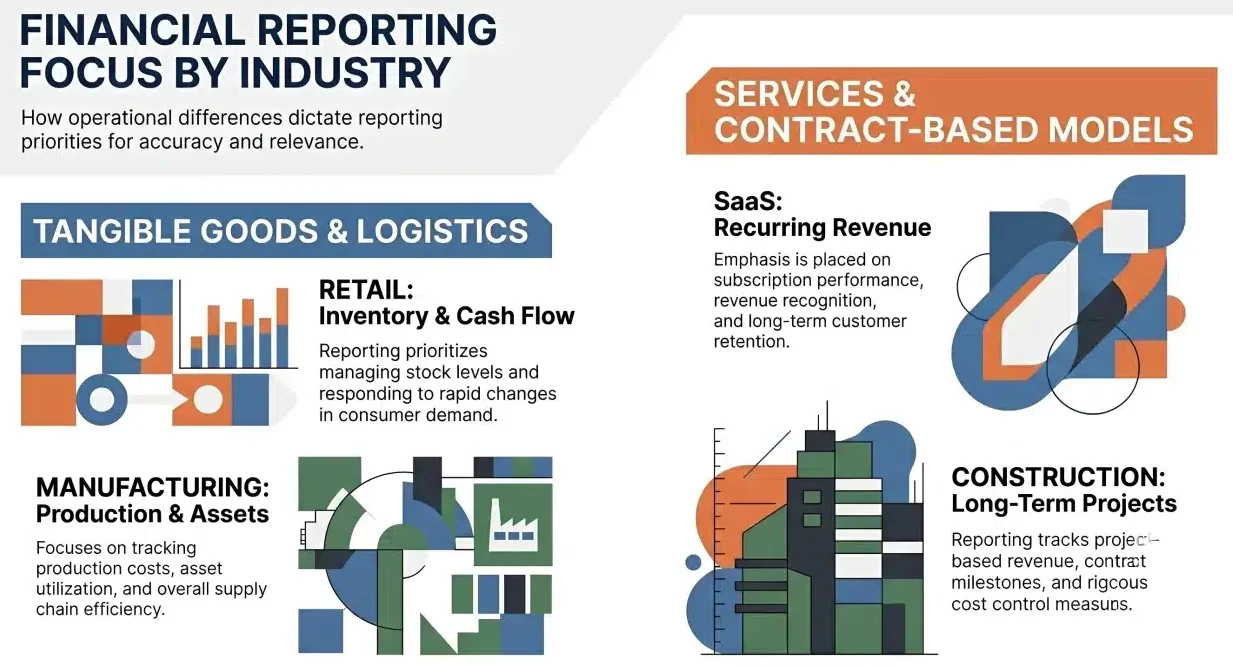
Financial reporting varies across industries due to differences in operations, revenue models, and financial risks. Each sector focuses on specific areas to maintain accuracy and relevance.
- Retail and e commerce: Retail businesses focus on inventory management and cash flow. Accurate reporting helps manage stock levels and respond to demand changes.
- Manufacturing and logistics: Manufacturing reporting centres on production costs and asset utilisation. It also tracks supply chain efficiency and capital investment.
- SaaS and technology: Technology businesses focus on recurring revenue and subscription performance. Reporting also emphasises revenue recognition and customer retention.
- Construction and real estate: Construction reporting tracks project-based revenue and long-term contracts. It also focuses on cost control and asset valuation.

Building an Effective Financial Reporting Process
A structured financial reporting process ensures data is accurate, consistent, and easy to interpret. It connects financial activities into a system that supports timely reporting and better decision making.
Many businesses also review accounts payable insights alongside reporting data to gain a clearer view of outgoing commitments and cash obligations.
Define reporting objectives
Clear reporting objectives determine what information is needed and who will use it. This helps ensure reports are relevant and aligned with business priorities.
Structure chart of accounts
A well organised chart of accounts groups financial data into logical categories. This improves report clarity and makes analysis more efficient.
Integrate financial systems
Integration is critical for businesses operating across multiple departments. Without it, finance teams often spend hours combining data from separate sales, operations, and payroll spreadsheets to create reports. An integrated system automates this process, providing real-time financial data without manual consolidation.
Establish controls and reconciliation
Strong internal controls ensure financial data is recorded correctly. Regular reconciliation keeps reports aligned with actual balances.
Automate reporting workflows
Automation helps generate reports faster and more consistently. For mid-sized businesses in Australia, automated systems can generate P&L statements, balance sheets, and cash flow reports on a set schedule or on demand while ensuring data is pulled from a single source. It also allows teams to focus on analysis rather than manual preparation.
Download Free Financial Analysis Report Templates
Financial analysis requires consistent structure to compare performance across metrics and reporting periods. Without it, insights can become fragmented and difficult to interpret.
The templates below are designed around common analysis scenarios and adjusted to align with applicable requirements in Australia, ensuring relevance for both evaluation and compliance.
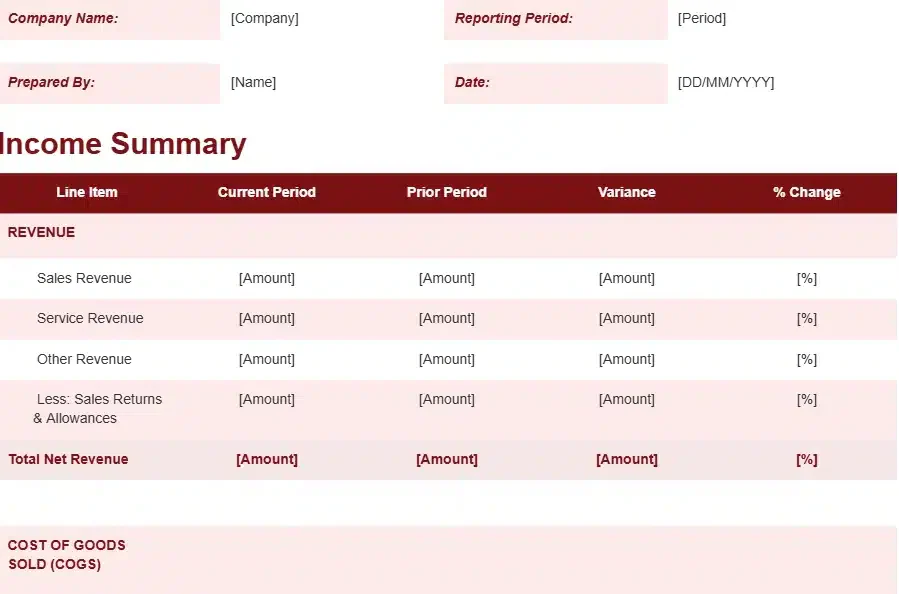
Profitability analysis report template
Focuses on evaluating profit margins and overall financial performance across different periods.
PROFITABILITY ANALYSIS REPORT TEMPLATE
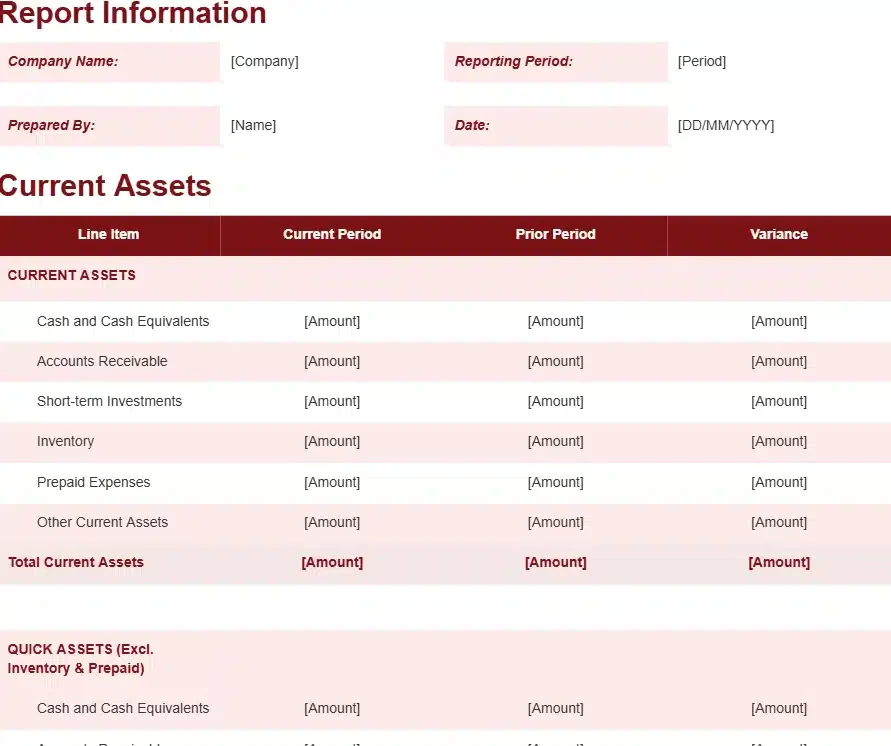
Liquidity analysis report template
Assesses a company’s ability to meet short term obligations using key liquidity metrics.
LIQUIDITY ANALYSYS REPORT TEMPLATE
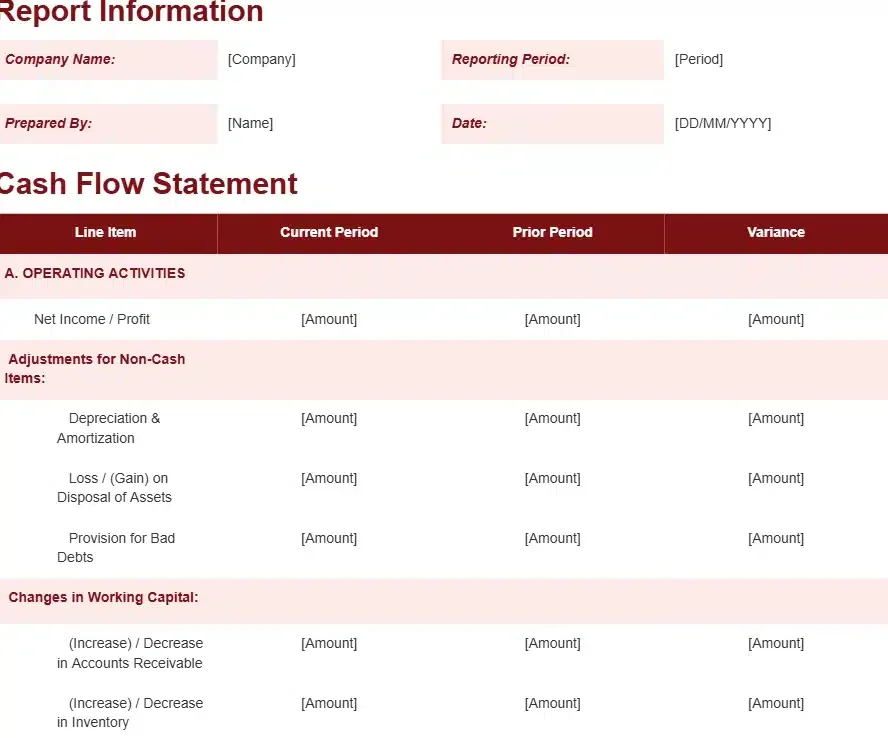
Cash flow analysis report template
Tracks cash inflows and outflows to evaluate financial stability and operational sustainability.
CASH FLOW ANALYSIS REPORT TEMPLATE
Horizontal trend analysis report template
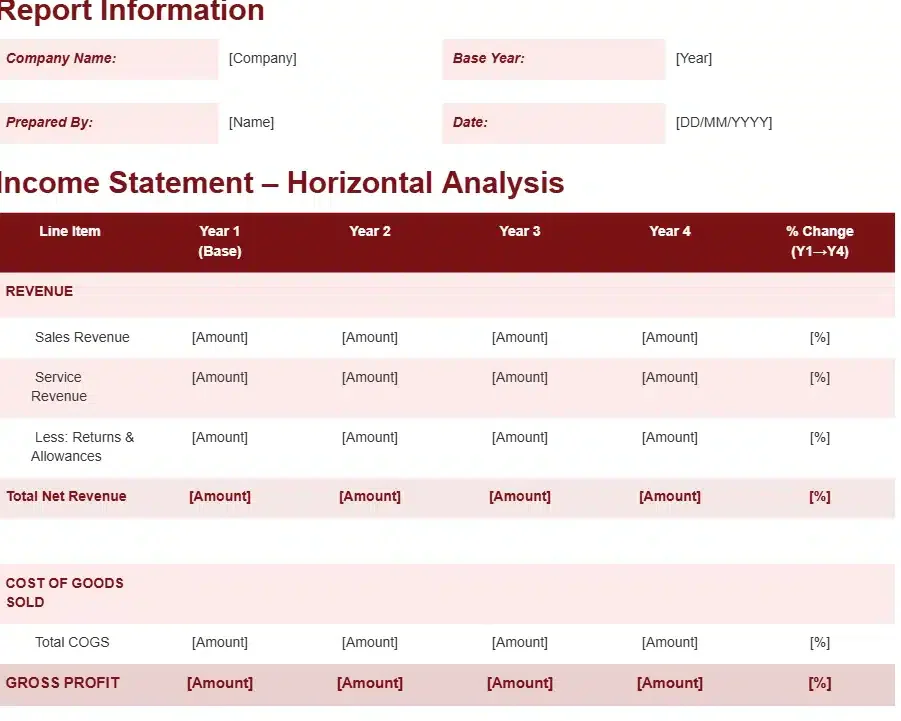
Compares financial data over multiple periods to identify growth patterns and performance changes.
HORIZONTAL TREND ANALYSIS REPORT TEMPLATE
Vertical common size analysis report template
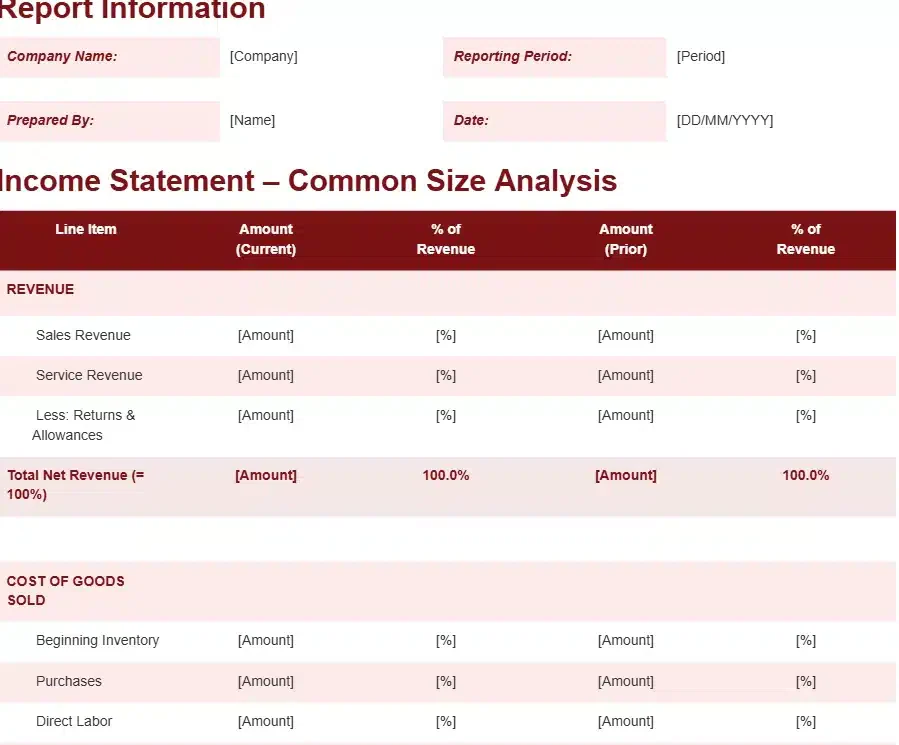
Breaks down financial statements into percentages to analyse structure and cost distribution.
VERTICAL COMMON SIZE REPORT TEMPLATE
Break even analysis report template
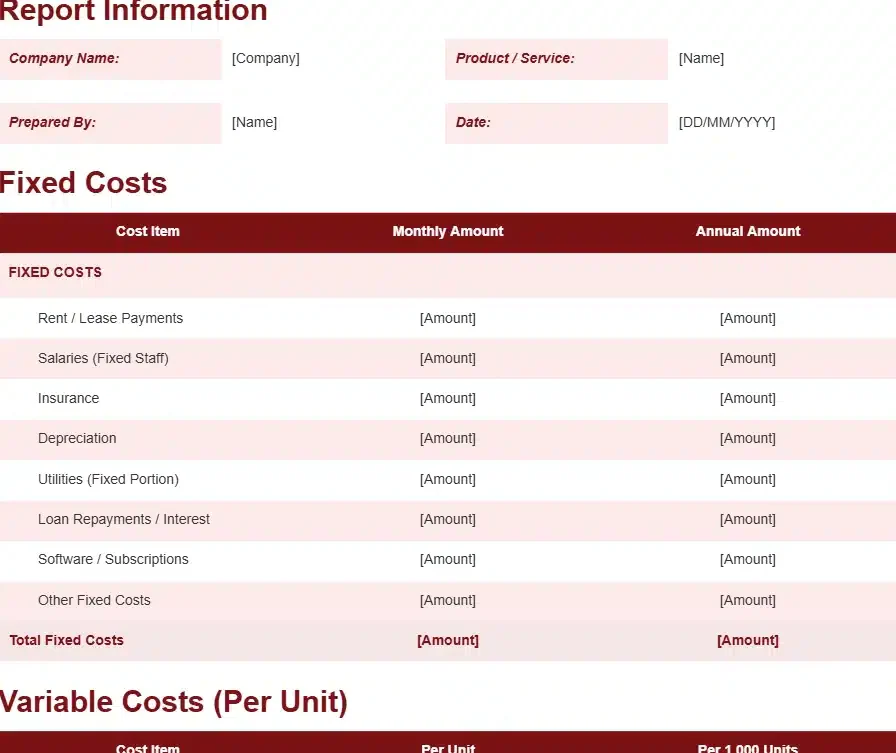
Determines the point at which revenue covers total costs to support pricing and cost control decisions.
BREAK EVEN ANALYSIS REPORT TEMPLATE
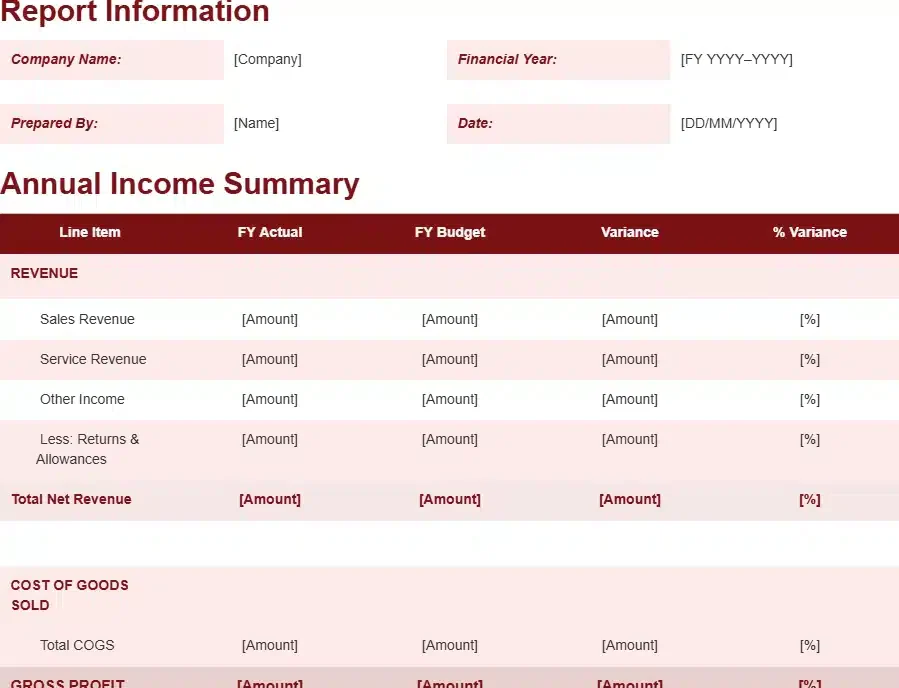
End of financial year analysis report template
Summarises financial performance at year end to support tax planning and strategic decisions.
END OF FINANCIAL YEAR ANALYSIS REPORT TEMPLATE
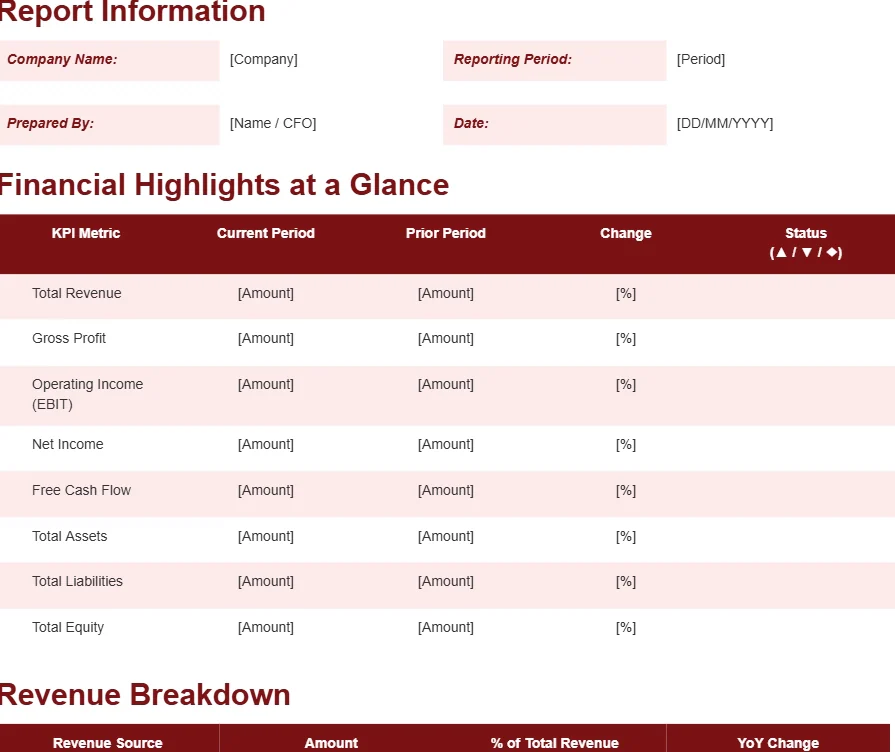
Executive financial analysis dashboard template
Provides a high level overview of key financial metrics for management and stakeholder reporting.
PROFITABILITY ANALYSIS REPORT TEMPLATE
Common Challenges and Advanced Financial Reporting Practices
Financial reporting challenges often come from gaps in process and data management. At the same time, advanced practices help businesses improve accuracy and gain deeper financial insight.
Manual processes and data errors
Manual reporting increases the risk of errors and inconsistencies. It also slows down reporting and reduces overall efficiency.
Lack of cash flow visibility
Focusing only on profit without tracking cash flow can limit financial control. This makes it harder to manage liquidity and short-term obligations.
Misclassification and poor disclosure
Incorrect classification of financial data can distort reports. Weak disclosures also reduce transparency and affect decision making.
Advanced financial reporting practices
As reporting processes improve, businesses can adopt more advanced approaches to enhance accuracy and insight.
- Predictive analytics and forecasting: Predictive analytics uses historical data to estimate future performance. This helps businesses plan and respond to potential changes earlier.
- Real time dashboards: Real time dashboards provide up-to-date financial data. This allows faster monitoring and more responsive decision making.
- AI driven insights: AI helps identify patterns and anomalies in financial data. It improves accuracy and supports more informed financial analysis.
Conclusion
Financial reporting helps businesses maintain visibility, control performance, and support informed decision making. With a structured approach, companies can improve accuracy and ensure financial data remains reliable.
As reporting needs grow, inconsistent processes can reduce clarity and increase risk. Businesses that implement clear systems and automation can maintain better control and improve overall financial performance.
If your business wants to improve financial reporting accuracy and gain better visibility into performance, you can request a free consultation to find the right approach for your needs.

FAQ About Financial Reporting
What is the purpose of financial reporting?
Financial reporting helps businesses present accurate financial data to support decision making, maintain transparency, and meet compliance requirements.
How often should financial reports be prepared?
Financial reports are typically prepared monthly, quarterly, or annually depending on business needs and regulatory requirements.
What makes financial reporting accurate?
Accurate financial reporting depends on consistent data entry, proper classification, and regular reconciliation of financial records.
Why is financial reporting important for cash flow management?
Financial reporting helps track cash inflows and outflows, allowing businesses to manage liquidity and avoid financial shortfalls.