














Choosing an ERP in Australia can get confusing fast. Buyers from mid-market and enterprise businesses often compare 10+ vendors, sit through polished demos, and still miss the operational gaps that only show up months after go-live. That is when costs rise, features go unused, and teams fall back to spreadsheets.
This guide helps you avoid that. We ranked 13 ERP systems available in Australia using 5 consistent criteria, including AU compliance, local support, scalability, and user adoption, not just the upfront price.
Key Takeaways
Business scale and operational complexity: smaller businesses may not need ERP yet, while growing companies often require integrated systems to improve visibility and operational control.
ERP evaluation criteria: we assessed each platform based on Australian compliance, local support, scalability, user experience, and total cost of ownership.
Of 13 ERP systems reviewed: entry pricing in Australia starts around A$34 per user per month and implementation costs typically start around A$50,000.
13 Best ERP Software in Australia Reviewed
The right ERP system should support your growth, improve visibility, and simplify daily operations. With that in mind, here are the best ERP solutions in Australia to consider for your digital transformation roadmap in 2026.
1. Microsoft Dynamics 365 Business Central
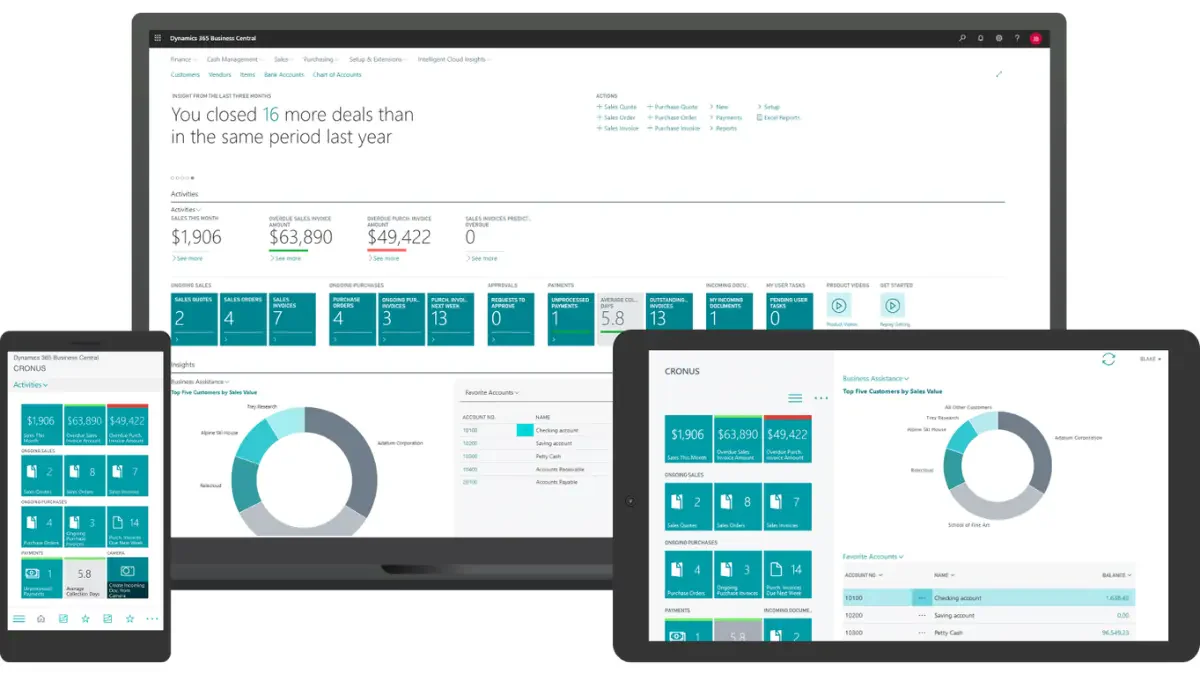
Microsoft Dynamics 365 Business Central is a cloud ERP designed for growing businesses that want finance, inventory, and operations managed within the Microsoft ecosystem.
It is commonly used by mid-sized companies that need stronger operational control without moving into complex enterprise ERP deployments.
Key features:
- Financial management: General ledger, budgeting, bank reconciliation, and reporting
- Sales and purchasing management: Quotes → orders → invoicing, vendor purchasing workflows
- Inventory and warehouse basics: Stock tracking, replenishment, item availability, and standard inventory processes
- Project and service workflows: Project costing and service management; manufacturing/service capabilities expand with Premium
Pricing range: Microsoft publishes AU list pricing (excluding GST) as: A$119.70 user/month (Essentials), A$164.60 user/month (Premium), and A$12.00 user/month (Team Members), paid yearly.
Best for: Growing businesses already using Microsoft tools that need stronger finance, inventory, and operational control.
| Pros | Cons |
|
|
2. Oracle NetSuite
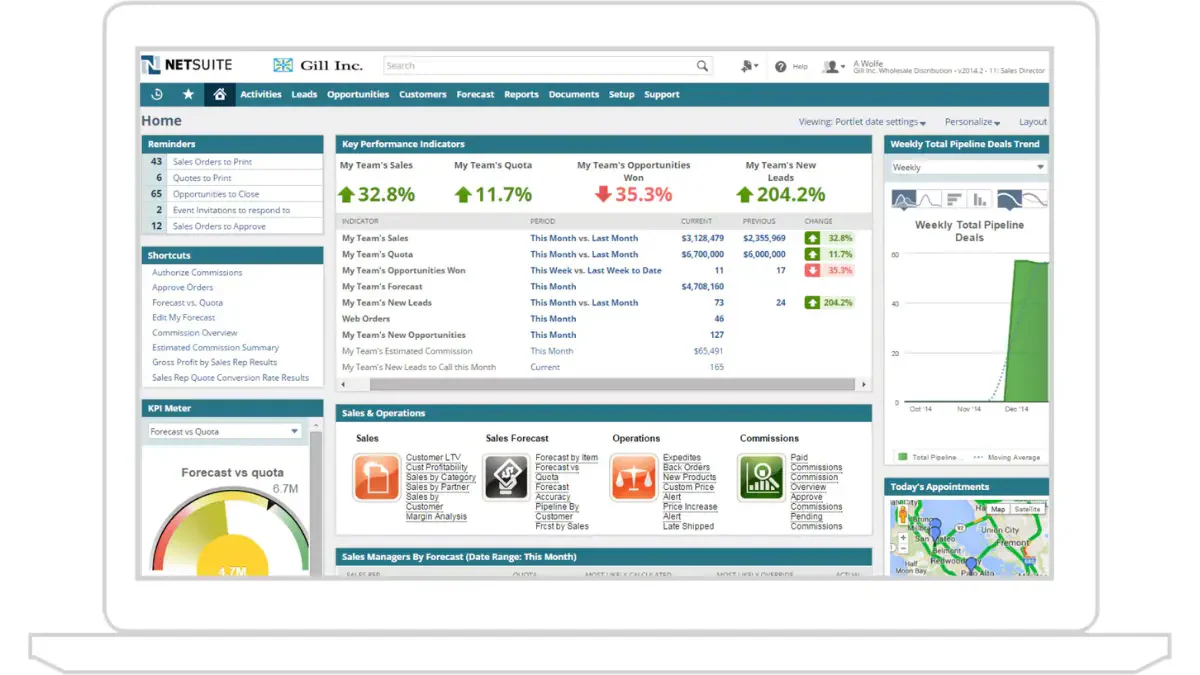
NetSuite is a cloud ERP software Australia that’s built for businesses that want one system across finance and operations, especially when you have multiple business units, entities, or locations, to reduce data silos.
It’s frequently listed among the leading ERP solution used in the Australian market, with most deployments delivered via implementation partners.
Key features:
- Financial management: Core accounting plus financial management and reporting across the functions.
- Sales and purchasing management: Order management and procurement in the same system, reducing handoffs between sales, ops, and finance.
- Inventory and warehouse management: Inventory, warehouse, supply chain, and related operational controls designed to run inside one platform.
- Dashboards and analytics: Role-based dashboards, KPIs, and reports (often packaged via SuiteSuccess) for faster rollout and standardised reporting.
Pricing range: For planning purposes, AU partners commonly cite entry-level subscriptions starting around ~A$1,000/month for very basic setups, while mid-sized companies often budget ~A$30,000–A$100,000+/year for subscription costs before implementation and ongoing partner support.
Best for: Multi-entity businesses requiring centralised financial and operational visibility.
| Pros | Cons |
|
|
3. MYOB Advanced
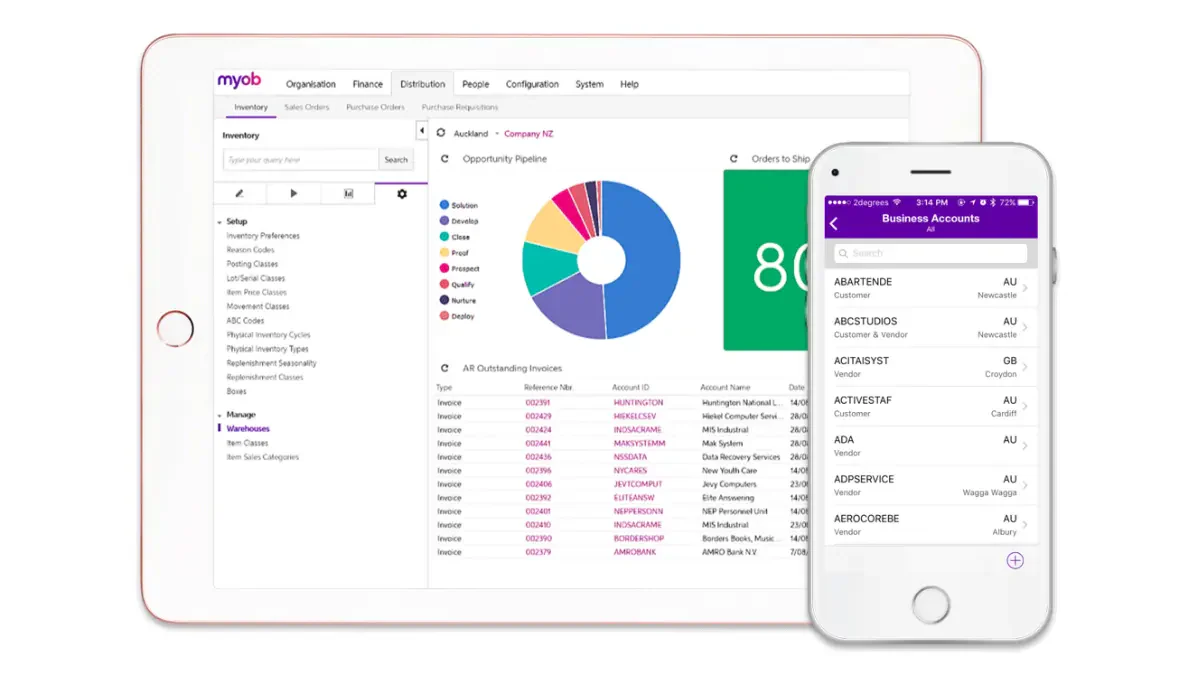
MYOB Advanced is an ERP platform designed for mid-market businesses that require stronger operational control across finance, inventory, projects, and workflows.
It is commonly used in distribution, construction, and manufacturing environments across Australia.
Key features:
- Job and project control: Timesheets, project/job costing, progress tracking, and flexible billing (materials and labour rules by job/customer).
- Manufacturing and distribution capability: Support for operational planning and costing concepts like bills of materials and end-to-end visibility across production-style workflows (edition/configuration dependent).
- Workflow automation and approvals: Configurable workflows to standardise purchasing, project, and finance handoffs so decisions don’t live in email threads.
- Anywhere access and mobility: Cloud access across devices, with mobile-friendly usage patterns (useful for site teams and supervisors).
Pricing range: MYOB Advanced / MYOB Acumatica is generally quote-based, but AU partners commonly cite A$104–A$179 per full user/month depending on edition (Standard/Plus/Enterprise), with implementation and ongoing support priced separately.
Best for: Mid-market businesses in distribution, construction, and manufacturing environments.
| Pros | Cons |
|
|
4. HashMicro ERP Software
HashMicro is an advanced ERP solution built for Australian businesses in manufacturing, retail, distribution, and multi-entity services. It covers end-to-end operations, from procurement to finance, in a single platform.
The platform is commonly used by Australian mid-sized and enterprise businesses that require local compliance support and multi-site operational visibility.
Key features:
- Built-in BI (Business Intelligence): Business intelligence tools provide real-time dashboards and analytics to track performance across finance and operations without stitching reports together manually.
- AI-generated reports and explainers: Automated reporting with plain-English business explanations.
- Role-based access levels: Permission controls for approvals, visibility, and audit tracking.
- Mobile apps: ERP access on the go for approvals, checks, and operational updates, handy for multi-site teams and managers.
- Flexible hosting methods: Cloud, on-premise, and hybrid hosting options.
- GST-ready transaction tracking: Support accurate GST calculation and tax-related record keeping.
- Hashy AI assistant: Native AI support for in-system queries, summaries, and automated task prompts across ERP modules.
- AI insight reporting: Detect anomalies, read trends, and generate plain-language summaries from financial and operational data.
Pricing range: Pricing typically depends on the modules you need, user scope, hosting method (cloud/on-prem/hybrid), and implementation complexity. A free demo is available so you can scope requirements and see workflows before requesting a formal proposal.
Best for: Mid-sized and enterprise businesses requiring integrated operational and financial management.
| Pros | Cons |
|
|
Click on the pricing calculator below to get a personalised quote and understand the potential investment.
Overview of the ERP Market in Australia
Australia’s ERP market continues to expand as businesses adopt integrated systems to manage their everyday operations. According to IBISWorld Australia, the ERP Software Developers industry reached A$4.8 billion in 2024-25, after growing at an annualised 14.0% over the five years through 2024-25.
What makes Australia different from the US or UK is the strong focus on local compliance. Companies often prefer ERP systems with built-in STP Phase 2, BAS lodgement, and Fair Work record-keeping, rather than tools that need extra add-ons or heavy partner customisation.
Conclusion
Based on our evaluation, the best ERP software in Australia includes both local and global vendors. Pronto Xi and TechnologyOne stand out as local options, while HashMicro and MYOB Advanced are also strong choices for businesses that need local support.
There is no single answer to which ERP system your business should use. The right choice depends on your industry, operational complexity, compliance needs, integration requirements, and long-term cost.
To make the decision easier, use the evaluation points above as a checklist before shortlisting vendors. For faster guidance, you can also book a free consultation to map your requirements, prioritise the right modules, and identify integration risks early.

FAQ about ERP Software
What is ERP and what’s the importances for business?
ERP is an integrated system that connects core business functions like finance, purchasing, inventory, projects, and reporting in one platform. It helps teams work from a single source of truth and typically needs to align with local requirements such as GST/BAS reporting and payroll reporting like STP Phase 2.
What variable ERP costs should Australian businesses consider?
Variable ERP costs depend on scope and complexity. Common cost drivers include the number of users, modules selected, level of customisation, integrations with payroll, POS, or eCommerce, data migration effort, training, and the number of entities or locations across Australia. Deployment choice (cloud vs on-premise) and security requirements can also shift the budget.
Which ERP cost items usually change the most during a project?
Customisation and integration work often change the most once teams map real workflows. Data migration can also expand if legacy data has gaps, duplicates, or inconsistent item codes. Change management (training, SOP updates, role redesign) can rise when more departments join the rollout.
What are the main ERP modules?
Core ERP modules often cover Finance & Accounting, Procurement, Inventory, Sales, and Reporting/BI. Many suites also include CRM, HR & Payroll, Warehouse Management (WMS), Manufacturing, Project Management, Asset Management, and Service/Helpdesk. Module choice should match the processes that drive revenue, cost control, and compliance in your business.
How long does ERP implementation usually take?
For mid-to-large businesses, ERP implementation commonly takes about 9–24 months, especially with multiple sites, many integrations, or heavy customisation. However, some ERP vendors offer accelerated implementation for a limited scope: HashMicro, for example, can reach a 1-month go-live when the rollout stays focused.
Which ERP is best for the manufacturing industry?
The best ERP for manufacturing depends on your production complexity, inventory needs, and growth plans. Manufacturers often look for ERP systems with production planning, bill of materials (BOM), shop floor control, procurement, and real-time inventory tracking to improve efficiency and reduce downtime.
Which is the best cloud ERP for product-centric enterprises?
For product-centric enterprises such as distributors, wholesalers, manufacturers, and retailers, the best cloud ERP is one that offers strong inventory control, demand forecasting, supply chain visibility, and financial management. Scalability and real-time reporting are also key factors when choosing a cloud ERP platform.
Does this ERP support automatic GST and BAS reporting to the ATO?
Many ERP systems designed for Australian businesses support GST calculations, BAS preparation, and local tax reporting features. However, capabilities vary by vendor, so businesses should confirm whether the ERP includes ATO-ready BAS reports, GST coding, and integration with payroll or accounting compliance tools.
Which is the best ERP for the retail sector?
Retail businesses usually benefit most from ERP software that combines POS integration, inventory management, omnichannel sales, purchasing, and customer data in one platform. The right solution helps retailers manage stock across stores, warehouses, and online channels more accurately.