















Australian business are facing increasing pressure to improve how new employees transition into the workplace. Hiring strong talent is no longer enough, as many businesses still struggle with slow ramp up times and early turnover.
Employee onboarding has evolved into a structured process that aligns operational readiness with cultural integration. When managed systematically, it helps new hires adapt faster and reduces the risks associated with fragmented manual approaches.
This article explains the key phases, best practices, and compliance considerations that shape effective employee onboarding programs in modern Australian business.
Key Takeaways
Understanding the employee onboarding process helps business integrate new hires more effectively across operational and cultural dimensions.
Why structured onboarding matters becomes clear when business aim to improve retention, accelerate productivity, and reduce early workforce risk.
The employee onboarding key phases outline how business guide new hires from preboarding through their first year of employment.
Effective employee onboarding best practices help business standardise workflows, strengthen engagement, and maintain consistency at scale.
What Is Employee Onboarding in Modern Business
Employee onboarding is the structured process of integrating new hires into a company both operationally and culturally. It goes beyond basic orientation and typically spans several months to help employees adapt effectively to their roles and work environment.
Many businesses still confuse onboarding with orientation. Orientation focuses mainly on administrative tasks and introductions, while onboarding is a longer journey that builds clarity, engagement, and long term alignment from the start.
A well designed onboarding program often follows the Four Cs framework. Compliance covers legal requirements, Clarification defines roles and expectations, Culture introduces workplace values, and Connection builds essential internal relationships.
When managed strategically, employee onboarding becomes a cross functional effort supported by managers, IT, and leadership. Digital workflows and centralised platforms, such as an HRM system, help company deliver consistent onboarding across remote and hybrid work environments.
Why Employee Onboarding Matters for Business
Employee onboarding plays a critical role in improving retention, productivity, and early employee engagement. Company that invest in structured onboarding typically experience faster ramp up times and lower early turnover.
A well executed onboarding process also reduces operational and compliance risks by ensuring documentation, system access, and payroll administration are properly established from the start. This structured approach helps new hires contribute more confidently in their first months.
Over time, consistent onboarding strengthens employer reputation and supports workforce stability. Employees who experience a smooth transition are more likely to stay longer and perform at expected levels.
The Employee Onboarding Process in 5 Key Phases
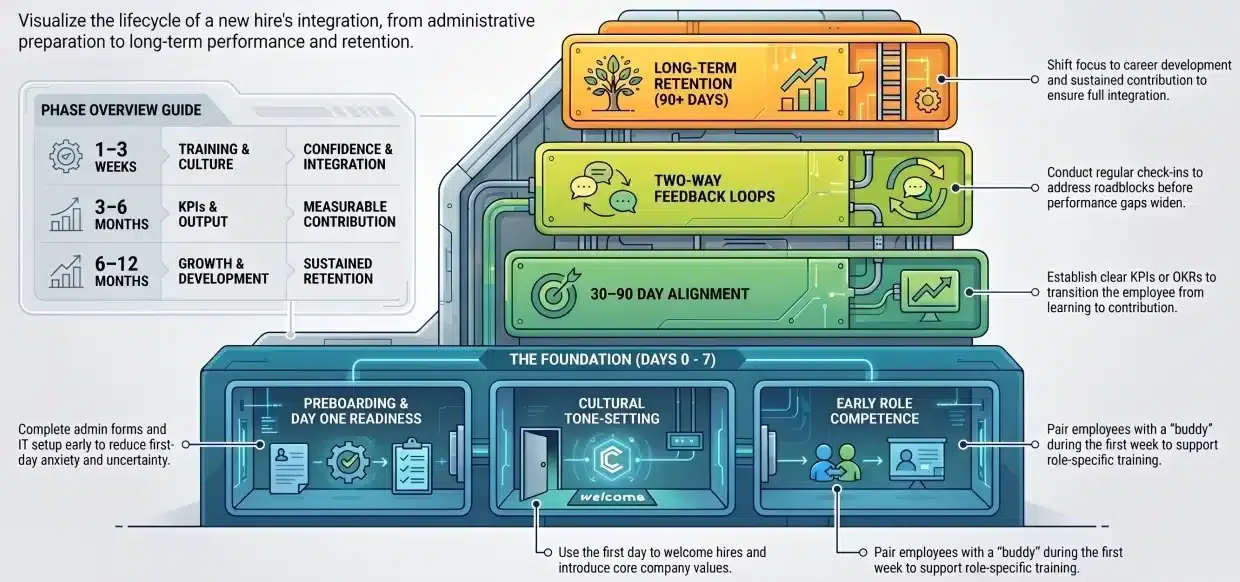
Designing an effective employee onboarding process requires a structured, phased approach. Clear stages help company guide new hires progressively, prevent information overload, and maintain consistent support from offer acceptance through the first year.
1. Preboarding
The preboarding phase covers the period between offer acceptance and the employee’s first day. This stage reduces uncertainty and reinforces the new hire’s decision to join the company.
Administrative preparation should be completed early, including tax forms, payroll details, and compliance documents. At the same time, IT teams must ensure devices, system access, and required software are fully ready before day one.
Proactive communication strengthens confidence during this transition. Personalised welcome messages and access to key company resources help new employees understand expectations and arrive better prepared.
2. First Day
The first day sets the psychological tone for the overall employee experience. The priority is helping new hires feel welcomed, oriented, and confident rather than pushing immediate productivity.
A structured introduction to the workplace is essential. Employees should receive guided tours of physical or digital environments and meet key team members in a focused, well planned setting.
Technical verification and early culture exposure complete the experience. Confirming system access while introducing company values and working norms helps employees build clarity and early alignment.
3. First Week
During the first week, the focus shifts toward building role specific competence and deeper team integration. Business must balance structured learning with realistic pacing so new hires can absorb information without feeling overwhelmed.
Role specific training becomes the primary priority during this stage. Managers should introduce key processes, tools, and performance standards through guided practice while helping employees become familiar with internal systems and daily workflows.
Assigning a peer buddy or mentor supports faster cultural adjustment. Regular team meetings and informal check ins allow new employees to observe team dynamics, ask questions more comfortably, and begin contributing with greater confidence.
4. First 30–90 Days
During the first 30 to 90 days, employees transition from learning mode to measurable contribution. At this stage, business must clearly align individual output with business priorities to ensure the onboarding process delivers real operational value.
Managers should establish clear KPIs or OKRs so new hires understand what success looks like early. Regular one on one check ins help address roadblocks, reinforce priorities, and provide timely feedback before performance gaps widen.
This phase also deepens cultural integration as employees begin collaborating beyond their immediate team. Strong guidance and two way feedback during this period help build confidence, strengthen accountability, and accelerate long term productivity.
5. 90 days to 12 Months
Between 90 days and the first year, onboarding shifts toward sustained development and long term retention. Business should maintain support during this period to reinforce performance consistency and strengthen employee commitment.
Formal reviews, career discussions, and continuous feedback help employees progress beyond basic competence toward higher impact contribution. By the end of the first year, they should be fully integrated, culturally aligned, and performing at expected levels.






Best Practices for Effective Employee Onboarding
Implementing effective employee onboarding requires a structured and consistent approach, often supported by an HRM solution for enterprise that helps standardise workflows and improve coordination.
1. Align cross functional teams
Successful onboarding depends on coordination between human resources, IT, facilities, and hiring managers. Clear ownership and internal service expectations help prevent common first week issues such as missing access or incomplete documentation.
2. Standardise While Allowing Personalisation
Core onboarding steps should remain consistent, but delivery should reflect the employee’s role, seniority, and learning needs. This balance improves relevance while maintaining operational control.
3. Leverage Digital Onboarding Tools
Modern businesses increasingly rely on automated workflows to assign tasks, track document completion, and guide new hires through early milestones. Digital enablement is especially important for remote and hybrid work environments.
4. Establish a Buddy or Mentorship Program
Peer support accelerates cultural integration and reduces early uncertainty. A trained buddy provides informal guidance that complements manager led onboarding activities.
5. Measure and Continuously Improve
High performing business collect feedback at key milestones such as day seven, day thirty, and day ninety. Analysing this data helps identify friction points and refine the onboarding experience over time.
6. Apply Advanced and AI Driven Onboarding Approaches
Leading business increasingly combine cohort onboarding with AI driven learning pathways. This approach helps new hires build cross functional networks early while ensuring training adapts to individual progress and role requirements.
Employee Onboarding in Australia: Compliance Requirements
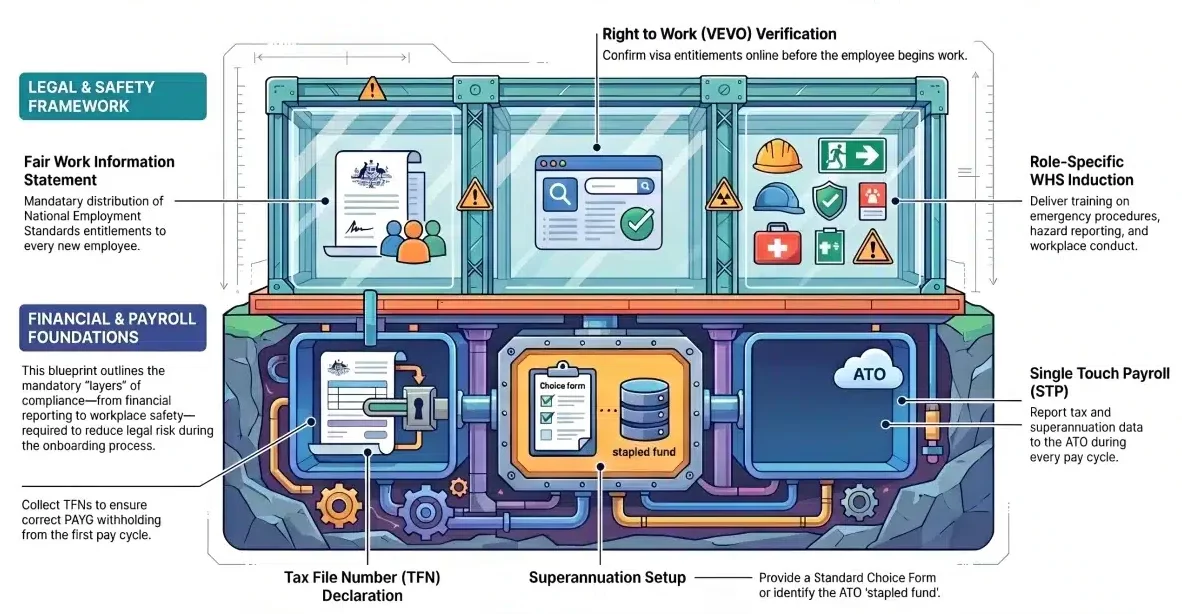
Operating in Australia requires strict compliance with employment and payroll regulations. A structured employee onboarding process ensures all statutory obligations are completed before new hires begin, reducing legal and operational risk. Key requirements typically include:
-
Fair Work Information Statement
Employers must provide the Fair Work Information Statement to all new employees and ensure they understand their National Employment Standards entitlements. -
Tax File Number Declaration
Accurate TFN collection is essential, and businesses must complete the Tax File Number Declaration to ensure correct PAYG withholding from the employee’s first pay cycle. -
Superannuation Setup
New hires must receive a Standard Choice Form to nominate their preferred fund. If no selection is made, employers must identify the stapled fund via the Australian Taxation Office. -
Single Touch Payroll reporting
Payroll systems must follow Single Touch Payroll reporting requirements to ensure accurate submission of tax and super data each pay cycle. -
Workplace Health and Safety Induction
Companies must deliver role-specific safety training, including emergency procedures, hazard reporting, and workplace conduct expectations, in line with Workplace Health and Safety Requirements. -
Right to Work Verification (VEVO)
Employers must confirm work rights using the Visa Entitlement Verification Online system before allowing employees to start work.
Industry Specific Employee Onboarding Strategies
Although employee onboarding follows common principles, execution varies by industry due to different risk levels, workforce structures, and technical needs. Aligning onboarding with sector demands helps company accelerate productivity and improve early retention.
1. Manufacturing Onboarding: Safety and Equipment Readiness
In manufacturing environments, employee onboarding must prioritise workplace safety and equipment readiness. Inadequate training not only reduces productivity but also increases compliance and safety risks.
New hires should complete structured safety certification before operating machinery or entering high risk areas. Many business apply shadowing, where employees observe experienced operators before performing tasks under supervision.
Hands on validation remains essential. A structured onboarding approach ensures employees can perform procedures safely, consistently, and in real production conditions.
2. Retail Onboarding: Customer Focus and Floor Readiness
In retail environments, employee onboarding must emphasise customer experience and rapid floor readiness. High turnover and fast paced operations require new hires to become confident in customer interactions as quickly as possible.
Structured role play is widely used during the first week. Practising returns, product inquiries, and complaint handling helps employees build confidence before facing real customers.
Retail onboarding should also reinforce brand understanding. When employees grasp the brand story, target customers, and product positioning early, they can deliver more authentic and consistent service on the sales floor.
3. Distribution and Logistics Onboarding: Process and Shift Readiness
In distribution and logistics environments, onboarding must emphasise process accuracy and operational discipline. Tight delivery schedules and high volume workflows leave little room for error, making early role clarity essential for new hires.
Training typically focuses on warehouse management systems, picking and packing procedures, and safe equipment handling. Clear instruction helps employees understand how their tasks affect downstream supply chain performance.
Shift based operations add another layer of complexity. Structured peer support and targeted safety guidance help new hires adapt faster, maintain productivity, and operate safely in fast moving logistics environments.
4. E-commerce Onboarding: Digital Tools and Agile Workflows
In e-commerce environments, onboarding must prioritise rapid digital tool mastery and cross functional awareness. New hires typically interact with multiple platforms such as inventory systems, CRM tools, and marketing dashboards from the start.
Effective programs provide guided, hands on training so employees can navigate core systems confidently. Brief cross functional exposure also helps new hires understand how marketing, fulfilment, and customer service workflows connect in the digital order lifecycle.

Employee Onboarding Implementation Steps
A structured onboarding setup helps businesses deliver a consistent and efficient experience for new hires. Clear processes reduce confusion and ensure each stage runs smoothly.
- Review existing onboarding materials
Evaluate current documents, workflows, and tools to identify gaps or outdated processes that need improvement. - Map the onboarding journey
Define what new employees should experience from preboarding to their first months. This helps create a clear and consistent structure. - Define roles and responsibilities
Assign responsibilities across HR, managers, and teams to ensure each part of onboarding is handled properly. - Standardise workflows
Create consistent processes for documentation, training, and communication to reduce errors and improve efficiency.
KPIs to Monitor Employee Onboarding Success
Tracking onboarding performance helps businesses measure effectiveness and identify areas for improvement. Clear metrics make it easier to evaluate long-term impact.
- Time to productivity
Measures how quickly new hires reach expected performance levels after joining. - First-year retention rate
Tracks how many employees stay within their first year, indicating onboarding effectiveness. - Employee satisfaction score
Evaluates how new hires feel about their onboarding experience through surveys or feedback tools.
How HR Platforms Streamline Employee Onboarding Processes in Australian Businesses
Modern HR platforms, such as integrated employee management software, help businesses simplify onboarding by automating tasks, improving visibility, and reducing manual coordination.
- Automating document collection and compliance checks
HR systems streamline the collection of forms such as contracts, TFN declarations, and policy acknowledgements, ensuring compliance requirements are completed accurately. - Centralising employee data and onboarding workflows
All onboarding activities, documents, and employee data are stored in one system, reducing duplication and improving visibility across teams. - Integrating onboarding with payroll and HR systems
Seamless integration ensures employee data flows directly into payroll and HR processes, reducing manual entry and improving accuracy. - Tracking onboarding progress and performance
HR platforms provide dashboards to monitor onboarding progress, helping businesses identify delays and improve overall efficiency.
Common Employee Onboarding Pitfalls and Solutions
Even well designed employee onboarding programs can underperform without disciplined execution. Many failures occur not because the framework is weak, but because delivery across teams is inconsistent or poorly monitored.
1. Information overload and cognitive fatigue
New hires are often overwhelmed with excessive information in the first few days, which reduces retention and slows confidence building.
Solution: Prioritise essential knowledge early and distribute secondary training gradually through structured microlearning.
2. Manager disengagement from onboarding
When managers treat onboarding as solely an HR responsibility, new hires lack role clarity and team integration.
Solution: Assign clear onboarding ownership to direct managers and include onboarding success in their performance metrics.
3. Limited two way feedback
Onboarding that flows only one direction prevents company from detecting early confusion or frustration.
Solution: Implement regular pulse check conversations and short surveys during the first 30 to 90 days.
Addressing these risks early helps business maintain onboarding quality, accelerate productivity, and improve new hire retention.
Conclusion
Employee onboarding has become a strategic function that directly impacts retention, productivity, and workforce stability. Business that structure the transition journey effectively help new hires adapt faster and contribute with greater confidence.
Each phase, from preboarding to sustained development, plays a critical role in building operational readiness and cultural alignment. Supported by clear ownership and digital workflows, a structured approach reduces early turnover and strengthens the employee experience.
As workforce expectations continue to evolve, business should regularly review and refine their onboarding strategy. If you want help evaluating the right approach, request a free consultation with our team.
Frequently Asked Questions About Employee Onboarding
What are the red flags in onboarding?
Common red flags include lack of structured processes, unclear role expectations, minimal manager involvement, and overwhelming new hires with too much information early on.
How long does onboarding usually last?
Onboarding typically lasts from a few weeks to several months, depending on the role. Many businesses extend onboarding up to the first year to ensure full integration and performance.
What does a good onboarding look like?
A good onboarding process is structured, consistent, and personalised. It combines compliance, training, and cultural integration to help new hires adapt and perform effectively.
What is the role of the manager in onboarding?
Managers play a key role by setting expectations, providing guidance, and supporting new hires throughout the onboarding process to ensure faster adaptation and productivity.