















eInvoicing is the secure digital exchange of invoice data between a buyer’s and supplier’s accounting software through the Peppol network. It reduces manual entry, paper invoices, and PDFs while helping businesses speed up payments and prevent invoice fraud.
In Australia, more businesses are replacing manual invoice processing with e-invoicing to improve speed, accuracy, and compliance. Through the Peppol network, invoice data moves directly between accounting systems, removing the need for paper invoices, PDFs, and manual data entry. The ATO states paper or PDF invoices can cost $27 to $30 to process, while e-invoicing can reduce this to less than $10 per invoice.
The ATO is also the Australian Peppol Authority, meaning it manages Australia’s local Peppol framework and approves accredited service providers called Access Points. However, the ATO does not receive, store, or view the contents of eInvoices exchanged between businesses.
For Australian businesses, e-invoicing can reduce errors, speed up payments, lower admin costs, and improve visibility over accounts payable and receivable. As adoption grows, businesses that modernise early can gain a strong operational advantage.
Key Takeaways
E-invoicing automates invoice processing, eliminating manual data entry and improving operational efficiency.
Peppol enables secure, system-to-system communication of invoices, ensuring accuracy and compliance across platforms.
Businesses in the public sector and large enterprises are required to adopt e-invoicing for transactions, with growing adoption in B2B.
What Is E-Invoicing?
E-invoicing is a software solution for invoice automation that enables the automated exchange of invoice data between buyers and suppliers, answering what is e invoicing in a practical business context. Unlike PDFs that require manual entry, e-invoicing uses a standardized format that integrates with accounting or ERP systems for accurate, secure transactions.
In Australia, invoicing is becoming essential for businesses, with the Australian Tax Office (ATO) promoting its adoption. E invoicing software simplifies financial operations by eliminating paper trails and ensuring compliance with legal and tax standards. With systems like Peppol, businesses can seamlessly exchange invoices, reducing administrative costs and improving cash flow.
As more companies in Australia and worldwide shift to e-invoice, it’s no longer just a convenience but a necessity for staying competitive. The ATO has mandated e invoicing for government transactions, pushing businesses to adopt this efficient invoicing method and boosting their operational efficiency.
E-Invoice vs E-Billing: What’s the Difference?
In Australia, e-invoicing and e-billing are often used interchangeably, but they carry distinct technical meanings. The ATO and Peppol-compliant businesses use specific definitions for each term.
| Aspect | E-Billing | Peppol e-Invoicing |
|---|---|---|
| Format | PDF, email, or Word document | Structured UBL 2.1 XML data |
| Delivery Method | Email attachment or portal upload | Sent securely through the Peppol network via accredited Access Points |
| Processing | Requires manual data entry | Automatically imports data into the buyer’s system |
| ATO Standard | Not recognised as the Peppol standard | Recognised under the Australian Peppol framework |
| Government Compliance | Does not meet Commonwealth e-invoicing requirements | Accepted by Commonwealth agencies and government suppliers |
| Risk of Errors | Higher due to manual handling | Lower through automated data exchange |
| Processing Speed | Depends on manual processing | Near real-time electronic processing |
Sending a PDF invoice via email is not e-invoicing under ATO standards. Commonwealth suppliers must be Peppol-compliant, as a PDF alone is not sufficient. Peppol-ready accounting software closes this gap automatically.
How Does Electronic Invoicing within the Peppol Network Work?

Peppol eInvoicing follows a standardised process that allows invoices to move securely between suppliers and buyers without manual data entry. Each invoice is validated, transmitted through the Peppol network, and delivered directly into the buyer’s accounting or ERP system.
1. Supplier Creates the Invoice
The supplier creates an invoice using their accounting or ERP system. Instead of sending a PDF or email attachment, the invoice is generated in the PINT A-NZ format, the Peppol eInvoicing standard adopted in Australia and New Zealand.
2. Invoice Is Sent to the Supplier’s Access Point
The invoice is sent to the supplier’s accredited Peppol Access Point, which validates that it meets the PINT A-NZ standard before transmission. If the invoice format is invalid, it is rejected before reaching the buyer. Businesses can find a list of accredited Access Point providers on the Australian Taxation Office (ATO) website.
3. Invoice Is Transmitted Through the Peppol Network
Once validated, the supplier’s Access Point securely sends the invoice to the buyer’s Access Point through the Peppol network. The transmission is encrypted to maintain data integrity, allowing businesses using different accounting systems to exchange invoices seamlessly.
4. Buyer’s Access Point Delivers the Invoice
The buyer’s Access Point receives the invoice and automatically imports it into the buyer’s accounting or ERP system. Because the invoice arrives as structured data, there is no need for manual retyping, allowing finance teams to review, approve, query, or reject invoices more efficiently.
5. Invoice Data Supports Reconciliation and GST Reporting
Since invoices are exchanged digitally, the data is readily available for reconciliation and financial reporting. This also helps support GST reporting, BAS preparation, and ATO data matching to improve compliance and detect potential tax fraud.
| Actor in the Peppol Network | Role |
|---|---|
| Supplier | Creates the invoice in the PINT A-NZ format using an accounting or ERP system. |
| Supplier’s Accredited Access Point | Validates the invoice format and securely sends it to the Peppol network. Invalid invoices are rejected before transmission. |
| Peppol Network | Securely transfers the invoice between the supplier’s and buyer’s Access Points while protecting data integrity. |
| Buyer’s Accredited Access Point | Receives the invoice from the Peppol network and delivers it directly to the buyer’s accounting or ERP system. |
| Buyer | Receives the invoice as structured data and can review, approve, query, or reject it without manual data entry. |
Australian E-Invoicing Adoption Timeline and Government Requirements
E-invoicing is not currently mandatory for all private Australian businesses. Most businesses can still send invoices by paper, PDF, or email. However, the Australian Government continues to encourage adoption because e-invoicing reduces processing costs, improves accuracy, and speeds up payments between trading partners.
1. ATO Peppol eInvoicing timeline (2019 to 2026 and beyond)
Australia’s e-invoicing journey has moved quickly since 2019, with the ATO driving adoption through accreditation, mandates, and SME support. Here is how the key milestones have unfolded.
- 2019: ATO adopts Peppol as Australia’s national e-invoicing standard. Australia officially joins the global Peppol network, aligning with international standards used across Europe and Asia Pacific.
- 2020: ATO launches the Peppol Access Point accreditation programme. Businesses can now register with an accredited provider and begin sending and receiving Peppol e-invoices.
- 1 July 2022: B2G mandate takes effect. All Commonwealth entities must be capable of receiving Peppol e-invoices from suppliers. The mandate covers all entities under the Commonwealth Entities Framework.
- 2023: State governments begin encouraging e-invoicing adoption. NSW and Victoria lead state-level initiatives promoting e-invoicing, though B2B adoption remains voluntary across all states.
- 2024 to 2025: ATO rolls out SME readiness programmes. Targeted incentives and resources help small and medium-sized businesses adopt e-invoicing, with a focus on reducing compliance burden.
- 2026 and beyond: ATO continues to expand adoption. A B2B mandate is under active discussion as global peers including Malaysia, New Zealand, and other OECD nations move toward mandatory B2B e-invoicing.
2. B2G mandate: what it means if you supply to the Australian government
The B2G mandate directly affects any business that invoices a Commonwealth entity. Knowing whether your business falls within scope is the first step to avoiding payment delays and contract issues.
You MUST use Peppol e-invoicing if:
- You supply goods or services to a Commonwealth department (such as the ATO, DESE, or Department of Finance)
- Your procurement contract involves a federal Australian government entity
- You submit invoices for payment to any Commonwealth entity after July 2022
- You are a sub-contractor to a prime contractor supplying to the Commonwealth
You are not yet mandated (but it is strongly recommended) if:
- You supply business-to-business only (B2B e-invoicing is currently voluntary in Australia)
- You supply to state or territory government. Check the specific regulations for your state.
- You supply to local government councils, which are not yet covered by the federal mandate.
While B2B e-invoicing is still voluntary in Australia, early adoption gives your business a clear competitive advantage.
Larger buyers and enterprise clients increasingly prefer Peppol-ready suppliers. For B2G non-compliance, Commonwealth agencies may delay payment or flag contract issues.
3. How to register for Peppol eInvoicing in Australia
Getting your business onto the Peppol network is more straightforward than it sounds. Most of the process runs through your Access Point provider, and many accounting platforms handle the setup automatically.
- Choose an ATO-accredited Access Point provider. Search the official list at ato.gov.au/einvoicing for approved providers. Many AU accounting platforms, including MYOB, Xero, and HashMicro, already bundle an Access Point.
- Register your Peppol ID. Your Peppol ID is your unique business identifier on the Peppol network. In Australia, it is ABN-based and assigned through your Access Point provider during registration.
- Connect your accounting software to the Peppol network. Configure your accounting or ERP system to route invoices through your Access Point. Peppol-ready software typically handles this automatically during setup.
- Send a test e-invoice. Use your Access Point provider’s sandbox or test environment to verify that invoice data reaches the buyer’s system correctly before going live.
- Go live and monitor compliance. Begin sending Peppol e-invoices to eligible buyers and government entities. Keep your Peppol ID and access point registration current to maintain compliance.
Who Needs to Use E-Invoicing?
As e-invoicing becomes more common in Australia, it’s important to understand which businesses need to adopt it. Whether you’re working with the government or large enterprises, here’s a breakdown of who needs to make the switch:
- Business to Government (B2G) E-Invoicing Mandate: For businesses supplying the Australian government, e invoicing is essential. The federal government requires suppliers to adopt e invoicing software, ensuring faster payments within five days for eligible invoices, significantly improving cash flow for SMEs.
- Voluntary B2B Use and Future Trends: While e-invoice is voluntary for B2B transactions, large enterprises are increasingly requiring their suppliers to adopt e invoicing via the Peppol network. As e invoicing australia continues to grow, businesses that don’t transition risk falling behind, facing longer payment terms and higher operational costs.
- Increasing Need for Small and Medium Businesses: Small and medium-sized businesses must adopt e-invoicing to stay competitive with larger companies. As e invoicing becomes more integrated into accounting software, the cost of entry is dropping, making adoption more accessible.
Benefits of E-Invoicing for Australian Businesses

As Australian businesses continue to embrace digital solutions, e-invoice has become a game-changer for improving financial operations. By moving away from manual processes, companies are not only boosting efficiency but also reaping numerous benefits that improve accuracy, speed, and compliance.
Here are some of the key advantages of adopting e-invoicing:
1. Cost savings through e-invoicing
E-invoicing offers significant cost savings by eliminating paper-based processes. For Australian businesses, e invoicing software reduces operational costs, with traditional invoice processing often costing around $30 AUD per invoice.
In contrast, e invoicing via systems like Peppol costs less than $10 AUD per invoice, saving companies thousands annually. This cost reduction comes from less administrative labor, eliminated postage fees, and the reallocation of resources to more strategic roles.
2. Eliminate data entry errors and duplicate invoices
One of the main benefits of e-invoicing is the elimination of manual data entry errors, which can lead to financial discrepancies. With e invoicing, data is transferred directly between systems, removing the chance for human mistakes.
Additionally, e invoicing systems can automatically flag and prevent duplicate invoices, ensuring you never accidentally pay the same bill twice. This not only improves accuracy but also fosters stronger supplier relationships and better cash flow management.
3. Speed up invoice approval and processing
Traditional invoice approval processes are often slow, causing delays in payments and bottlenecks in operations. With e-invoicing in place, invoices are automatically routed to the correct department or manager, speeding up the approval process.
Automated systems can even approve invoices below a certain threshold without human intervention, reducing the approval cycle from weeks to minutes. This makes the entire process faster and more efficient, helping businesses keep their operations running smoothly.
4. Eliminate the need for paper storage and manual tracking
E-invoicing works as a digital system for managing invoice records, helping businesses eliminate paper storage while improving accessibility and compliance. Digital invoices are stored securely and are easily accessible for future reference, eliminating the need to sort through piles of paper.
This system allows businesses to quickly retrieve invoices with detailed timestamps and audit trails, which also aids in compliance during audits. Plus, it aligns with corporate Environmental, Social, and Governance (ESG) goals by drastically reducing paper consumption.
5. Reduce discrepancies with automatic matching
E-invoicing software reduces discrepancies by automatically matching invoices with purchase orders and delivery receipts. This system ensures that invoices are accurately processed and eliminates the need for manual reconciliation.
By automating this step, businesses save time and reduce the risk of paying incorrect invoices. This process also improves accuracy, ensuring that payments are made correctly and on time.
6. Simplify ATO compliance and avoid penalties
Adopting e-invoicing helps businesses comply with the Australian Taxation Office (ATO) standards more easily. The system automatically generates invoices that are compliant with ATO guidelines, ensuring accurate tax reporting.
By using e invoicing software, businesses avoid errors that can lead to costly penalties or audits. This simplifies the compliance process, reducing administrative burdens and ensuring businesses stay on top of regulatory requirements.
7. Improve cash flow with real-time tracking
With e-invoicing, businesses gain real-time insights into their invoices, improving cash flow management. The system reads the structured data and automatically populates the accounts payable (AP) ledger, ready for approval and payment without manual intervention.
This visibility helps businesses anticipate cash flow needs and adjust their strategies accordingly. By improving tracking and reducing delays, e-invoicing ensures timely payments and better financial planning.
E-Invoicing vs Traditional Invoicing: Key Differences
E-invoicing is the automated exchange of invoice data between systems, streamlining processes and reducing errors, while traditional invoicing relies on manual handling, such as PDFs or paper, often causing delays and mistakes. E invoicing software helps businesses save time and money by ensuring accurate, faster transactions and compliance, particularly in Australia, where government and business mandates are driving digital adoption.
| Aspect | Traditional Invoicing | E-Invoicing |
| Process | Manual entry, email, or paper-based | Automated data exchange between systems |
| Cost | High due to paper, postage, and manual handling | Lower due to reduced administrative labor and postage costs |
| Speed | Slow, with delays in approval and processing | Fast, with instant transmission and automated approval |
| Errors | Prone to human errors, misentries, and duplicate invoices | Minimal errors due to system-to-system data transfer |
| Compliance | Risk of non-compliance with tax and legal regulations | Built-in compliance with tax standards like ATO regulations |
| Environmental Impact | Uses paper and physical storage | Eco-friendly with paperless storage |
| Accessibility | Requires manual tracking and storage | Instant access and digital archives |
How to Implement E-Invoicing in Your Business
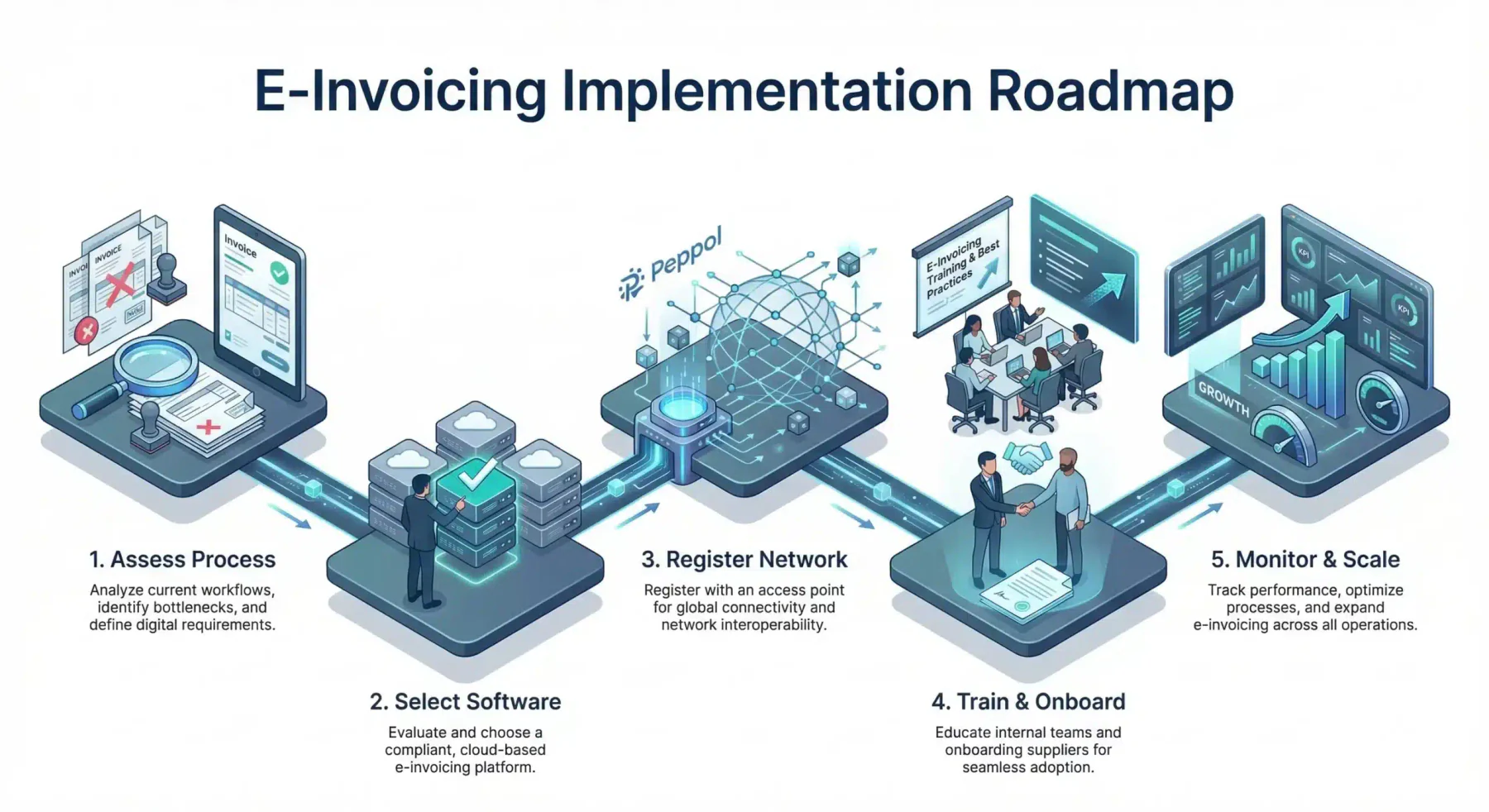
Implementing e-invoicing in your business can be straightforward when following a clear plan. Here are 5 simple steps to get started:
1. Assess your current invoicing process
Start by reviewing your current invoicing workflows to identify inefficiencies. Look for bottlenecks such as manual data entry, slow approvals, and errors that slow down the process. Understand the pain points and how e invoicing software can solve these issues. This assessment will give you a clear idea of how e-invoice can improve your operations.
2. Choose the right e-invoicing solution
Select e invoicing software that integrates well with your existing accounting or ERP system. Look for a solution that supports compliance with e-invoicing Australia regulations, such as the Peppol network.
Ensure the software is scalable to accommodate future growth and evolving needs. A suitable solution will help streamline invoice creation, transmission, and tracking, ensuring smoother operations.
3. Register with an e-invoicing network
To ensure your invoices are compliant and correctly exchanged, register with a recognized e-invoice network like Peppol. This registration allows your business to connect directly with other businesses and government agencies for seamless invoice transmission.
Ensure your e invoicing software is compatible with the chosen network to avoid any integration issues. This step ensures you are ready to exchange electronic invoices securely.
4. Train your team and onboard suppliers
Once the system is in place, train your finance team on how to use the new e invoicing system. Educate them on the benefits and features, such as automated approval workflows and error-free data entry.
Also, onboard your suppliers and clients, guiding them on how to send and receive invoices. This ensures all parties are aligned and able to fully benefit from the new system.
5. Monitor, optimize, and scale
After implementation, closely monitor your e invoicing system’s performance to ensure it’s functioning smoothly. Regularly check for improvements in processing speed, accuracy, and compliance.
Use system insights to adjust or scale your invoicing processes. This continuous optimization will help your business maintain efficiency and stay ahead in the digital economy.
HashMicro provides an integrated e-invoicing software solution that simplifies the transition to digital invoicing. We help businesses streamline their invoicing process through easy integration with existing ERP systems, ensuring compliance with Australian regulations like Peppol.
Our software automates the entire invoicing lifecycle, from invoice creation to payment, reducing human errors and saving time. With HashMicro, your business can implement e-invoicing seamlessly, driving operational efficiency and improving cash flow management.
E-Invoicing Solutions: What to Look For in Software

When selecting e invoicing software, it’s important to focus on features that improve efficiency and support Australian compliance requirements. Here’s what to look for:
- Peppol-ready connectivity: Ensure the software is Peppol-ready or connected through an accredited Peppol Access Point. This allows your business to send and receive e-invoices securely with other registered businesses and government agencies.
- PINT A-NZ support: Choose software that supports the PINT A-NZ framework, the Peppol International Invoice standard tailored for Australia and New Zealand. This helps ensure invoice data follows current regional requirements.
- ABN and GST-ready fields: The system should include built-in fields for ABN, GST, tax codes, and Australian business details. This improves invoice accuracy and simplifies tax reporting.
- Seamless integration with existing systems: The software should integrate easily with your accounting or ERP system to streamline workflows. HashMicro’s invoicing solution connects with a wide range of business systems, helping businesses automate processes with minimal disruption.
- AP and AR automation: Look for software that automates accounts payable and accounts receivable tasks such as invoice capture, approvals, reminders, and payment tracking. This reduces manual work and speeds up processing.
- Security and data privacy: A reliable e-invoicing solution should encrypt invoice data during transmission and protect sensitive financial information in line with privacy standards.
- User-friendly interface: The software should be simple to use, allowing your team to adopt it quickly and stay productive with minimal training.
- Real-time tracking and reporting: Choose a solution that provides live updates on invoice status, payments, and approvals. This improves cash flow visibility and supports faster decision-making.
Conclusion
The shift to e-invoicing is revolutionizing business operations by eliminating manual processes and delivering key benefits such as cost savings, enhanced security, faster payments, and greater efficiency. Transitioning to a fully digital system is no longer optional but a necessity for modern business success.
Industries such as healthcare, construction, and professional services are already reaping the benefits of e-invoicing to streamline operations, reduce errors, and improve cash flow. It’s clear that adopting e invoicing is critical to maintaining a competitive edge in today’s fast-paced market.
To make the most of e-invoicing, careful planning and the right support are essential. If you’re ready to streamline your invoicing and boost efficiency, you can consult with our expert to find an e-invoicing solution for your business. We’re here to guide you every step of the way!
FAQ About E-Invoicing
Frequently Asked Question
E-invoicing sends invoice data directly between accounting systems in a structured digital format through the Peppol network. A PDF invoice sent by email is still a document attachment that usually requires manual handling or data entry.
PINT A-NZ stands for Peppol International Invoice for Australia and New Zealand. It is a standard invoice format designed for local business and tax requirements, helping businesses exchange invoice data accurately through the Peppol network.
Most Australian businesses receive a Peppol ID when they register for e-invoicing through an accredited Peppol Access Point or supported accounting software provider. Your ABN is commonly used as part of the identifier.
B2G e-invoicing refers to businesses sending invoices to government agencies, while B2B e-invoicing is between private businesses. In Australia, Commonwealth agencies must be able to receive Peppol e-invoices, while most private sector use remains voluntary.
Yes. Businesses must still keep proper tax and financial records, including e-invoices, in line with ATO record-keeping requirements. Digital records should be accurate, complete, and accessible when needed.
Invoice solutions automate data entry, approvals, reminders, and payment tracking. This reduces manual work, lowers processing costs, minimises errors, and helps businesses get paid faster.
Most Australian businesses, government agencies, and organisations with an ABN can register for Peppol e-invoicing through an accredited Access Point or compatible software provider.
You can start by choosing e-invoicing software or an Access Point provider that supports Peppol. Once registered, you can send and receive e-invoices directly through your accounting system.
The ATO oversees Australia’s Peppol framework as the local Peppol Authority. It supports e-invoicing standards and tax compliance, but it does not receive or store invoice contents exchanged between businesses.
Peppol is a secure international network that standardises how invoice data is exchanged between systems. Australia uses it to improve invoice accuracy, reduce fraud, lower processing costs, and simplify business transactions.