















Every business faces the complex challenge of managing outgoing cash flow effectively. Accounts payable represent a fundamental pillar of finance that dictates overall financial health.
Business leaders must understand this function thoroughly to maintain strong vendor relationships and ensure long-term operational stability. Failing to manage accounts payable properly will surely bring unwanted risks to your company and potentially ruin relationships with partners and suppliers.
The importance of understanding accounts payable is a vital and fundamental part of business. This blog will elaborate on every important detail you need to know about accounts payable, and even additional information that all businesses in Australia must know.
Key Takeaways
Understand the fundamental definition of accounts payable and its role as a short-term liability.
Explore how accounts payable works through a comprehensive seven-step procure-to-pay process.
Discover the differences between accounts payable and account receivable to balance incoming and outgoing cash.
Learn about things to consider when managing accounts payable regarding local tax compliance.

What is Accounts Payable?
Accounts payable (AP) is the short-term debt a company owes to its suppliers or vendors for goods and services received on credit. This financial obligation appears as a current liability on the corporate balance sheet. Businesses must settle these debts within a specified timeframe to maintain their credibility.
Managing these liabilities requires a delicate balance between preserving cash and fulfilling vendor agreements. Delaying payments too long can damage supplier relationships and result in late fees, while paying invoices too fast can drain cash reserves that the business might need for unexpected cash needs.
Analysts closely monitor the accounts payable turnover ratio to evaluate liquidity and operational efficiency. A high turnover ratio indicates quick payments to suppliers and responsible debt management. A low ratio might suggest cash flow problems or a strategic decision to hold onto cash for longer periods.
AP serves as vital control over corporate spending and fraud prevention. Accurate payable data is needed to forecast cash requirements and make informed decisions. Accurate data ensures a truthful picture of your company’s financial health to external stakeholders.

How Accounts Payable Works
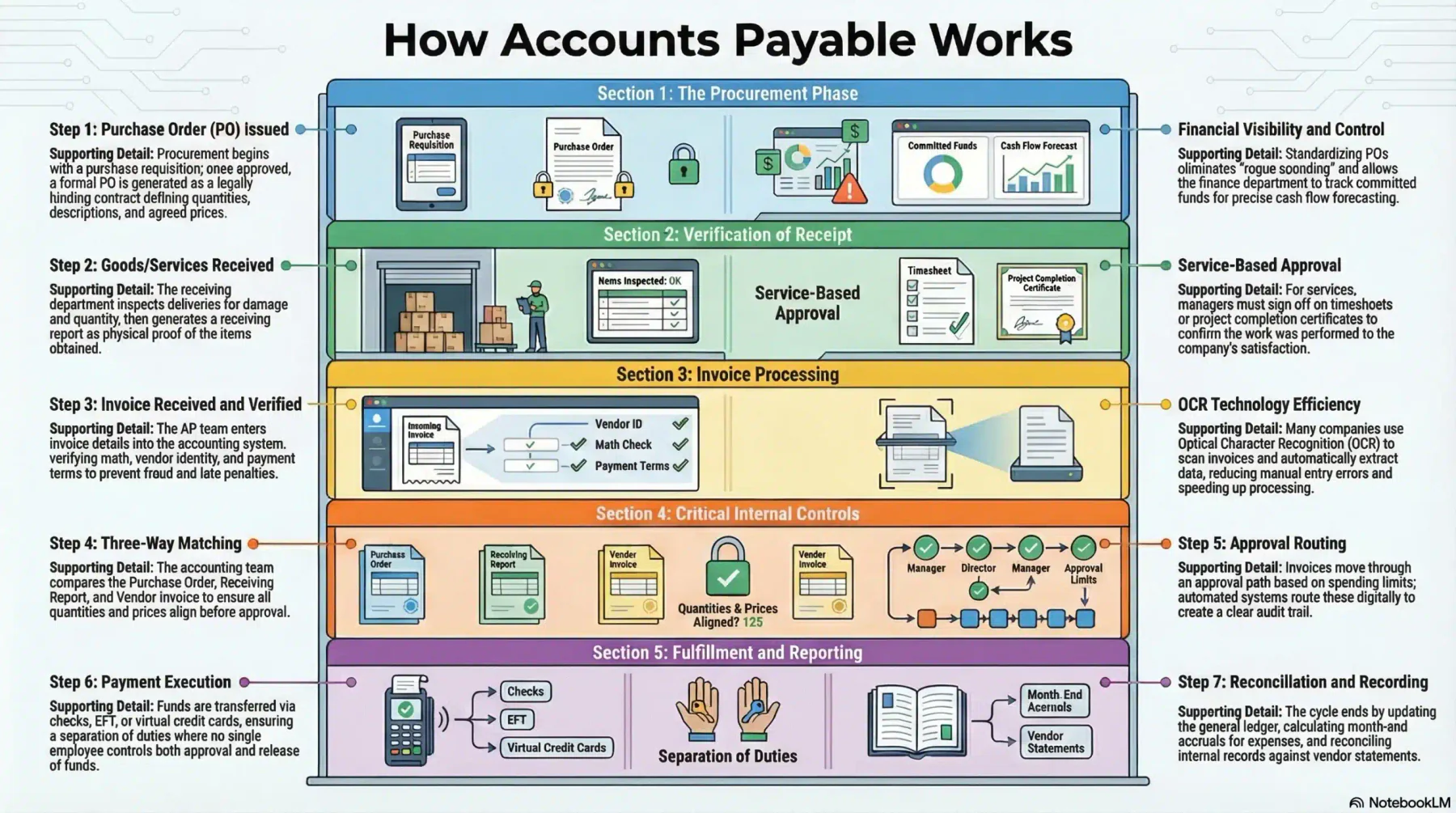
The accounts payable process encompasses a series of coordinated steps known as the procure-to-pay cycle. This workflow ensures that your company only pays for goods and services that are actually ordered and received, as it will protects the business from financial inconsistency and internal fraud.
1. Purchase order issued
Procurement begins when a department identifies a specific business need and submits a purchase requisition. After management approves, the purchasing department generates a formal purchase order (PO).
This document outlines the quantities, descriptions, and agreed prices for the requested goods or services. A purchase order serves as a legally binding contract between buyers and vendors, protecting both parties by defining the expectations and terms of the transaction before any work begins.
Vendors rely on this document to prepare their shipments and allocate their internal resources accordingly. Issuing a purchase order also helps the finance department track committed funds before the invoice arrives. This visibility allows cash flow forecasts to be adjusted with high precision.
Without PO, companies risk overspending and losing control over expenses. Standardizing POs processes eliminates rogue spending and unauthorized vendor engagements. This approach allows your company to negotiate better volume discounts and build stronger relationships with suppliers.
2. Goods/services received
The next phase occurs when the vendor delivers the physical goods or completes the requested services. The receiving department takes responsibility for inspecting the delivery to ensure it matches the original order.
Staff members must verify the physical quantities and check for any visible damage during transit. Upon successful inspection, the receiving team generates a receiving report to document the delivery. This internal document serves as proof that the company obtained the items listed on the PO.
The receiving report becomes a vital piece of evidence for the accounting department later in the payment cycle. Handling partial deliveries requires attention to detail from the receiving staff. If a vendor ships only half of the ordered items, the receiving report must clearly state the exact shortage.
Service-based transactions has a slightly different approach to the receiving process. A department manager must sign off on a timesheet or a project completion certificate. This approval confirms that the vendor performed the services to the company’s satisfaction.
3. Invoice received and verified
After goods or services are delivered, the vendor sends an official invoice requesting payment. The accounts payable team receives it and begins a review by entering the invoice details into the accounting system and checking that everything is accurate.
They verify the math, confirm the vendor’s identity against the approved master vendor list, and review the payment terms. This step prevents fraud, avoids late penalties, and lets your company take advantage of early payment discounts when available.
Many companies now use optical character recognition (OCR), a technology that scans invoices and automatically extracts key data. This reduces manual entry errors, speeds up processing, and makes the verification stage far more efficient.
4. Three-way matching (PO vs receipt vs invoice)
Three-way matching is one of the most important control steps in the accounts payable process. Before any payment is approved, the accounting team compares three documents: the purchase order, the receiving report, and the vendor invoice to make sure quantities and prices match.
If there is a mismatch, the invoice will be put on hold. The team then works with procurement and the vendor to resolve the issue, often by requesting a revised invoice or credit memo.
To avoid unnecessary delays, many companies set tolerance levels. This allows the system to automatically approve invoices with very small price differences, so staff do not waste time investigating minor discrepancies.
5. Approval routing
After an invoice clears the matching stage, it moves into the formal approval process. The approval path depends on the invoice amount and the department involved, guided by a delegation of authority that defines which managers can approve specific spending limits.
Smaller invoices may be approved by a department supervisor, while larger amounts are escalated to senior management or the CFO. This structure ensures financial control and accountability before any payment is released.
Manual approval processes often create delays, especially when paper documents are misplaced or managers are unavailable. Automated workflow systems solve this by routing invoices digitally, speeding up approvals and creating a clear audit trail of who approved each payment.
6. Payment execution
The payment execution phase is when the company actually transfers money to the vendor. The accounts payable team schedules payments based on invoice terms and accurate cash position monitoring to ensure bills are paid on time without slowing liquidity.
Businesses use different payment methods depending on vendor preferences and transaction size. While paper checks are still used in some industries, electronic funds transfers are faster and more secure, and virtual credit cards are increasingly popular because they offer potential cash rebates.
Strong internal controls are critical at this stage. Companies must separate approval and payment responsibilities to prevent fraud, ensuring that no single employee has full control over releasing company funds.
7. Reconciliation and recording
The final stage of the cycle focuses on recording and reconciliation. Once payment is made, the accounting team updates the general ledger to reduce the outstanding liability and ensure the financial statements reflect the company’s true position.
During month-end closing, the team reviews any unentered invoices and calculates accrued liabilities for goods received but not yet invoiced. Accruals (expenses recognized before payment is made) ensure costs are recorded in the correct accounting period.
They also reconcile vendor statements by comparing the supplier’s records with the company’s internal ledger. Resolving discrepancies and maintaining organised documentation not only protects vendor relationships but also prepares the company for smooth external audits.
Accounts Payable vs Accounts Receivable: What’s the Difference?
Accounts payable and accounts receivable represent opposite sides of the same transaction. When one company records a payable, the other records a receivable for the exact same amount. Together, these two functions directly impact cash flow, liquidity, and the overall cash conversion cycle.
| Accounts Payable (AP) | Accounts Receivable (AR) | |
| Definition | Money owed to vendors for credit purchases. | Money owed by customers for credit sales. |
| Financial Position | Current liability (future cash outflow). | Current asset (future cash inflow). |
| Main Objective | Manage payments strategically without harming vendor relationships. | Collect payments quickly to support operations. |
| Key Risk | Fraud, duplicate payments, missed discounts. | Bad debt and customer default. |
| Cash Flow Impact | Reduces cash when payments are made. | Increases cash when customers pay. |
Managing both functions effectively requires strong internal controls, accurate data, and continuous coordination. When customers delay payments, it can create pressure on accounts payable, increasing risks of liquidity issues if your supplier invoices still need to be settled.






Accounts Payable Examples
Real-world examples make the accounts payable process easier to understand. While industries may differ, the core accounting principles remain the same: record the obligation first, then settle it when payment is made.
In a retail scenario, a clothing chain orders 50,000 winter jackets with Net 60 payment terms. After receiving the goods and matching the PO, receiving report, and invoice, the company records an increase in inventory and accounts payable. The payment is made within 60 days later, as per agreed terms.
In a service-based example, a software agency receives a monthly invoice for cloud hosting services. Once usage is reviewed and approved, the company records the expense and increases accounts payable. When the invoice is paid, accounts payable and cash both decrease at the same time.
Accounts Payable for Australian Businesses: Key Considerations

Managing accounts payable in Australia requires businesses to comply with strict tax and record-keeping rules set by the Australian Taxation Office. Companies must maintain accurate transaction records to ensure regulatory compliance and avoid audit risks.
The Goods and Services Tax (GST) adds a 10% tax to most purchases, which businesses can later claim as a credit. To qualify, accounts payable teams must collect valid tax invoices and verify the supplier’s Australian Business Number (ABN).
Large businesses must also follow the Payment Times Reporting Scheme, which requires public reporting on how quickly suppliers are paid. This regulation encourages faster payments to small businesses and improves cash flow transparency.
How Accounting Systems Help Australian Businesses Manage Accounts Payable
Large Australian businesses rely on accounting systems to manage high-volume, complex accounts payable operations with accuracy and control. These systems centralise invoices, approvals, and payments, giving finance teams real-time visibility into cash flow and outstanding liabilities.
For example, companies like Woolworths Group handle thousands of supplier invoices daily across retail, logistics, and distribution networks. An integrated accounting system automates invoice matching and approval workflows, reducing payment delays and strengthening supplier trust.
In capital-intensive industries, BHP uses enterprise accounting systems to manage global supplier payments, ensure compliance, and forecast cash requirements accurately. Automation helps enforce strict controls and prevents duplicate payments or fraud risks at scale.
Telecommunications leaders like Telstra depend on accounting software to integrate procurement, accounts payable, and reporting into one platform. This allows finance leaders to analyse spend, optimise payment timing, and support strategic working capital decisions across the business.
Common Accounts Payable Pitfalls and Mitigation Strategies
Even with strong systems in place, accounts payable teams still face risks that can harm the company’s finances, reduce cash flow, and damage supplier relationships. Understanding these common problems is the first step to building a stronger and more reliable financial process.
- Invoice Discrepancies and Exceptions
Invoice exceptions are one of the most common challenges in accounts payable. These happen when invoice details do not match the purchase order or receiving documents, such as incorrect prices, missing items, or wrong tax amounts.
If not managed properly, these mismatches create delays, payment backlogs, and frustrated suppliers. To reduce this risk, many companies enforce a “No PO, No Pay” policy to ensure all purchases are pre-approved.
Automated matching systems also help by allowing small, predefined differences while flagging larger issues for review. This keeps payments moving while still maintaining financial control.
- Duplicate Payments and Fraud Risks
Duplicate payments are a serious issue because they directly reduce working capital and are often difficult to recover. They usually happen when the same invoice is submitted more than once or when small data entry errors create duplicate records.
Accounts payable is also a major target for fraud, including Business Email Compromise (BEC) and scams where criminals impersonate suppliers to redirect payments. These attacks can result in large financial losses if controls are weak.
To reduce these risks, companies must regularly audit their vendor master data, require multi-factor authentication for bank detail changes, and use automated tools that flag duplicate invoices or unusual payment patterns.
Advanced Best Practices for Accounts Payable
Turning accounts payable from a basic back-office task into a strategic business function requires a modern finance handling solution and a more proactive approach to managing finances.
- Dynamic Discounting and Supply Chain Finance
Business leaders use accounts payable to create financial value through tools like dynamic discounting. Instead of fixed early payment terms, dynamic discounting offers flexible discounts that decrease as the due date gets closer, helping companies earn better returns on excess cash.
Another strategy is supply chain finance, also known as reverse factoring. In this model, a third-party financial institution pays the supplier early, and the buyer repays the institution on the original due date.
This approach improves supplier cash flow while allowing the buying company to preserve its own working capital position.
- Centralized Master Vendor Data Management
A strong accounts payable process starts with clean and well-managed vendor data. Leading AP teams use centralized master data controls to keep supplier information accurate and up to date.
This includes regularly reviewing vendor records, removing inactive suppliers, merging duplicates, and verifying tax identification numbers. Maintaining an organized vendor database reduces compliance risks, simplifies year-end reporting, and improves the accuracy of spending analysis.
- Continuous Improvement and Spend Analytics
Modern accounts payable teams do more than process invoices; they use transaction data to guide future business decisions. By analyzing AP data, finance leaders gain insights into spending patterns, cash flow trends, and vendor performance.
Advanced analytics tools can reveal hidden costs, highlight opportunities for contract renegotiation, and improve purchasing decisions. Regularly reviewing workflows and automation performance also helps companies scale operations efficiently without significantly increasing administrative staff.
- Leveraging Accounting Software for Efficiency and Accuracy
Using accounting managing for enterprise systems automates many manual accounts payable tasks, such as invoice capture, matching, and approvals.
The software provides real-time visibility into outstanding liabilities, early-payment opportunities, and cash flow forecasts. This helps companies manage working capital more effectively.
Centralizing AP data in a digital platform makes reporting easier, ensures compliance, and allows tracking of vendor performance. Overall, accounting software improves efficiency, strengthens financial control, and supports smarter, strategic decision-making.
Conclusion
Accounts payable is far more than a routine bill-paying function. It plays a critical role in managing cash flow, protecting profitability, and maintaining strong supplier relationships. When handled strategically, AP strengthens supply chains and supports long-term financial stability.
Ultimately, an optimized accounts payable process gives businesses a real competitive advantage. Paying suppliers accurately and strategically helps unlock financial value while keeping operations stable and scalable.
To optimize your own account payable cycle, you can try our free consultation and let us aid you in enhancing your business even further. Take the first step today and turn your finance operations into a stronger, more strategic advantage.

Frequently Asked Question
Accounts payable is important because it affects cash flow. If managed improperly, your company will risk cash shortages, damaged supplier relationships, and penalties or late fees.
Accounts payable is a liability, not a cost. Expense is recorded when goods or services are used. Accounts payable simply records the unpaid amount owed.
Yes, some companies strategically extend payment timing to manage working capital. However, excessive and unplanned payment delays can lead to improper accounts payable management.
Accounts payable is recorded by debiting the relevant expense or asset account and crediting the accounts payable account when an invoice is received. The payable is cleared once the payment is made to the supplier.
The two main types of accounts payable are trade payables, which relate to goods and services from suppliers, and non-trade payables, such as taxes, utilities, and other operating obligations.