














Managing inventory, warehousing, transportation, and order fulfillment can become challenging when processes are handled across disconnected systems. Distribution management software helps centralize these activities, improving visibility, coordination, and operational efficiency.
According to the New Straits Times (NST), Malaysia’s e-commerce sector continues to expand, increasing pressure on distributors to manage inventory, deliveries, and order fulfillment more efficiently. Digital tools help businesses maintain visibility and responsiveness as operational demands grow.
Distribution management software helps bring these processes together, enabling greater visibility and operational control. Here’s a closer look at the key workflows behind effective distribution management.
Key Takeaways
Distribution businesses bridge manufacturers and markets, managing logistics, inventory, sales networks, and product distribution efficiently.
Distribution models vary by ownership, risk, capital, and sales channels, shaping strategy, operations, and profitability.
Use integrated systems to control inventory, demand, logistics, and cash flow more accurately and efficiently.
Disconnected distribution processes can lead to delays, stock inaccuracies, and poor visibility. Distribution management software helps centralize operations and improve control across the supply chain.
What Is a Distribution Business?
A distribution business model acts as a crucial intermediary within the supply chain. It effectively bridges the gap between producers and the final consumers.
Fundamentally, a distribution company purchases products in large quantities directly from manufacturers. It then stores, sells, and ships them to retailers or other business entities.
This role extends beyond mere product transportation. Distributors also handle logistics, inventory management, and sales within a specific territory.
This allows manufacturers to focus on innovation and production. Meanwhile, their products reach a broader market efficiently through the distributor’s network.
The primary value of a distributor lies in creating large-scale efficiency and market access. This is something producers would find difficult to achieve independently.
Distributors assume the risk of inventory ownership and manage warehousing complexities. They build solid sales networks to ensure products reach the right hands at the right time.
Types of Distribution Business Models
Understanding different distribution models is an important first step for FMCG distributors looking to improve efficiency and scale operations. Each model comes with unique operational requirements, cost structures, and fulfillment challenges that can influence business performance and long-term growth.
Your chosen model will influence pricing, supplier relations, and market positioning, making operational efficiency vital. Integrated technology ensures visibility and profitability that offers deeper insights into managing complex supply chains effectively.
1. Wholesale distributor
This is the most common model where a company purchases products in large volumes from manufacturers. They then resell these products in smaller quantities to retailers or other businesses.
The main advantage is securing low purchase prices due to bulk buying. However, it requires substantial capital for inventory and highly efficient warehouse management.
2. Retail distributor
Retail distributors sell products directly to the end consumer. They may still purchase goods from manufacturers or other wholesalers for their stock.
This model often uses physical stores or e-commerce platforms as its primary sales channels. The main challenges are intense market competition and the need for effective marketing.
3. Agent or broker
Agents or brokers act as intermediaries connecting manufacturers with buyers. They never physically own or store the product inventory themselves.
They earn a commission from each successful transaction they facilitate. This model relies heavily on a strong network and deep market understanding.
4. Exclusive distributor
In this model, a distributor gets exclusive rights to sell a specific product in a defined area. This relationship is often a strategic partnership with the manufacturer.
The advantage is minimal direct competition for that product. However, the distributor is under significant pressure to meet sales targets and uphold the brand’s reputation.
Step-by-Step Guide to Building a Successful Distribution Business
Building a distribution business from the ground up is a complex process that demands strategic planning and precise execution. It requires establishing efficient operations, strong partnerships, and sound financial management to create a solid foundation for long-term growth.
Success depends on integrating all elements into a cohesive system supported by technology. Unified processes enhance efficiency, ensure data accuracy, and enable real-time decision-making for a more resilient and sustainable distribution business.
1. Market research and industry niche selection
First, conduct in-depth market research to identify an industry with stable demand and healthy profit margins. This analysis should include understanding your target customers, main competitors, and market gaps.
Choosing a specific niche, like precision electronic components, is often more profitable. It allows you to build strong expertise and a solid reputation in a focused area.
2. Developing a solid business plan
A business plan is your strategic roadmap detailing every operational and financial aspect. This document should cover your market analysis, business model, and marketing strategies.
Include realistic financial projections like revenue forecasts and cash flow statements. A solid business plan is essential for guiding internal decisions and seeking funding.
3. Managing legality and permits
Every business must operate under a clear legal framework. This includes choosing and registering the appropriate business entity and securing necessary permits.
Depending on the products you distribute, you may need special permits from regulatory bodies. For example, you might need distribution permits from NPRA for food and drug products.
4. Building relationships with trusted suppliers
The quality and reliability of your suppliers are the lifeblood of your business. Research to find manufacturers with a good reputation and competitive pricing.
Build strong partnerships through open communication and timely payments. This ensures a smooth and dependable supply chain for your operations.
5. Preparing warehouse and logistics infrastructure
The warehouse is your operational center, so its management must be planned carefully. Decide whether to rent, buy, or build a warehouse based on your business scale.
Design an efficient layout to maximize storage and speed up processes. Additionally, build your own logistics fleet or partner with reliable third-party logistics (3PL) companies.
6. Developing marketing and sales strategies
Marketing and sales strategies are crucial for reaching potential customers. Build a competent sales team to establish relationships with retailers or other businesses.
Leverage digital marketing like a professional website and SEO to increase brand visibility. Offer a clear value proposition to differentiate yourself from competitors.
7. Implementing technology for operational efficiency
Running a distribution business manually is slow and prone to errors. Invest in the right technology, such as an Enterprise Resource Planning (ERP) system, from the beginning.
The right software provides real-time stock visibility and automates ordering. It also supplies accurate data for better strategic decision-making and overall efficiency.
Read more: What Are Precision Components and How to Choose Them?
Key Challenges in Running a Distribution Business
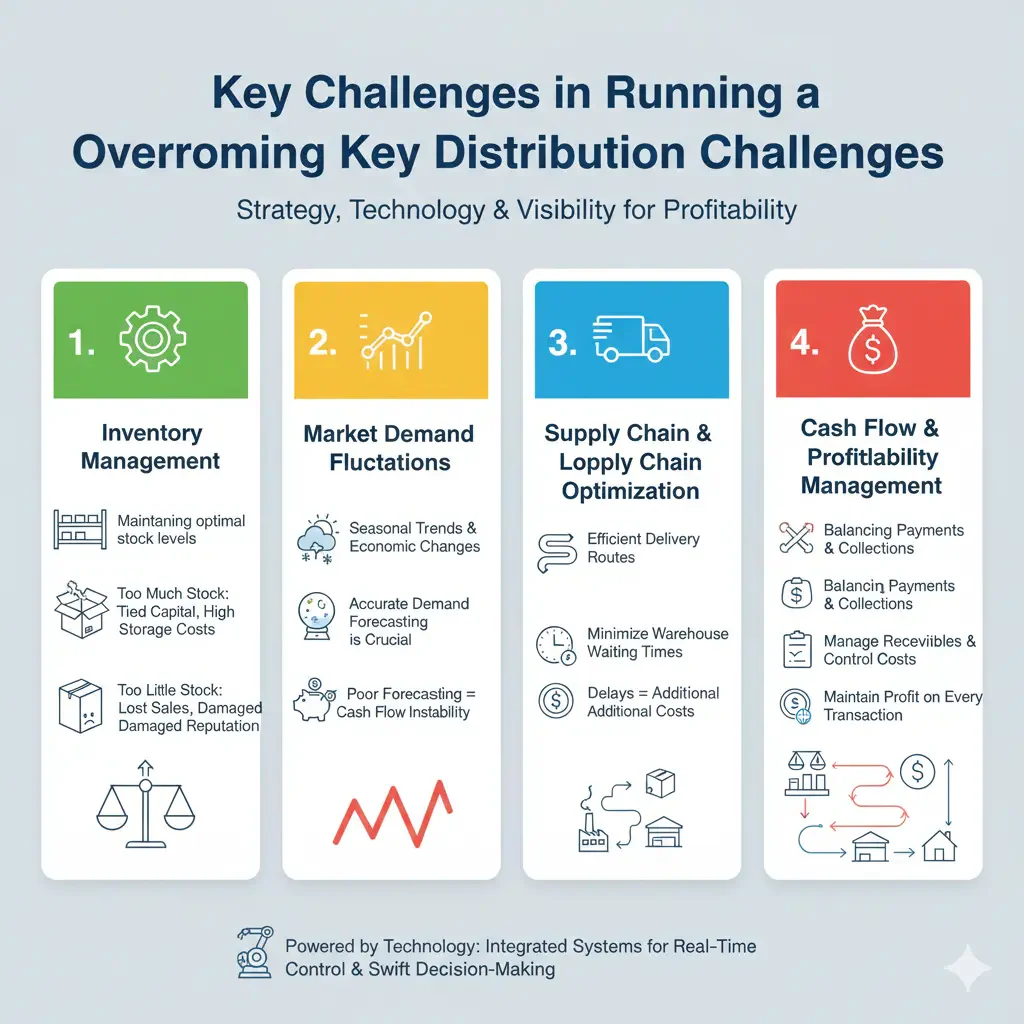
The distribution business offers substantial profit potential but comes with complex challenges that require strategic management. Business leaders must handle fluctuating markets, intricate stock movements, and constant operational changes to maintain profitability and sustainability.
Overcoming these challenges requires visibility, control, and swift decision-making supported by technology. Integrated systems enable real-time monitoring across operations, while insights from food packaging industries illustrate the importance of adopting specialized technological solutions.
1. Complex inventory management
This is the biggest challenge for almost all distributors. Maintaining a perfect stock balance is a difficult art to master.
Too much stock ties up capital and increases storage costs. Too little stock leads to lost sales and disappoints customers, damaging your reputation.
2. Market demand fluctuations
Market demand is rarely static and is influenced by seasonal trends and economic conditions. Distributors must forecast this demand as accurately as possible to adjust inventory.
A failure in demand forecasting can lead to inventory problems. It also disrupts the company’s cash flow stability, making future planning difficult.
3. Supply chain and logistics optimization
Efficiency in the supply chain directly impacts operational costs and customer satisfaction. Challenges include managing delivery routes and minimizing warehouse waiting times.
Every delay or error in these processes can incur additional costs. This makes it a constant area of focus for improvement and optimization.
4. Cash flow and profitability management
The distribution business often operates on thin profit margins, making cash flow management crucial. The challenge is balancing payments to suppliers with collections from customers.
Managing outstanding receivables and controlling operational costs is a constant struggle. Maintaining profitability on every transaction is essential for long-term success.
The Role of Technology in Optimizing a Distribution Business
As distribution networks grow more complex, technology has become essential for maintaining operational to support business growth. Manual processes can no longer handle modern complexities, but the right technology transforms challenges into opportunities by improving efficiency, control, and agility in responding to market demands.
A centralized ERP system provides the visibility needed to manage increasingly complex distribution operations. This aligns with Malaysia’s broader digital transformation agenda, where businesses are encouraged to adopt digital technologies to improve productivity and competitiveness.
1. Automation of inventory management
Modern inventory systems enable real-time stock tracking and provide automatic low-stock notifications. This directly addresses the problems of overstock and understock, freeing up working capital.
Features like demand forecasting help companies make smarter procurement decisions. With automation, human error is minimized, leading to more accurate inventory records.
2. Centralization of sales and customer data
Integrating Sales Management and CRM systems centralizes all order and customer data. The sales team can access this information to provide more personalized service.
Management can monitor sales team performance and analyze sales trends more accurately. This unified view of the customer enhances relationships and drives repeat business.
3. Efficiency in financial management
Accounting software automates time-consuming tasks like invoice creation and accounts receivable tracking. This system provides real-time visibility into cash flow and simplifies financial reporting.
With accurate financial data, companies can make better decisions to maintain financial health. This also ensures compliance with financial regulations and simplifies auditing processes.
4. Enhanced supply chain visibility
Technology like a Supply Chain Management (SCM) System provides end-to-end visibility. Companies can track shipments from suppliers and manage warehouse operations more efficiently.
This visibility improves internal efficiency and allows companies to provide accurate tracking information to customers. Ultimately, this increases customer satisfaction and loyalty.
Study Case: Transforming Operations at a Malaysian Distribution Business
A Malaysia-based FMCG distributor struggled with inventory inaccuracies and delayed order fulfillment because stock data was managed manually across multiple warehouses. Limited visibility often resulted in stock discrepancies, inefficient replenishment decisions, and slower responses to customer demand.
After implementing an integrated distribution management system, the company gained real-time visibility across inventory, sales, procurement, and warehouse operations. Within 90 days, stock discrepancies dropped from 12% to 3%, order fulfillment time improved from two days to same-day processing, and inventory holding costs decreased by 18%.
The results demonstrate how a centralized distribution platform can improve operational control, reduce inventory-related risks, and support faster, more reliable fulfillment. As distribution networks grow more complex, integrated systems play an increasingly important role in maintaining efficiency and service quality.
Conclusion
Starting a distribution business demands strategic planning, operational precision, and the ability to turn real-world challenges into actionable improvements. Success comes from managing inventory, logistics, and cash flow with clarity and informed decision-making.
Technology plays a key role in connecting operations, improving visibility, and supporting more efficient workflows. When systems work together, businesses can respond faster to change and maintain stronger control across the supply chain.
To explore how the right approach can support your distribution goals and operational needs, feel free to reach out for a consultation and tailored advice.

FAQ About Distribution Business
How do distributors make money?
Distributors primarily make money by purchasing products in bulk from manufacturers at a discounted price and selling them to retailers or other businesses at a higher price. The difference, known as the margin, constitutes their profit. They also add value through services like logistics, warehousing, and sales.
What is the most profitable distribution business?
The most profitable distribution businesses are often in niches with high demand, stable supply, and healthy margins. Industries such as pharmaceuticals, high-tech electronics, and specialty foods are known to be lucrative due to product value and consistent demand.
Is a distribution business hard to start?
Starting a distribution business can be challenging due to high initial capital requirements for inventory and warehousing, complex logistics, and the need to build strong supplier and customer networks. However, with a solid business plan and the right technology, these challenges can be effectively managed.
How much capital is needed to start a distribution business in Malaysia?
The capital required depends on factors such as product category, inventory levels, warehouse requirements, transportation needs, and business scale. Small distributors may start with a modest investment, while larger operations often require significantly more capital to support inventory purchases, logistics, staffing, and working capital.
What licences are required for distributors in Malaysia?
Licensing requirements vary by industry and the products being distributed. At a minimum, businesses typically need company registration with the Companies Commission of Malaysia (SSM), while certain sectors such as food, pharmaceuticals, electronics, or regulated products may require additional permits, certifications, or regulatory approvals.
How can software reduce stockouts in a distribution business?
Distribution management software helps reduce stockouts by providing real-time inventory visibility, tracking stock movements across locations, and generating replenishment alerts when inventory reaches predefined thresholds. This allows businesses to make more informed purchasing decisions and maintain optimal stock levels.