















As HR processes become more digital, managing employee data is no longer just an administrative task. Payroll details, medical records, performance reviews, and other sensitive information now move faster across systems, which means the risk of misuse, unauthorized access, or poor handling can also increase if the right safeguards are not in place.
For businesses, understanding the Personal Data Protection Act is not only about meeting legal requirements. It also plays an important role in strengthening corporate governance, protecting confidential employee information, and maintaining trust in how the company handles personal data at every stage of the employment cycle.
By understanding and applying the core PDPA principles in human resource management, companies can reduce the risk of data breaches, avoid unnecessary penalties, and build a safer and more reliable work environment. This article will walk through the key principles and show how they apply in day to day HR practices.
Key Takeaways
PDPA in HR starts with knowing what employee data is being handled and how far the company is responsible for protecting it.
The 7 principles of PDPA help companies control how employee data is collected, shared, secured, retained, and accessed across HR operations.
Failing to apply PDPA properly can expose the business to legal penalties, leadership liability, and long term reputational damage.
7 PDPA Principles Summary: HR Quick Reference
Now that we’ve walked through each of the 7 PDPA principles in detail, here’s a quick-reference table to help HR teams implement them effectively. Bookmark this summary for onboarding, audits, or policy reviews.
| Principle | Core Requirement | HR Application Example | Key Action |
| 1. Consent | Process data only with clear, specific consent | Signed consent forms during employee onboarding | Use active opt-ins; avoid pre-ticked boxes |
| 2. Notice & Choice | Inform individuals of data collection purpose & give choice | Bilingual Privacy Notice (BM & EN) before recruitment | Include DPO contact & consequences of non-provision |
| 3. Disclosure | Limit data sharing to legitimate purposes & authorized parties | Share payroll data only with contracted vendors | Sign Data Processing Agreements (DPA) with third parties |
| 4. Security | Protect data against unauthorized access or breaches | Encrypt employee databases + role-based access controls | Implement MFA, regular security audits, staff training |
| 5. Retention | Delete data once purpose is fulfilled or retention period ends | Keep tax records for 7 years; delete unsuccessful applications after 12 months | Document retention policy + schedule secure disposal |
| 6. Data Integrity | Ensure data is accurate, complete, and up-to-date | Validate employee inputs via self-service portals | Schedule periodic data audits; encourage employee updates |
| 7. Access Rights | Honor individuals’ right to access & correct their data | Respond to Subject Access Requests (SAR) within 21 days | Prepare identity verification flow + redact third-party data |
The Severe Consequences of Non-Compliance
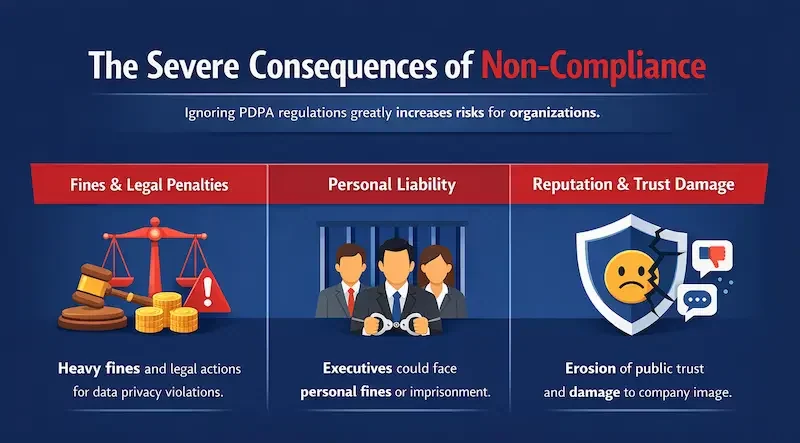
Treating the 7 principles of PDPA as optional rather than mandatory legal requirements can expose an organization to serious consequences. As data protection enforcement becomes stricter, the cost of non compliance can extend beyond regulatory penalties to broader business risk.
Financial and Legal Repercussions
In jurisdictions that enforce the PDPA, breaches can lead to significant financial penalties. Organizations may face substantial fines for each violation, and the liability may not stop at the company level. Directors, chief executive officers, managers, and other corporate officers can also be held personally accountable, which may result in personal fines or imprisonment depending on the severity of the breach.
Reputational Damage and Loss of Trust
The impact of non compliance is not limited to legal and financial exposure. A data breach or public compliance failure can also damage the organization’s reputation, weaken stakeholder confidence, and reduce employee trust in how personal data is handled.
To support stronger employee data management in practice, it also helps to compare HR software pricing before choosing the right solution.

Conclusion
Understanding the 7 PDPA principles is not only about staying compliant with legal requirements, but also about managing employee data with greater care and accountability. In HR, where personal and sensitive information is handled every day, these principles help businesses build clearer processes for consent, access, disclosure, retention, and security.
When applied consistently, the principles do more than reduce the risk of penalties or data breaches. They also support stronger corporate governance, protect confidential employee information more effectively, and reinforce trust in how the organization manages data across the employment lifecycle.
As HR operations become more digital, this is a good time for businesses to review whether their current practices still align with PDPA expectations and the level of protection employees now expect. For companies that want to explore this more carefully, a free consultation can be a practical way to discuss current challenges, identify possible gaps, and see what improvements may be worth prioritizing.

Frequently Asked Questions About PDPA in HR
Does every company in Malaysia need to appoint a Data Protection Officer?
Not every company was historically required to do so, but Malaysia’s recent PDPA amendments and related guidance have made DPO appointment a more practical compliance consideration for many businesses. For organizations handling significant employee data, this is increasingly becoming an important governance issue.
What should a company do first if an employee data breach happens?
The first step is to contain the incident, assess what personal data was affected, and activate an internal response process immediately. This is especially important as Malaysia’s evolving PDPA framework places greater attention on breach response and notification readiness.
Can employee data be transferred outside Malaysia?
Cross border transfers can still happen, but companies should not treat them as routine administrative work. Businesses need to review whether their HR systems, cloud vendors, and regional workflows apply the right safeguards before employee data is transferred outside Malaysia.
Does PDPA affect employee monitoring and automated HR decisions?
Yes. Employee monitoring, profiling, and automated HR decisions are becoming more important under Malaysia’s evolving PDPA landscape, especially when technology is used for performance tracking, screening, or workforce analysis. Companies should review these activities carefully to ensure transparency, fairness, and proper internal controls.