















Many sales teams in Malaysia struggle to close deals consistently because their sales process is unclear or inconsistent. Without a structured workflow, teams often face poor follow-ups, uneven pipeline management, and lower conversion rates. Implementing a clear sales process helps businesses improve consistency, organize sales activities, and increase overall sales performance.
This is supported by research from McKinsey, which found that companies with structured and documented sales processes tend to achieve 28% more revenue growth and higher win rates. When combined with CRM software, businesses also gain better pipeline visibility, more accurate tracking, and improved coordination across the sales team.
This article will discuss the seven essential steps in sales process, key workflows worth automating, and strategies businesses can use to improve sales performance, increase win rates consistently, and optimize pipeline management with a CRM sales system.
Key Takeaways
A structured sales process helps businesses improve consistency, optimize sales activities, and achieve more predictable results.
The seven-step sales process helps businesses manage each sales stage more systematically and improve overall sales effectiveness across different industries.
Continuously improving your sales process helps businesses stay competitive, adapt to changing buyer behavior, and achieve better sales performance over time.
Many businesses struggle with inefficient sales processes and missed follow-ups. An integrated sales automation solution helps improve lead management and sales efficiency.

What Is a Sales Process in Business?
A sales process is a structured series of steps used by sales teams to guide prospects from the first interaction to a successful deal. By following a consistent process, businesses can standardize how sales reps approach potential customers, making sales activities more organized and results more predictable.
A defined sales process also helps companies monitor each sales stage more effectively, making coaching and performance evaluation easier. In addition, it speeds up onboarding for new sales reps because they can quickly learn a proven workflow. Many businesses today integrate their sales process into CRM or sales management system to gain better pipeline visibility and identify areas for improvement.
Sales Process vs Sales Methodology vs Sales Cycle
These three terms get used interchangeably, but they describe three different things, and confusing them leads to confused tactics.
| Term | Definition | Focus | Example |
| Sales Process | A structured series of steps used to guide prospects from first contact to closing a deal. | Sales workflow and stages | Prospecting → Qualification → Closing |
| Sales Methodology | The selling approach or technique used during the sales process. | Communication and sales strategy | SPIN Selling, Challenger Sale |
| Sales Cycle | The time required to convert a prospect into a customer. | Sales duration and efficiency | 30-day or 120-day sales cycle |
The difference matters because each one fixes a different problem. If your win rate is low, the methodology probably needs work. If your conversion at one stage is poor, your process has a gap. If your cycle is long but conversion is healthy, the issue is throughput rather than skill.
Why Your Business Needs a Defined Sales Process?
A defined sales process helps businesses create more consistent and measurable sales performance by reducing guesswork throughout the pipeline. Companies with a structured sales process also tend to achieve higher win rates and better overall sales efficiency.
Some of the main benefits of a defined sales process include:
- Higher win rates through more consistent sales execution
Sales teams follow the same qualification, follow-up, and closing approach, which reduces inconsistency and improves the chances of converting opportunities into customers. - Shorter sales cycles with clearer workflows and follow-ups
A structured process helps reps know what actions to take at each stage, reducing delays and helping deals move through the pipeline faster. - Faster onboarding for new sales representatives
New sales reps can adapt more quickly because they already have a clear framework, workflow, and sales stages to follow from the beginning. - Better visibility into pipeline performance and bottlenecks
Businesses can track where deals are slowing down, identify weak stages in the pipeline, and make improvements more effectively.
- More accurate sales decisions based on clear data
Standardized sales activities produce more reliable reporting, helping managers make better forecasting and performance decisions.
- Improved conversion rates across each sales stage
Clear sales steps help teams handle leads more effectively, improving the likelihood of prospects moving from one stage to the next.
- Stronger consistency in how sales teams manage opportunities
Every sales rep follows similar processes and standards, creating a more organized pipeline and more predictable sales performance.
Research from HubSpot’s 2024 Sales Trends Report also found that teams using a defined sales process generally achieve higher win rates compared to teams without one.
By implementing a structured sales process, businesses can improve sales consistency, reduce inefficiencies, and make it easier for teams to maintain stronger performance over time. When supported by CRM sales software, companies can also monitor pipeline activity more accurately and optimize each stage of the sales cycle more effectively.
The 7 Steps of the Sales Process
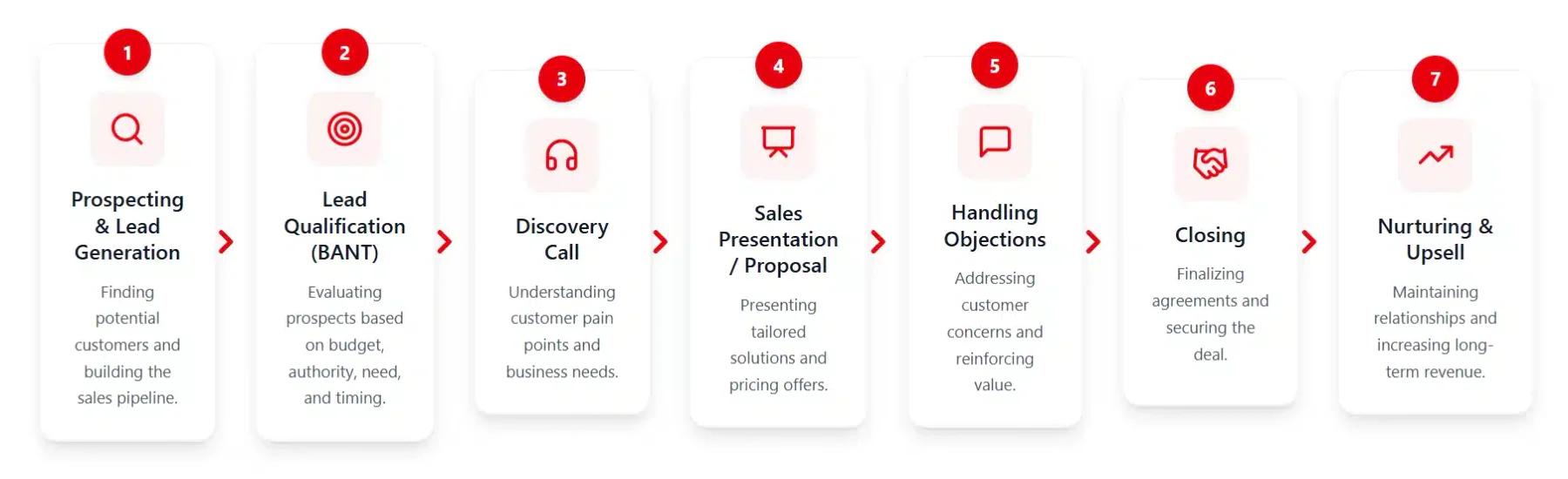
The framework below applies whether you sell software, industrial equipment, or professional services. What changes between industries is the time each step takes, not the steps themselves.
Step 1: Prospecting and Lead Generation
This stage focuses on identifying potential customers that match the ideal customer profile (ICP) and starting the first interaction. Leads can come from outbound outreach, inbound marketing, referrals, or business partnerships. The main goal is to build a healthy sales pipeline and secure qualified discovery calls with potential buyers.
Step 2: Lead Qualification with BANT
Not every prospect is ready to buy, which is why sales teams use the BANT framework: Budget, Authority, Need, and Timing. This method helps sales reps evaluate whether a prospect has the budget, decision-making power, business need, and urgency to move forward. By qualifying leads early, businesses can focus their time on high-potential opportunities.
Step 3: Discovery Call
The discovery call helps sales reps understand the prospect’s challenges, goals, and pain points in greater detail. Instead of focusing on product promotion, reps should ask open-ended questions and actively listen to the buyer’s needs. A successful discovery call usually reveals the customer’s main problem, the impact of the issue, and their expected timeline for making a decision.
Step 4: Sales Presentation or Proposal
After gathering information during discovery, the sales team presents a tailored solution that directly addresses the customer’s needs. A strong proposal typically explains the buyer’s problem, how the product or service solves it, pricing details, and supporting case studies or examples. Personalized presentations are generally more effective than generic sales pitches.
Step 5: Handling Objections
During the sales process, prospects may raise objections related to pricing, timing, product suitability, or internal approval. Sales reps should treat these concerns as opportunities to provide clarification and reinforce value rather than as rejection. Addressing objections effectively helps build trust and move the deal closer to closure.
Step 6: Closing
Closing is the stage where the prospect agrees to move forward with the purchase. In B2B sales, this process often involves multiple stakeholders such as operations, procurement, and finance departments before final approval is given. When the earlier sales stages are handled properly, closing becomes a smoother confirmation process instead of a hard sell.
Step 7: Nurturing and Upsell
The sales process continues even after the deal is closed. Businesses should maintain customer relationships through regular follow-ups, customer support, and upselling opportunities. Strong post-sales engagement can improve customer retention, increase long-term revenue, and create opportunities for repeat business.
Common Sales Process Mistakes in Business Field
Even teams with a documented process fall into predictable traps. These five are the most common.
- Skipping qualification
A rep books a demo without checking whether the prospect has budget or authority. Two weeks later, eight hours have gone into a deal that was never going to close. - Pitching before diagnosing
The rep opens the discovery call with a slide deck instead of a question. The prospect tunes out within five minutes. - Talking more than listening
Discovery calls where the rep talks more than half the time produce lower close rates. Gartner research shows the gap is roughly 2.5 times in favour of reps who let the prospect talk. - No follow-up system after the proposal
The rep sends the proposal and goes quiet when the buyer goes quiet. Buyers interpret silence as disinterest. A cadence of three follow-ups over 10 business days recovers a meaningful share of these deals. - No defined exit criteria
Without explicit conditions for moving a deal forward, deals advance on the rep’s optimism rather than the buyer’s readiness. The result is a pipeline that looks healthy on Friday and collapses on Monday.
What Parts of the Sales Process Should You Automate?
Sales process automation does not mean replacing salespeople. It means removing the manual administrative work that pulls reps away from selling. McKinsey research shows the average B2B sales rep spends about 28 percent of their week on actual selling activity. The rest is admin, CRM updates, and internal meetings. Automation closes that gap.
Four areas worth automating
| Automation Area | Description | Main Benefit |
| Lead Scoring & Routing | Automatically classifies leads as hot, warm, or cold and assigns qualified leads to the right sales rep. | Faster response time and higher conversion opportunities. |
| Pipeline Stage Updates | Automatically updates deal stages after sales reps complete activities such as discovery calls or note submissions. | Reduces manual work and improves pipeline accuracy. |
| Follow-up Email Sequences | Sends automated personalized follow-up emails after important sales stages like discovery or proposal submission. | Ensures consistent communication with prospects. |
| Quote & Proposal Generation | Sales force automation helps businesses automatically generate quotations and proposals using customer, pricing, and product data stored in the CRM. | Saves time and speeds up the sales process. |