















Managing leads from WhatsApp, LinkedIn, referrals, and trade events around KL or Shah Alam can get messy fast. Without a clear sales cycle, your team may follow up late, miss buyer signals, or lose deals simply because no one knows the next step.
This matters even more in Malaysia, where MSMEs contributed 39.5% to the economy in 2024 and recorded 5.8% GDP growth, according to DOSM. A structured cycle helps sales teams turn that momentum into more predictable revenue.
In this guide, you’ll learn what a sales cycle is, its 7 key stages, how to measure sales cycle time, and practical ways Malaysian businesses can manage each step better.
Key Takeaways
A sales cycle gives your team a clear path from first contact to closing, so every lead is managed with the right next step.
The 7 sales cycle stages help Malaysian businesses handle leads from WhatsApp, LinkedIn, referrals, and trade events more consistently.
Measuring your average sales cycle length helps your team find slow stages, qualify leads earlier, and reduce missed follow ups with better tracking.
How to Measure and Shorten Your Sales Cycle
To improve your sales cycle, you need to measure how long it takes for a lead to become a closed deal. This helps your team forecast sales demand more clearly and spot stuck deals faster. A simple way to calculate it is:
Average Sales Cycle Length = Total days for all closed deals ÷ Number of deals closed
For example, if a trading company in Selangor closed 10 deals with a total of 450 sales days, the average sales cycle length is 45 days. After qualifying leads earlier and using CRM automation in Malaysia, the company could reduce the cycle to 18 days because reps spend less time chasing unqualified prospects.
To shorten your sales cycle, start with these steps:
- Identify your longest stage: Check whether deals often get stuck at proposal, negotiation, or approval. If proposal review takes too long, prepare clearer pricing, scope, and payment terms upfront.
- Qualify leads earlier: Use simple questions about budget, authority, needs, and timeline before spending too much time on a deal. This prevents your team from chasing leads that are not ready to buy.
- Automate follow ups with CRM: Avoid relying only on WhatsApp reminders or manual notes. The right sales management software tools in Malaysia can remind your team when to follow up, record conversations, and reduce missed opportunities.
- Align sales and marketing: Marketing should pass leads that match your ideal customer profile, not just high volume contacts. Better lead quality means faster conversations for sales.
- Track metrics in real time: Monitor conversion rate per stage, average deal length, and drop off points. Strong sales cycle management helps your team fix bottlenecks before they affect monthly targets.
Common Sales Cycle Challenges for Malaysian Businesses
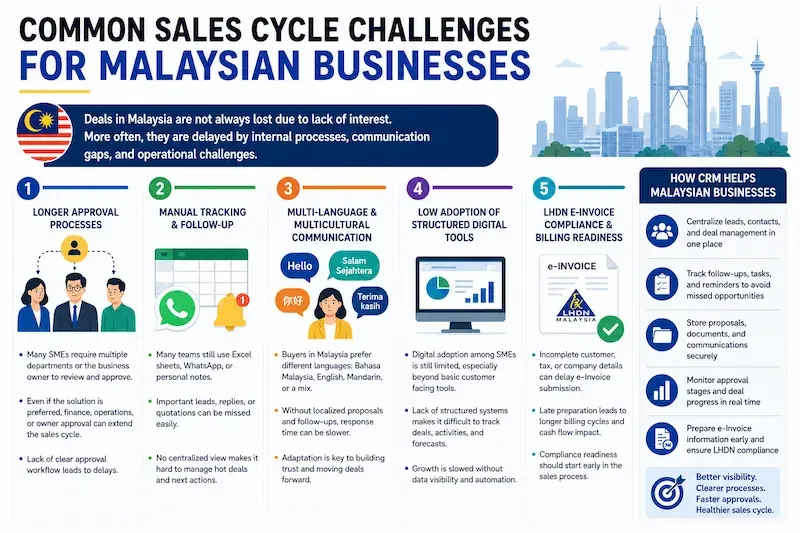
Malaysian businesses often face sales cycle delays that do not appear in generic global guides. We’ve seen this pattern across our clients in Malaysia: deals are not always lost because buyers are not interested, but because follow-ups, approvals, and billing steps are not managed clearly.
Extended approval processes: are common among Malaysian SMEs, especially when the owner is the final decision maker. Even when managers like the solution, the deal may slow down because finance, operations, or the business owner still needs to review the proposal.
Manual tracking and follow-up: can also make deals fall through. Many teams still rely on Excel sheets, WhatsApp groups, or personal reminders, which makes it easy to lose track of hot leads, missed replies, or pending quotations.
Multi-language and multicultural communication: can affect how quickly prospects respond. In Malaysia, buyers may prefer Bahasa Malaysia, English, Mandarin, or a mix of languages, so sales teams need flexible proposal materials and follow-up messages for different audiences.
Low adoption of structured digital tools: remains a challenge for many Malaysian SMEs. The World Bank notes that while many SMEs use ICT and internet tools, digital adoption is still lower in some sectors and often limited to basic customer-facing functions.
LHDN e-Invoice compliance: can also affect the closing and billing stage. If customer details, tax information, or invoice readiness are not prepared early, the final step of the sales cycle can take longer than expected. This is where CRM can help Malaysian businesses track deal status, follow-ups, documents, and billing readiness in one place.
Conclusion
A well-managed sales cycle gives your team a clear path from the first conversation to closing and long-term customer care. It helps you see where each deal stands, which steps take too long, and what your team can do next.
For Malaysian businesses, this matters because buyers often involve several people, use different communication channels, and need clear billing details before making a final decision. When every step is easier to track, your team can follow up on time, close deals faster, and build better relationships.
If your team is ready to manage leads, follow-ups, and deals more smoothly, book a free CRM demo and see how the right system can support your sales workflow.
FAQ About Sales Cycle
What are the 7 stages of the sales cycle?
The 7 sales cycle stages are prospecting, connecting with prospects, qualifying leads, presenting your solution, handling objections, closing the deal, and following up. These stages help your sales team manage each prospect from the first contact until they become a customer. For Malaysian businesses, this structure is useful when leads come from many channels, such as WhatsApp, LinkedIn, referrals, and trade events.
What is the difference between a sales cycle and a sales process?
The difference between a sales cycle vs sales process is that a sales cycle shows the stages a prospect goes through, while a sales process explains how your team moves them through those stages. For example, the cycle may go from lead to closed deal, while the process may include follow-up scripts, demo steps, or objection-handling methods.
How long should a sales cycle be?
A sales cycle time depends on the product, deal size, industry, and number of decision makers involved. Simple purchases may take a few days or weeks, while B2B software, property, and enterprise deals can take several months. To measure your average sales cycle length, divide the total days for all closed deals by the number of deals closed.
What is the 10-3-1 rule in sales?
The 10-3-1 rule in sales is a simple pipeline guideline where 10 prospects may lead to 3 serious opportunities and 1 closed deal. It helps sales teams understand that not every lead will convert. This rule is not fixed for every business, but it can help teams set realistic activity targets.
How can I shorten my sales cycle?
You can shorten your sales cycle by qualifying leads earlier, tracking where deals get stuck, automating follow-ups, and aligning sales with marketing. For example, if many deals slow down during proposal review, your team can prepare clearer pricing, scope, and approval documents upfront. A CRM can also help sales reps avoid missed follow-ups and track deal progress more consistently.
What is the average sales cycle length in Malaysia?
The average sales cycle length in Malaysia depends on the industry and buyer type. Retail, F&B, e-commerce, and simple trading deals may close within days or weeks. B2B software, property, manufacturing, and government-related projects often take longer because they involve owners, finance teams, procurement, or multiple departments before approval.
What tools help manage a sales cycle?
Sales cycle software such as CRM helps teams manage leads, follow-ups, proposals, deal stages, and customer conversations in one place. Instead of relying only on Excel, WhatsApp notes, or manual reminders, a CRM gives your team better visibility over each opportunity. This makes it easier to track sales cycle time, conversion rates, and pending actions.