














Equipment often goes missing between projects, while unused machines sit idle at other branches. Without clear asset visibility, businesses waste budget and face operational delays. Asset tracking software solves this by giving teams real-time visibility of every asset, helping reduce losses, minimize downtime, and improve maintenance planning.
More businesses are replacing spreadsheets with digital asset tracking systems to improve operational visibility. In Malaysia, this shift is supported by the Industry4WRD initiative, which encourages companies to adopt smarter digital operations. For industries like manufacturing, construction, and logistics, real-time asset visibility is now essential for staying efficient and competitive.
This article highlights eight top asset tracking software tools to consider in 2026. Explore the options to find the right fit for your organization’s needs and goals.
Key Takeaways
Asset tracking software is a digital solution designed to help businesses monitor physical assets’ location, condition, and usage throughout their lifecycle.
Best asset tracking software can help businesses improve visibility, reduce operational inefficiencies, and manage assets effectively across different locations.
Digital tracking tools monitor asset location, status, and movement in real time, helping businesses improve visibility and reduce operational inefficiencies.
Many businesses still struggle with lost equipment, limited asset visibility, and inefficient tracking across locations. With the right asset tracking system, companies can monitor assets in real time and improve operational efficiency more effectively.
Best Asset Tracking Software Tools in 2026
After evaluating a wide range of options, we’ve selected the best asset tracking software tools for 2026 that offer both scalability and ease of use. These tools help businesses monitor assets more effectively, reduce losses, and support better planning across teams.
 HashMicro

Best Because
Highly customizable system with barcode scanning, mobile check-in/out, and ticketing features. Also supports offline access and smooth integrations.
Best Because
Centralized platform with barcode, QR, and RFID support, plus item bundling and recurring reservations for streamlined physical asset tracking.

Best Because
Robust IT asset manager offering device mapping, structured asset grouping, and detailed reporting to support complex infrastructures.
 Brightly
Best Because
Purpose-built for schools and public facilities with easy work order tools, asset tracking, and energy usage monitoring in a clean interface.
After reviewing the top 5 recommendations, it’s important to compare their core features side by side to see which solution best fits your operational needs and business priorities. To make the comparison easier, here’s a quick overview of the top asset tracking software in Malaysia.
| Asset Tracking Software | GPS Tracking | Barcode / QR Scanning | Preventive Maintenance | Offline Access | Customization |
|---|---|---|---|---|---|
| HashMicro Asset Tracking Software | Yes - Real-time GPS asset tracking | Yes - Barcode and QR code scanning supported | Yes - Preventive maintenance scheduling included | Yes - Accessible without internet connection | Yes - Can be customized based on business needs |
| Asset Panda | Limited - GPS and RFID support available | Yes - Built-in barcode technology | Yes - Maintenance records and work orders included | Yes - Accessible without internet connection | Yes - Flexible customization options |
| EZOffice Inventory | Not confirmed | Yes - Barcode, QR code, and RFID scanning | Yes - Maintenance and depreciation tracking | Not confirmed | Limited - Advanced features available on higher plans |
| ManageEngine Asset Explorer | Not confirmed | Not confirmed | Not confirmed | Not confirmed | Limited - Mainly focused on IT asset management |
| Wasp Barcode AssetCloud | Not confirmed | Yes - RFID asset tag support available | Not confirmed | Yes - Cloud and on-premises deployment | Yes - Customizable reporting tools |
| Brightly | Not confirmed | Not confirmed | Yes - Work order and maintenance management | Not confirmed | Not confirmed |
| GoCodes | Yes - Real-time GPS asset tracking | Yes - QR code scanning supported | Yes - Maintenance reminders included | Yes - Mobile access available | Limited - Mainly focused on field asset tracking |
| QNE Optimum Ace | Not confirmed | Not confirmed | Not confirmed | Not confirmed | Yes - Customizable fields available |
What is Asset Tracking Software?
Asset tracking software, often integrated with ERP software, is a digital solution designed to help businesses monitor the location, condition, and usage of physical assets throughout their lifecycle.
From laptops and vehicles to machinery and tools, this software provides real-time visibility into where assets are, who is using them, and when maintenance is due.
It reduces the risk of loss, improves accountability, and supports smarter planning by giving teams accurate, up-to-date information from one centralized system.
Key Benefits of Asset Tracking Software
Adopting asset tracking software offers tangible improvements in how companies oversee and optimize their resources. By automating tracking and providing data insights, businesses can gain tighter control over their assets and improve overall operational outcomes.
1. Real-time asset visibility
Asset tracking software gives you live access to the location and condition of assets across your operations. This minimizes time wasted on asset searches, reduces the risk of misplacement or loss, and eliminates redundant purchases due to unclear inventory records.
2. Stronger asset accountability
By linking assets to users or departments, the software promotes responsible usage. It becomes easier to identify misuse, damage, or unusual activity, making individuals more accountable and improving transparency in how equipment is handled.
3. Smarter maintenance scheduling
With built-in alerts and usage logs, the software helps you plan maintenance before issues arise. This reduces the chance of unexpected equipment failure, lowers repair costs, and increases the reliability and lifespan of your assets.
4. More efficient operations
Manual inventory tasks are streamlined through automation. Processes like asset check-in/check-out, audits, and reordering become faster and more accurate, cutting down administrative work and reducing the chances of human error.
5. Insightful reporting and analytics
Accurate asset data supports better decision-making. Businesses can analyze usage trends, assess asset performance, and plan future investments more effectively. This leads to optimized asset allocation and a clearer understanding of ROI.
Top 8 Asset Tracking Software in Malaysia 2026
Now that we’ve explored the essential features to look for, let’s dive into the top asset tracking software options available in Malaysia for 2026.
These tools stand out for their capabilities and are designed to help businesses optimize asset management, improve efficiency, and stay ahead of industry demands.
1. HashMicro Asset Tracking Software
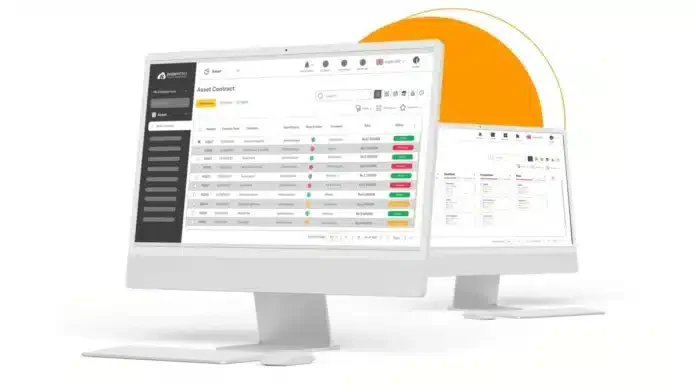
HashMicro Asset Tracking Software is a comprehensive asset management solution widely used by businesses in Malaysia. Established in 2015, this software is known for simplifying asset tracking across departments and locations, helping companies manage and monitor their assets more efficiently.
It offers a robust platform for maintaining control over physical resources ensuring they are properly utilized, well-maintained, and contributing to a better return on assets throughout their lifecycle. It also supports equipment maintenance software capabilities that help businesses schedule preventive maintenance and reduce unexpected asset downtime.
Key features:
- Asset GPS tracking
- Asset stocktake with barcode
- Preventive maintenance scheduling
- Parent & child asset management
- QR code scanning for facilities request
Pros Cons - Unlimited users.
- Integrates with IoT as well as GPS Tracking.
- Can be customized to match your business needs.
- Could be accessed without an internet connection.
- Intuitive and easy to access.
- The free demo may take time due to high demand.
2. Asset Panda
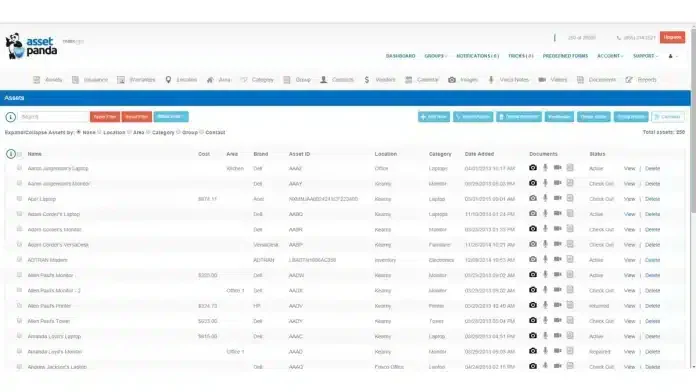
Asset Panda provides a flexible asset management system that keeps all your asset details in one place, including maintenance records and user manuals.
The mobile app lets employees check equipment in and out, scan barcodes, and report issues using trackable tickets, although GPS and RFID support is somewhat limited.
It also integrates smoothly with tools like Zendesk and Google Workspace, and businesses can explore its features through a free trial.
Key features:
- Ticketing/work orders
- Built-in barcode technology
- Contract management
| Pros | Cons |
|
|
3. EZOffice Inventory
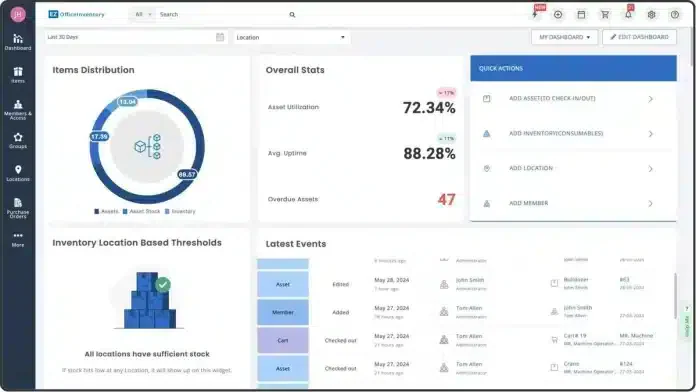
EZOffice Inventory is a widely adopted solution that helps businesses manage physical assets more effectively across various industries.
Trusted by companies of different sizes, it supports streamlined operations by offering a centralized platform for asset-related activities.
Key features:
- Carts and bundles
- Recurring reservations
- Maintenance & depreciation tracking
- Barcode, QR Code, and RFID Scanning
| Pros | Cons |
|
|
4. Manage Engine
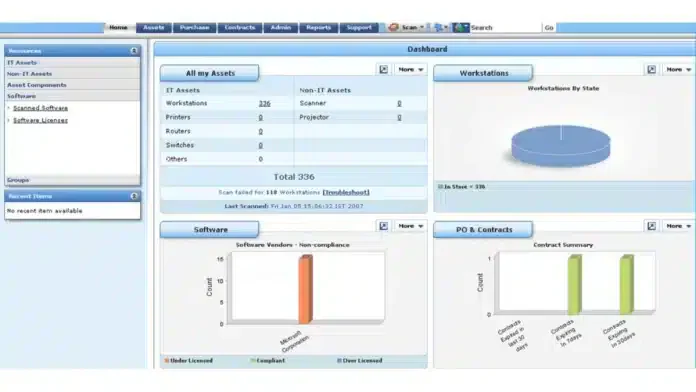
ManageEngine Asset Explorer is an IT asset management solution that helps businesses gain better visibility and control over their hardware and software assets.
Commonly used by organizations with complex IT infrastructures, it supports structured asset oversight and is widely adopted in both public and private sectors.
Key features:
- Asset categorization
- Dynamic asset grouping
| Pros | Cons |
|
|
5. Wasp Barcode Asset Cloud
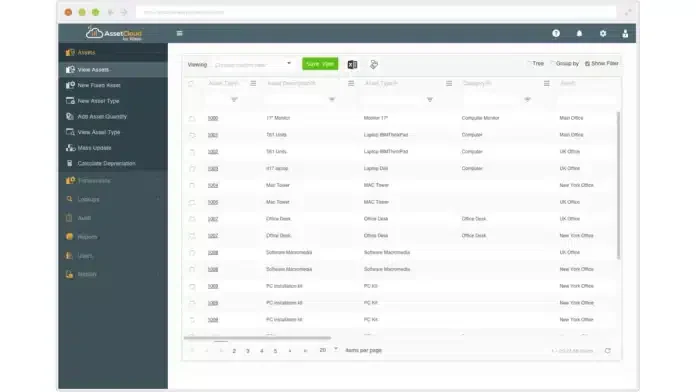
Wasp Barcode AssetCloud is designed to help companies keep track of their assets across different locations. It also lets users control how assets are used depending on their funding source and provides clear reports to monitor asset activity.
While it suits the needs of larger organizations, the cost may be a bit high for smaller businesses or nonprofits.
Key features:
- Funding source restrictions
- Detailed reporting tools
- Cloud and On-Premises options
| Pros | Cons |
|
|
6. Brightly
 Brightly, a Siemens-owned company offers asset management software for schools, factories, government agencies, and care facilities. Originally launched as Dude Solutions in 1999, it started by supporting school operations.Its tools help schools track assets, manage energy use, and stay organized so staff can focus more on education, not missing supplies.
Key features:
- Energy management
- Reporting tools
| Pros | Cons |
|
|
7. GoCodes
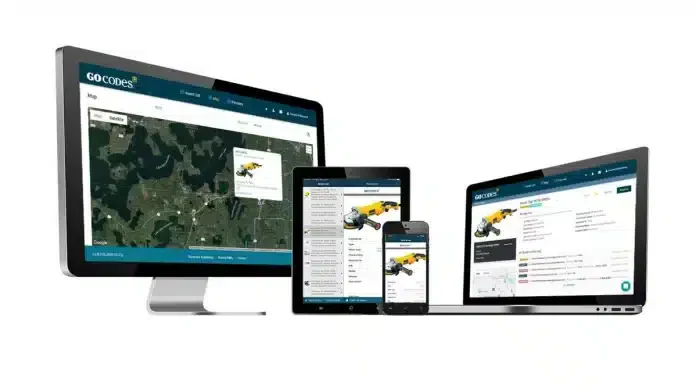
GoCodes focuses on GPS-enabled asset tracking using QR code technology, making it suitable for construction, logistics, and field service industries. The software helps businesses monitor equipment locations in real time, reduce asset loss, and improve accountability for tools and mobile assets used across multiple job sites.
Key features:
- GPS asset tracking
- QR code scanning
- Maintenance reminders
- Mobile asset tracking app
| Pros | Cons |
|
|
8. QNE Optimum Ace
QNE Optimum Ace is an all-in-one inventory tracking, asset tracking, and management solution built for manufacturing companies. It’s ideal for businesses that need to manage production processes, track serial and batch numbers, and account for landing costs.
Key features:
- Comprehensive inventory management
- Multi level access control
| Pros | Cons |
|
|
Overall Comparison of Asset Tracking Software in Malaysia
| Provider | Real-Time Tracking Capability | Multi-Location Asset Visibility | System Integration | Reporting & Asset Analytics |
|---|---|---|---|---|
| HashMicro | ||||
| Asset Panda | ||||
| EZOffice Inventory | ||||
| Manage Engine Asset Explorer | ||||
| Brightly Asset |
How Asset Tracking Software Works?
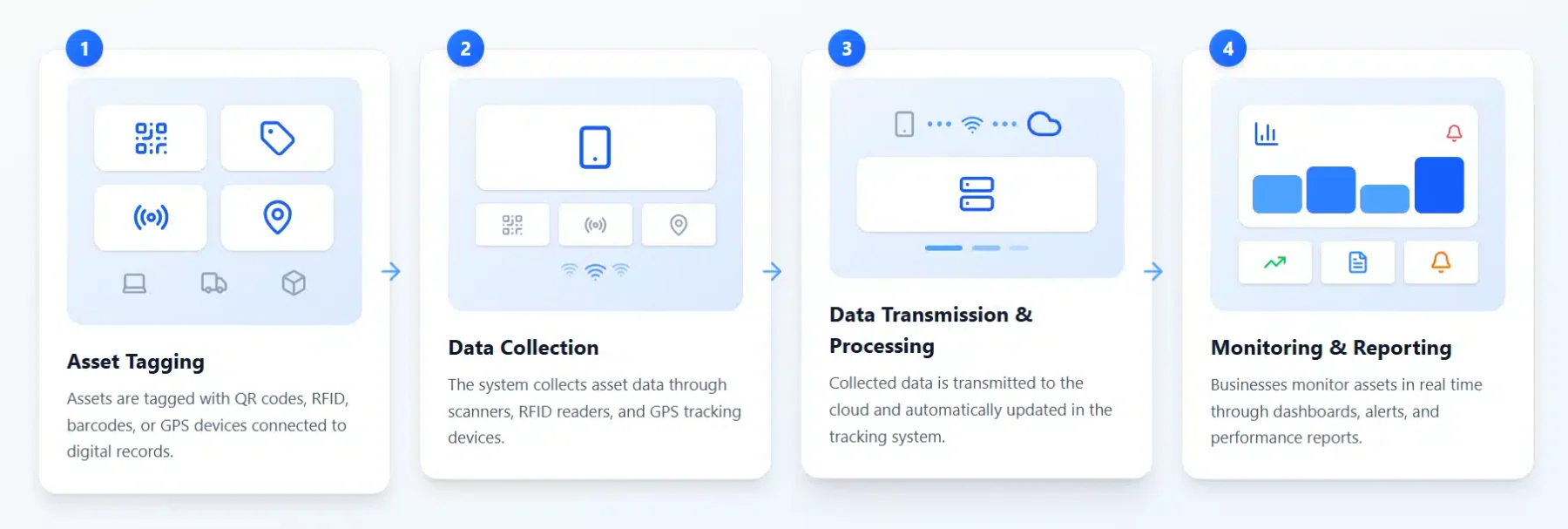 Asset tracking software functions by combining digital identification tools with real-time data systems. It enables businesses to continuously monitor asset locations, status, and movement, improving control, reducing losses, and supporting smarter asset utilization.
1. Asset tagging
Each asset is first tagged with a unique identifier. This could be a QR code, barcode, RFID tag, or GPS device. The identifier is attached to the physical asset and connected to a digital record in the software, allowing users to access relevant data whenever the asset is scanned or detected.
2. Data collection
After tagging, the system gathers data from identifiers like mobile scanners reading barcodes or QR codes during check-in/out, RFID readers wirelessly collecting info from nearby assets, and GPS trackers providing real-time asset locations, especially for mobile or remote assets equipment.
3. Data transmission and processing
Once collected, data is transmitted to a centralized platform through Wi-Fi, cellular networks, or local connectivity. The asset tracking software processes this information to update each asset’s real-time status, history, and movement. This creates a reliable, dynamic overview of all tracked resources.
4. Monitoring and reporting
Businesses can analyze data via dashboards and reports, receiving alerts for critical events like missed maintenance, equipment exit zones, or stock drops. Advanced reports support decision-making by revealing trends in asset use, costs, and performance.
What are the Key Features to Look for in Asset Tracking Software?
To choose the right asset tracking software, it’s important to understand which features truly add value and support your operational goals.Not all platforms offer the same capabilities, so knowing what to look for can help you make a more informed and strategic decision.
- Barcode and RFID integration: Ensure the software allows for barcode tracking to streamline asset identification and minimize manual entry, reducing the likelihood of errors.
- Real-time tracking: Opt for software with real-time tracking features, enabling immediate monitoring of asset location and status—an essential tool for businesses with assets that move frequently or are spread across various sites.
- Lifecycle management: Seek software that offers lifecycle management to track assets from acquisition to disposal. This helps with better planning and resource allocation throughout the asset’s entire life.
- Mobile compatibility: Consider software that is compatible with mobile devices, enabling asset tracking on the move via smartphones or tablets. This is particularly useful for businesses with field teams or employees working remotely.
- Alerts and notifications: Look for software that offers alerts and notifications for key events such as maintenance schedules or asset movements, ensuring timely actions to prevent asset loss or damage.
Conclusion
Asset tracking software is essential for businesses of all sizes to monitor and manage valuable assets efficiently. For medium to large companies, HashMicro offers a robust asset management system with real-time tracking and seamless integration across business functions to cut costs and streamline operations.
Whether in construction, manufacturing, healthcare, or any asset-heavy industry, Asset Tracking Software helps you gain better control over your assets. Try a free demo today and see how it can optimize your workflow and boost productivity.
FAQ Asset Tracking Software
How do I track assets in Excel?
You can track assets in Excel by creating a spreadsheet that lists all of your assets and information about them. Include information about each asset such as where it’s located, whether it’s in use or available, when you purchased it, and how much it’s worth.
What is the purpose of tracking?
A tracking system, also known as a locating system, is used for the observing of persons or objects on the move and supplying a timely ordered sequence of location data for further processing.
Should I choose barcode, RFID, or GPS for asset tracking?
The right technology depends on how your assets move. Barcode and QR code tags are affordable and work well for assets that stay within a fixed site, such as office equipment. RFID suits high-volume environments where scanning many items at once saves time. GPS is built for mobile assets like vehicles and heavy machinery, which is common in construction and logistics operations across Malaysia.
How much does asset tracking software cost in Malaysia?
Pricing varies widely based on the number of assets, users, and features included. Subscription-based tools usually charge per user or per asset each month, while enterprise platforms such as HashMicro use a customized pricing model based on business size and needs. The most accurate figure comes from requesting a quote, since the final cost depends on whether you need GPS hardware, RFID tags, or integration with other systems.
What is the benefit of tracking?
Automated time tracking can be utilized by individuals or companies to seamlessly keep track of the working day and tasks. The benefits of time tracking include increased productivity, reduced time wasters, better focus and an improved work life balance.