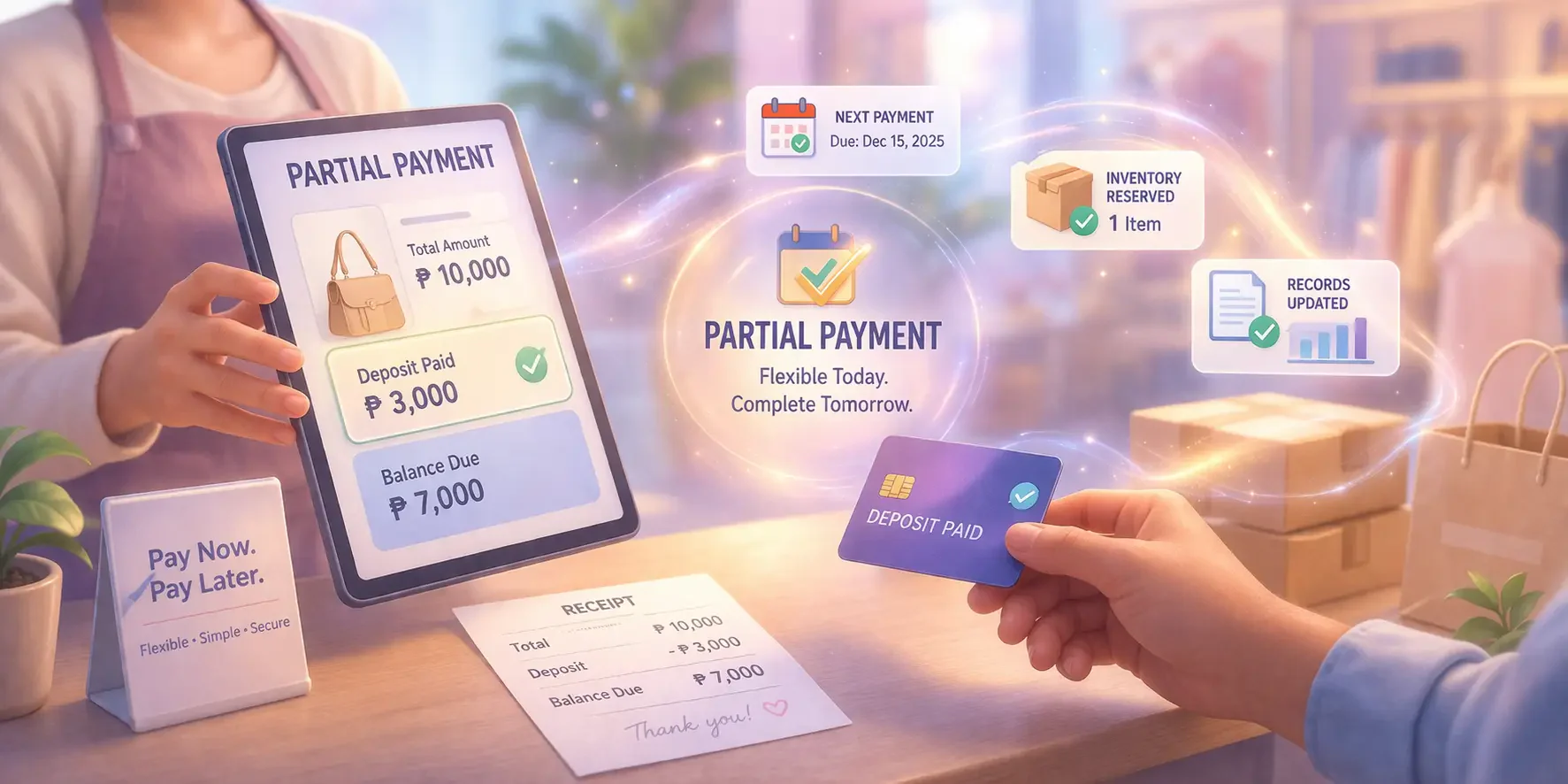















NFC payments have changed the way people pay for goods and services; walk into any modern store and you will likely see customers tapping their smartphones or smartwatches against a terminal to complete a transaction in under a second.
Consumer expectations have evolved, mobile wallet adoption has surpassed 52% globally as of 2024, and that figure is projected to grow by another 15.3% through 2029. In an increasingly cashless world, your business must be able to let go of its paper money and embrace electronic money.
This article will guide you on how to integrate NFC with your POS system and how to stay alive and prosper with it.
Contactless Payment Cards
Dual-interface payment cards (supporting both EMV chip and NFC contactless) have become the default card type issued by most banks in developed markets. These cards contain an NFC antenna embedded in the card body.
Unlike mobile wallet payments, contactless card transactions typically do not require any customer authentication for transactions below a certain threshold (which varies by country and card network, but is commonly in the range of $50–$100 USD equivalent). Above the threshold, PIN entry or other verification may be required.
Wearable Payment Devices
NFC payment is increasingly available on wearable devices beyond smartphones. Smartwatches (Apple Watch, Fitbit, Garmin Pay, Samsung Galaxy Watch) allow users to pay with a tap of the wrist, which is particularly convenient if the user is doing a physical activity or is at a place where carrying a phone is impractical. NFC-enabled rings, wristbands, and even stickers represent the frontier of wearable payment devices, often used in event and theme park environments for seamless, cashless experiences.
NFC-Enabled Loyalty and Transit Cards
Many transit systems (London’s Oyster card, Tokyo’s Suica, Hong Kong’s Octopus card) use NFC technology for fare payment, though these typically operate on proprietary systems rather than open banking networks. Some merchants issue NFC-enabled loyalty cards that also function as payment vehicles, combining identification and payment in a single tap.
Implementing NFC Payment in Your POS System

Rolling out NFC payment capability is a practical, achievable project for businesses of virtually any size. The following framework outlines the key steps and considerations.
- Assess current POS hardware to check if existing terminals support NFC, as many post-2018 models do, but may need activation or a software update. Older hardware may require new terminals or add-on NFC readers.
- Choose NFC-certified terminals and prioritize hardware with PCI PTS, EMVCo Level 1 and 2, and network-specific contactless certifications. Selection should align with your transaction volume, mobility needs, and POS software compatibility.
- Work with your payment processor to confirm your acquiring bank or processor supports contactless transactions and that your merchant account is enabled for NFC acceptance. Verify whether any incremental fees apply for contactless processing.
- Configure contactless transaction limits to set cardholder verification method (CVM) limits per card network requirements and local regulations, ensuring your terminal software enforces PIN entry for transactions above the applicable threshold.
- Train your staff so that your cashiers understand how to prompt contactless payments, handle failed transactions, identify potential terminal tampering, and troubleshoot common NFC payment issues.
- Communicate to customers through universal display of contactless symbols prominently at checkout, and update your website and social media to reflect NFC acceptance. Brief in-store messaging can help encourage adoption in less familiar markets.
- Monitor and optimize NFC transaction mix, error rates, declines, and fraud incidents through POS reporting. Use this data to refine terminal placement, staffing, and payment flow over time.
Integration with POS Software
Businesses using a full POS software platform should seamlessly integrate NFC payment data with inventory, CRM, and reporting modules. Many POS systems are designed to work with NFC-capable payment terminals as part of a broader operational management ecosystem, helping businesses consolidate payment data with sales analytics and inventory tracking in real time.
Common Challenges of NFC Payment Adoption and How to Overcome Them
While the business case for NFC is strong, the path to adoption is not without obstacles. Understanding these challenges in advance allows you to address them proactively.
| Challenges | Solutions |
| Upfront Hardware Investment — NFC terminals cost more than legacy readers, posing a barrier for smaller businesses. | Explore processor leasing programs, subsidized hardware, or payment-as-a-service models that spread costs over a contract period. |
| Connectivity & Technical Reliability — NFC payments rely on internet connectivity, making network outages disruptive. | Use redundant internet connections with a cellular backup, consider offline transaction queuing, and maintain a clear downtime procedure. |
| Consumer Unfamiliarity — In less established markets, customers may hesitate or incorrectly use NFC payment. | Invest in clear in-store signage, staff coaching, and point-of-sale messaging. Awareness campaigns can further accelerate customer adoption. |
| Inconsistent Device Compatibility — Older or budget devices may not support NFC tap-to-pay. | Offer NFC alongside chip, magnetic stripe, and manual entry fallbacks to ensure no sale is lost due to device incompatibility. |
| Legacy POS Integration Complexity — Older POS software may not integrate cleanly with NFC terminals, causing data silos or manual reconciliation. | Check if your POS provider offers NFC-integrated modules or API connections, or consider a broader POS system upgrade to fully realize NFC’s benefits. |
The Future of NFC Payment Technology
NFC payment is evolving rapidly, and the next five to ten years promise significant advances that will further expand its role in commerce and everyday life.
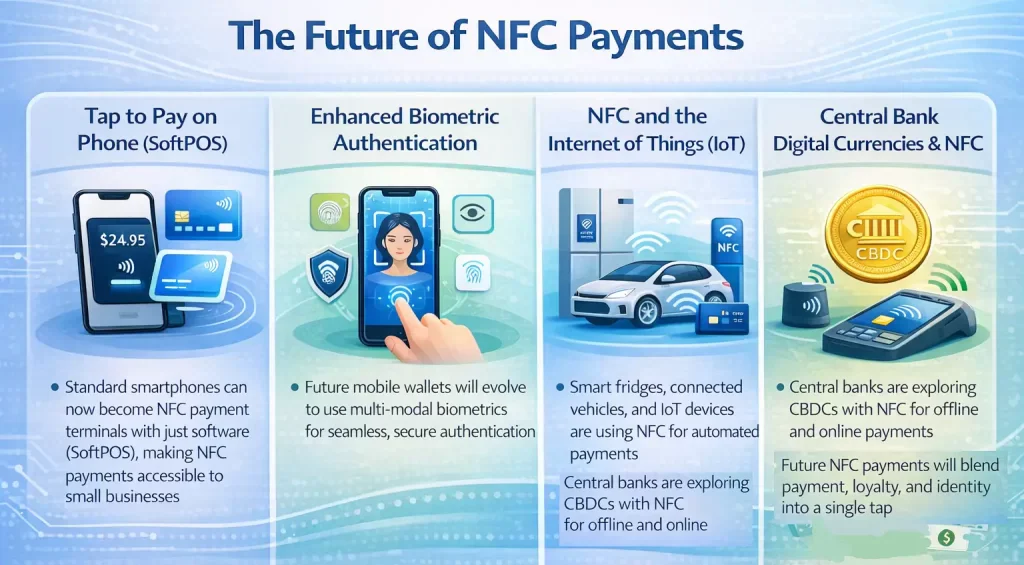
NFC payment penetration is already high in markets like the United Kingdom, Australia, Canada, and parts of Asia, and it will keep growing bigger and enter other markets, including the United States, India, Brazil, and much of Southeast Asia and Africa.
Infrastructure investment, smartphone penetration growth, and regulatory support for digital payments are driving rapid expansion in these markets, suggesting that global NFC payment volume will continue its strong compound annual growth trajectory for years to come.
NFC Payment Standards, Regulations, and Industry Bodies
For merchants and technology teams who need to navigate the technical and compliance landscape, understanding the key standards and regulatory frameworks governing NFC payments is important.
EMVCo
EMVCo is the technical body jointly owned by American Express, Discover, JCB, Mastercard, UnionPay, and Visa that manages the EMV standards family, including the contactless EMV specifications that underpin most NFC payment transactions. EMVCo’s Level 1 and Level 2 terminal certification processes ensure that NFC terminals meet minimum interoperability and security requirements before deployment.
NFC Forum
The NFC Forum is a non-profit industry association that defines and promotes NFC standards. It maintains the core NFC protocol specifications and runs a certification program for NFC devices and tags. While the NFC Forum focuses on the underlying communication technology rather than payment-specific implementations, its standards form the foundation on which payment-specific protocols are built.
PCI Security Standards Council
The PCI SSC publishes and manages the Payment Card Industry Data Security Standard (PCI DSS) and the PIN Transaction Security (PCI PTS) standard. Merchants accepting card payments, including NFC payments, must maintain PCI DSS compliance, and the terminals they use must be PCI PTS certified. PCI SSC has also published specific guidance on contactless payments and mobile payment acceptance through its PCI MPoC (Modular Payments on COTS) standard, which governs SoftPOS solutions.
Regional Regulations
Contactless payment limits, authentication requirements, and consumer protection rules vary significantly by country and region. The European Union’s Payment Services Directive 2 (PSD2) introduced Strong Customer Authentication (SCA) requirements that affect when additional verification is needed for contactless transactions. In Australia, the Reserve Bank of Australia has been active in regulating contactless payment fees and practices. Merchants operating in multiple geographies must be compliant with the specific rules in each market they serve.
Choosing the Right NFC-Enabled POS System for Your Business

Not all POS systems are created equal when it comes to NFC payment support. When evaluating options, businesses should consider the following dimensions.
- Hardware Compatibility and Certification: Confirm that the POS system supports certified NFC terminal hardware and that the terminal has current PCI PTS certification and network contactless certifications. Ask specifically about which mobile wallets are supported (Apple Pay, Google Pay, Samsung Pay) and whether the system supports contactless-only cards in addition to mobile wallets.
- Software Integration Depth: The best NFC payment implementations go beyond simple transaction processing. Look for POS systems where NFC payment data integrates with inventory management (to automatically decrement stock), customer relationship management (to link purchases to customer profiles), and business analytics (to provide real-time revenue and payment method mix reporting).
- Multi-Channel Support: If your business operates across both physical stores and e-commerce channels, evaluate whether the POS system unifies NFC in-store payment data with online payment data in a single reporting environment. Unified commerce capabilities are increasingly the standard against which enterprise-grade POS platforms are evaluated.
- Scalability: Consider your growth trajectory. A POS system that works well for a single store should also be capable of scaling to multiple locations, with centralized NFC terminal management, consistent configuration, and consolidated reporting.
Conclusion
NFC payment is a game changing technology that has made every day payment as easy as tapping a card on a POS hardware. Not only is it efficient, it is also much more safe and secure compare to alternative payment methods. It is not surprising how it became a popular method of payment that is still growing.
A business owner now have to implement NFC payment as many consumers prefer that method. To implement it they must do a number of things, from training staff to checking their POS system, and understand the challengers of NFC adoption. With this in mind, it is recommended for you to use an ERP system that can integrate NFC payment.
FAQ for NFC Payment
What is the NFC payment?
NFC payment is a contactless transaction method that uses near-field communication technology to transfer payment credentials from a consumer’s device or card to a POS terminal.
Is GCash NFC?
No, while GCash supports NFC-based payments through its integration with mobile wallets like Google Pay and Apple Pay, GCash itself is an app that does not natively have NFC.
What is the purpose of NFC in mobile phones?
NFC in mobile phones enables contactless payments, data sharing, and device pairing at close range. For payments specifically, it allows users to store card credentials securely and complete transactions by tapping their phone on a compatible terminal.
How to know if a card has NFC?
Look for a four curved lines resembling a Wi-Fi icon on its side. This indicates NFC or contactless capability. You can also check with your issuing bank or review your card’s product details online to confirm whether tap-to-pay is supported.
Are there spending limit?
Yes, spending limits may apply, and they vary by issuer and transaction setup. For example, BPI Debit Mastercard allows tap payments up to ₱5,000, while BDO says purchases below ₱2,000 can go through without a PIN or signature.