
















Imagine running a business where your inventory data is scattered, financial reports are off, and stock shortages occur unexpectedly. Without a structured inventory accounting system, these issues can lead to cash flow problems and poor decision-making. Proper inventory accounting helps businesses stay organized, profitable, and competitive.
In Singapore, the need for efficient inventory management is increasing, particularly with the rise in demand in retail and manufacturing. According to data from the Department of Statistics, retail sales in January 2024 exceeded S$4.3 billion. This illustrates the importance of maintaining accurate inventory records in fast-paced markets.
This article explains the fundamentals of inventory accounting—from its definition and methods to best practices and tools. You’ll also learn how systems like HashMicro’s integrated software can simplify inventory management. Understanding this topic is crucial to enhancing operations and maintaining financial stability.
Key Takeaways
Inventory accounting is a method used by businesses to track the value of their inventory from the point of purchase to the time the goods are sold.
The process of inventory accounting involves tracking, valuing, and recording a company’s stock to ensure precise financial reporting and efficient cost control.
One of the key benefits of inventory accounting is providing accurate financial reports.
HashMicro’s integrated accounting system provides a comprehensive solution that simplifies inventory accounting, improves data accuracy, and streamlines overall financial management. Book a Demo Now!
What is Inventory Accounting?
Inventory accounting is the process of recording and managing the value of a business’s inventory throughout its lifecycle, from purchase to sale. It ensures that the cost of goods sold (COGS) and the value of remaining inventory are accurately reflected in financial records.
Implementing effective inventory accounting enables businesses to monitor the capital tied up in stock and assess its impact on overall profitability. It also plays a vital role in setting appropriate selling prices, maintaining healthy cash flow, and making informed decisions regarding restocking and procurement.
With consistent and precise tracking through inventory management software, companies can minimize the risk of excess inventory or stockouts. This ultimately supports better financial forecasting and operational efficiency, helping businesses make data-driven decisions that enhance profitability.
How Inventory Accounting Works
Inventory accounting is the process of tracking, valuing, and recording a company’s stock to ensure accurate financial reporting and cost management. It helps businesses determine the value of their inventory at any given time and calculate the cost of goods sold (COGS), which directly impacts profitability.
There are several used inventory methods, including FIFO (First-In, First-Out), where older inventory is sold first; LIFO (Last-In, First-Out), which assumes the newest inventory is sold first; and the Weighted Average Cost method, which calculates an average cost for all inventory items. Each method can have a significant impact on financial results, tax obligations, and strategic planning decisions.
An effective inventory accounting system doesn’t just ensure compliance with accounting standards—it also minimises financial loss caused by overstocking, spoilage, shrinkage, or mismanagement. By maintaining accurate inventory records, businesses can align purchasing decisions with actual demand, reduce storage costs, and gain visibility into their supply chain performance.
Benefits of Inventory Accounting for Businesses

Implementing proper inventory accounting practices provides businesses with significant advantages. It enhances the accuracy of financial data, strengthens inventory oversight, and enables more strategic decision-making across operations. Below are some of its core benefits:
- Reliable financial reporting: With precise inventory valuation, financial statements reflect a company’s true financial position. This minimises errors in profit calculations and supports compliance with accounting standards while improving financial transparency.
- Stronger inventory management: Tracking inventory costs and stock quantities helps avoid excess or insufficient inventory. Conducting periodic inventory audits ensures that records are accurate and discrepancies are identified and addressed promptly, resulting in streamlined operations, reduced waste, and enhanced forecasting accuracy.
- Efficient cash flow management: Understanding the actual value of inventory enables companies to regulate their cash flow more effectively. It prevents over-investment in stock while ensuring product availability, helping maintain healthy financial performance.
- Higher profitability: Clear insights into the cost of goods sold (COGS) allow businesses to price products strategically. This contributes to improved profit margins and sustainable financial growth.
Through accurate inventory accounting, businesses can better manage resources, increase efficiency, and make informed decisions to support long-term success.
If you are interested in learning more about how HashMicro’s Inventory Accounting Software can optimize your inventory management and financial processes, click the banner below to view the pricing scheme.


Important Terms and Formulas in Inventory Accounting
Mastering the terms and formulas in inventory accounting is crucial for businesses to effectively control inventory costs, assess their financial health, and produce accurate reports. These basic concepts allow companies to assess inventory value, calculate cost of goods sold (COGS), and improve inventory efficiency.
Here are some key terms that every business should understand:
1. Beginning inventory
Beginning inventory is the value of all unsold stock that a company has at the beginning of an accounting period. It includes products carried over from previous periods and is used to calculate metrics such as COGS and inventory flow.
Maintaining an accurate beginning inventory figure ensures proper stock tracking and financial reporting. It provides a basis for evaluating stock movements and guides procurement and sales strategies.
The formula to calculate the beginning inventory is:
Beginning Inventory=Cost of Goods Sold (COGS)+Ending Inventory−Purchases
This formula ensures that inventory records are accurate and aligned with the company’s sales and purchasing activities, preventing discrepancies in financial statements.
2. Ending inventory
Ending inventory refers to the total value of remaining unsold goods at the end of an accounting period. Ending inventory is the value that remains after accounting for all purchases and sales, and is critical for determining the cost of goods sold.
Accurately monitoring ending inventory helps businesses avoid stock imbalances, improve forecasting, and ensure smooth operations while maintaining the integrity of financial statements.
The formula to calculate ending inventory is:
Ending Inventory=Beginning Inventory+Purchases−Cost of Goods Sold (COGS)
This formula ensures that inventory levels are correctly recorded, providing valuable insights into a company’s financial health and stock management efficiency.
3. Inventory turnover
Inventory turnover measures the frequency with which a business sells and replenishes its inventory over a specified period. High turnover reflects strong sales performance and efficient inventory handling, while lower levels may indicate excess or slow-moving stock.
By analyzing inventory turns, companies can adjust inventory levels, manage cash flow more effectively, and gain insight into consumer demand and operational effectiveness.
The formula to calculate inventory turnover is:
Inventory Turnover=Cost of Goods Sold (COGS) / Average Inventory
Inventory Accounting Methods
Choosing the appropriate inventory accounting method is crucial for businesses to accurately value their stock, determine profits, and remain compliant with financial regulations. Each method impacts how inventory is recorded, how cost of goods sold (COGS) is calculated, and how financial results are presented.
The method selected typically depends on a business’s size, industry standards, tax considerations, and operational goals. Below are two commonly used inventory accounting approaches:
1. Cash Basis Inventory Accounting
Cash basis inventory accounting recognizes revenue and expenses only when cash changes hands. This means that sales are recorded when payment is received, and inventory purchases are logged only once they have been paid for.
This method is typically used by smaller businesses that maintain limited inventory and require a straightforward view of their cash flow. However, it may not accurately represent financial performance because it doesn’t match income and inventory costs to the correct accounting period.
- Advantages: Simple to apply, provides an immediate view of the cash position, and is suitable for businesses with minimal inventory.
- Disadvantages: Doesn’t accurately reflect inventory value or COGS, and is not compliant with GAAP standards.
Due to its limitations, cash basis accounting isn’t recommended for businesses with complex inventory operations, especially those that need detailed reporting.
2. Accrual Basis Inventory Accounting
Accrual basis inventory accounting records income and expenses when transactions occur, regardless of when money is exchanged. Inventory purchases are considered assets until items are sold, at which point the cost is transferred to COGS. Likewise, sales revenue is recorded when the sale is made, not when payment is received.
This method offers a more precise picture of a company’s financial condition because it aligns costs and revenue with the appropriate reporting periods. It is required for larger businesses under GAAP and IFRS standards.
- Advantages: Accurate inventory tracking, aligns expenses with sales, and better reflects profitability.
- Disadvantages: Requires more effort to maintain, involves detailed documentation, and has higher administrative work.
For businesses with substantial inventory, accrual accounting is the preferred method because it offers a complete and consistent view of inventory value and overall financial health.
Best Practices for Inventory Accounting
Ensuring accurate inventory accounting is vital for strong inventory control and sound financial management. By following proven best practices, businesses can reduce errors, improve cash flow, and make more strategic decisions. Below are some essential strategies for enhancing inventory accounting performance:
1. Select the right costing method
When item prices vary over time, businesses must decide which costing approach to use—whether the earliest purchase price or the latest.
Choosing the wrong method can lead to inaccurate financial records and tax filings, potentially resulting in compliance issues or audit problems. Leveraging accounting software with built-in costing options, such as FIFO, LIFO, or weighted average, helps standardize this process and minimize human error.
2. Implement real-time inventory valuation
Relying only on beginning and end-of-month inventory records can cause inconsistencies, especially if data is not updated regularly.
Using a perpetual inventory system, supported by digital tools, allows for continuous tracking of inventory levels and COGS using methods like FIFO, LIFO, or weighted average, helping maintain up-to-date and accurate valuations.
3. Estimate costs early and adjust accordingly
Landed cost calculations can be delayed by slow-arriving transportation invoices, even though supplier and customs fees come in quickly.
To maintain accuracy, businesses should estimate landed costs promptly using available supplier data and historical shipping trends. This reduces reporting delays and ensures financial clarity.
4. Utilize the right inventory tools
Many businesses still rely on Excel spreadsheets for inventory tracking and accounting. While Excel is a powerful tool for analysis, it can be prone to errors and time-consuming to maintain.
Implementing an inventory management system allows businesses to automate calculations, improve accuracy, and support perpetual inventory tracking, reducing the risks associated with manual data entry.
The Integration of Inventory Management with HashMicro’s Accounting System
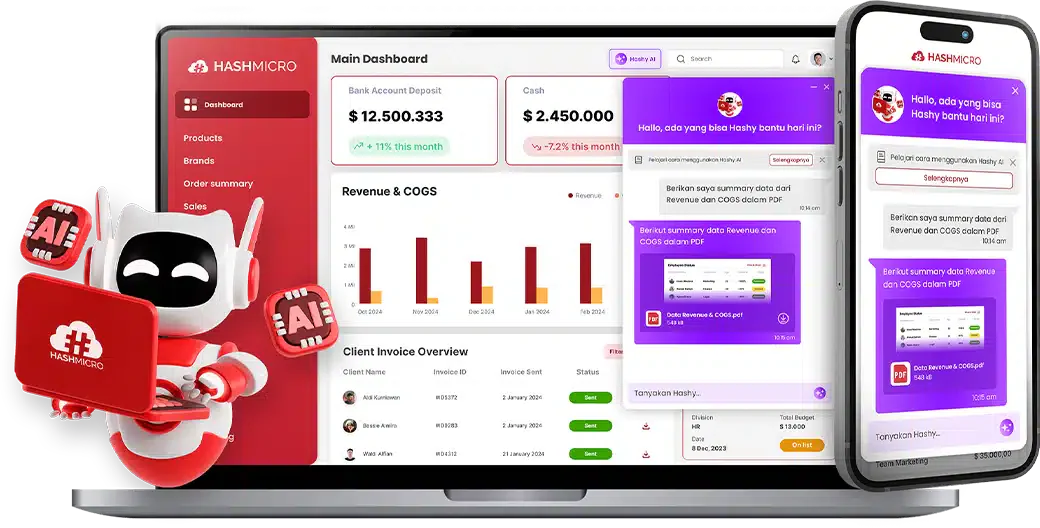
Integrating inventory management with HashMicro’s accounting software allows businesses to unify operational and financial data, resulting in improved accuracy, efficiency, and control. Rather than managing inventory and accounting separately, this integration ensures that every inventory transaction—whether a purchase, sale, or stock adjustment—is automatically reflected in the financial system.
This approach reduces manual work, minimizes the risk of discrepancies, and enhances decision-making across departments. Below are key features of HashMicro’s system that enable efficient inventory and accounting management.
- Hashy AI: Optimize financial and inventory management with automation and intelligent analytics, ensuring accuracy in the management of receivables, payments, and budgets. Features such as invoice tracking and bank reconciliation support operational efficiency and better stock management.
- Bank integration – auto reconciliation: This feature automatically aligns your bank transactions with your accounting records, including payments for inventory purchases and receipts from sales. It reduces manual reconciliation efforts and increases accuracy in inventory-related financial tracking.
- Bank integration – auto payment: With auto payment, the system automates supplier transactions directly through connected bank accounts. This ensures timely payments for inventory procurement and keeps your financial records up to date without delay.
- Multi-level financial analysis: Businesses can break down financial reports by branch, project, or business unit. This feature allows you to monitor how inventory-related costs perform across different segments, supporting more precise budget planning and resource allocation.
- Cash flow reporting: This tool provides insights into how inventory buying and selling affect your cash flow. With real-time updates on cash movements tied to stock activities, companies can better manage liquidity and make informed operational decisions.
Conclusion
Effective inventory accounting plays a crucial role in helping businesses maintain accurate financial data, manage cash flow efficiently, and support better strategic planning. With the right accounting methods and consistent practices, companies can ensure that their inventory costs and stock values are accurately recorded and accurately reflected in financial reports.
HashMicro’s accounting software provides a powerful, integrated solution to streamline inventory and financial operations. Equipped with features such as automatic reconciliation, in-depth financial analysis, and real-time cash flow tracking, the system enables businesses to manage inventory and accounting on a single, centralized platform.
Ready to optimize your inventory and financial processes? Book a free demo with HashMicro today and discover how our solution can drive greater efficiency and accuracy for your business.

Question About Inventory Accounting
-
What are the 4 types of inventory?
The four main types of inventory are:
– Raw materials: Basic inputs used in the production process.
– Work-in-progress (WIP): Items that are in the process of being manufactured.
– Finished goods: Completed products ready for sale.
– Maintenance, Repair, and Operations (MRO): Supplies used in production but not part of the final product. -
How is inventory recorded in accounting?
Inventory is recorded as a current asset on the balance sheet. The cost of inventory is initially recorded based on the purchase price or production cost, and adjustments are made through methods such as FIFO, LIFO, or weighted average to reflect inventory valuation and cost of goods sold.
-
What are the golden rules of accounting?
The golden rules of accounting are foundational principles used to record financial transactions accurately. They are categorized based on the type of account involved:
1. Personal Account – Debit the Receiver, Credit the Giver
Example: If you pay a supplier, the supplier (a personal account) is credited, and cash is debited.
2. Real Account – Debit What Comes In, Credit What Goes Out
Example: When you buy machinery, debit the machinery account (asset comes in), and credit cash or bank.
3. Nominal Account – Debit All Expenses and Losses, Credit All Incomes and Gains
Example: When you pay rent, debit the rent account (expense), and credit cash or bank. -
How do you treat inventory in accounting?
Inventory is treated as an asset until it is sold. When goods are sold, the value of that inventory is moved from the balance sheet to the income statement as Cost of Goods Sold (COGS). Regular adjustments are made to reflect shrinkage, obsolescence, or valuation changes.